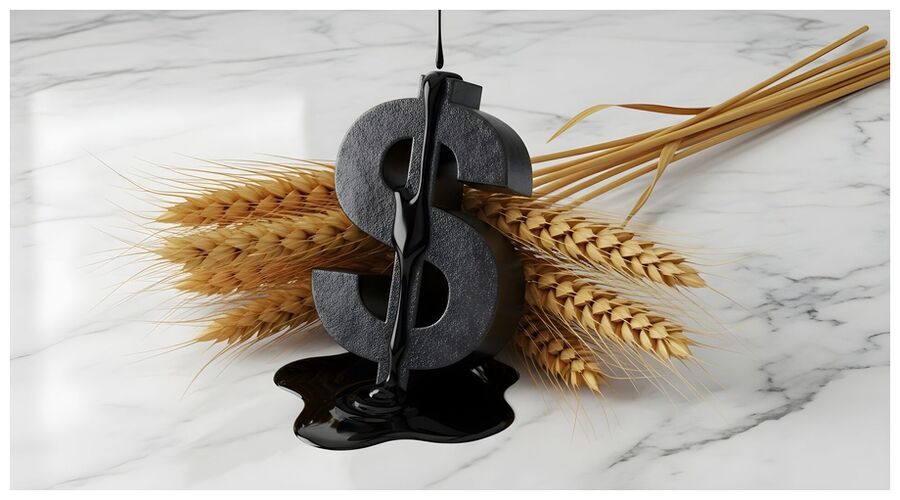
© Off-GuardianPetroleum industry impact, agriculture market, crude oil spill, currency symbol, wheat harvest, resource dependency.
The near-total closure of the Strait of Hormuz in March 2026 has impacted the Indian agrarian landscape.
As 16 million barrels of oil and massive LNG shipments stall daily, India's domestic urea production has plummeted. It is now clearer than ever that industrial agriculture is a sub-branch of the petroleum industry.
Having spent decades forcing farmers into dependency on West Asian gas for synthetic nitrogen, the state now watches as global urea prices spike by 20% in a week. This validates what
Norman J Church warned in 2005: that
vast amounts of oil and gas are the hidden raw materials of every stage of food production — from planting and irrigation to the very construction of the trucks and roads that facilitate the industry.The industrial food supply is basically a system of fossil-fuel conversion.
With the just-in-time supply chain for granular urea broken by war, the Indian government has accelerated the push for Nano Urea. Developed by IFFCO (Indian Farmers Fertiliser Cooperative) as a central pillar of
Aatmanirbhar Bharat (Self-Reliant India), this liquid fertiliser, sold in 500 ml bottles containing nitrogen at the nanoscale (20-50 nanometres), is marketed as a miracle of self-reliance.
The claim that a single 500 ml bottle replaces a 45 kg bag of urea is the ultimate 'technological fix'. But this 'fix' is an optical illusion. A bag of granular urea builds a nutritional reservoir in the soil, but the 500ml Nano Urea is a foliar spray that merely stimulates the plant's leaves (like a caffeine shot). This forces crops to mine the soil's remaining internal reserves to stay green while the earth beneath them is hollowed out.
Soil-based fertility (like compost or legumes) is a permanent asset. A foliar spray is a just-in-time commodity that must be purchased every season. Nano Urea represents a transition from a commodity-based dependency to a proprietary one. Unlike soil and compost, Nano Urea is a controlled, patented substance. It is the Trojan horse of the current crisis, used to maintain chemical dependency while rebranding it as high-tech efficiency.
The February launch of Bharat-VISTAAR — the AI-powered 'voice of authority' personified as the chatbot 'Bharati' — aims to provide real-time, multilingual advisory to 140 million farmers. By integrating with the AgriStack ID system, the state is creating a digital panopticon for farmers.





















Comment:
- Here is the updated list of US-based food manufacturing plants destroyed while Biden's been in office
- The super-centralized agribusiness model and supply chain is failing
- 7 Reasons Food Shortages Will Become a Global Crisis
- The supply chain is breaking and food shortages are getting worse
"Whoever has ears, let them hear." - Matthew 13:9