Puppet MastersS


Bad Guys

The Shadow Cabinet of Soros

soros shadow cabinet biden admin
© DataRepublican/X
Inside the Soros-funded nonprofit that hand-picked Biden's national security team, then pretended to dissolve

On January 30, 2017 — ten days into the Trump presidency — Rosa Brooks published an article in Foreign Policy titled "3 Ways to Get Rid of President Trump Before 2020." She outlined four scenarios for removing the new president from office: impeachment, the 25th Amendment, cabinet revolt, and a military coup. Of the last option, Brooks wrote that it was "a possibility that until recently I would have said was unthinkable in the United States of America."

Brooks was a former Counselor to the Under Secretary of Defense for Policy at the Pentagon, where she reported to Michele Flournoy from 2009 to 2011. Before that, she served as Special Counsel to the President at the Open Society Institute — the predecessor name for George Soros's Open Society Foundations. After leaving government, she went to Georgetown Law, where she holds the Scott K. Ginsburg Chair in Law and Policy
.
Within the same year of her article, a new organization was quietly incorporated. National Security Action was incorporated in 2017 and launched publicly on February 2018 . Its co-chairs were Ben Rhodes, Obama's deputy national security advisor, and Jake Sullivan, who would become Biden's national security advisor. Rosa Brooks sat on its advisory council. So did approximately sixty other people — 88.6% of them Obama administration alumni.

Attention

'Ways of war' are in metamorphosis: Lessons from the Iran war

Iran Wars
© Public Domain
Although the Iran war largely has been viewed through the lens of conventional western warfare, its lessons are anything but conventional. They are in fact insurrectionary.

The post-war western approach (especially in the Cold War context) relied on the ability to outspend any military adversary through the acquisition of high-end, over-engineered and costly manned aircraft and munitions. Dominance of airspace and heavy reliance on aerial bombardment, i.e. air-war, was the doctrinal end.

The expenditure overmatch (as well as an imputed technical innovation) was viewed as the crucial element in the confrontation with the USSR.

Similarly, the impulse in naval warfare was toward investment in ever bigger carriers and their associated tiers of naval support vessels.

In ground warfare, the weighting in the Iraq War's 'Desert Storm' was on tanks 'punching' and thrusting through the adversaries' defence lines - though this approach was dropped by the West in Ukraine following the turn to 21st century drone-led 'trench warfare' on the front line.

The high-end outspend-approach both favoured the U.S.' Military Industrial Complex, and together with U.S. dollar hegemony, provided America with the unique advantage of allowing the U.S. effectively to 'print' those high-end overmatch supplementary expenses.

Then came the Iran war of 2026, whose asymmetric model upended conventional doctrines.

Syringe

Hantavirus -The wrong virus?

Soothsayer tweet hantavirus
Picture this scene: Cruise ship. Three dead. Contact tracing across twelve countries. Passengers ordered to their cabins, two ports refusing to let the ship dock, masks onboard, PCR running flat out, first patient possibly asymptomatic on boarding and infecting others before anyone noticed. Critical cases medevaced to European hospitals.

Diamond Princess vibes...

Strong ones.

Just to confirm we're not in 2020: this is May '26.

The boat is the MV Hondius.

The virus is hantavirus, Andes strain.

So obviously we'll handle this with the calm and rigour of five years of accumulated lessons. Right?

Lockdown sceptics vindicated. PCR cycle threshold gaming exposed for what it was. Pharmaceutical industry permanently chastened. Centuries of accumulated medical wisdom about endemic pathogens dusted off the shelf and put back to work.

Yeah. Not so fast...

So what did actually happen?

Comment: To what extent will the PTB try a rerun of the Covid period in order to distract from a badly managed economy, a disastrous energy policy and losing wars in Iran and Ukraine? And if they try a rerun, will people buy it again?

Meanwhile people on X are not having it:


Vader

SOTT Focus: Iran's Strikes Rewrite Washington's West Asia Doctrine: US Bases Are Not Coming Back

us iran war graphic bases destroyed middle east
© The Cradle
Iran's dismantling of the US base shield exposes the central weakness of Washington's regional order: its occupation infrastructure can no longer protect itself.

To riff on Bruce Springsteen's My Hometown: "Tehran says 'These bases are going, boys / And they ain't coming back / To your hometown'."

The Washington Post's 6 May 2026 article, 'Iran has hit far more US military assets than reported, satellite images show,' was an overdue admission - based on leaks from the US Department of Defense (DOD) and Washington's intelligence community - that Iran had inflicted significant damage to US assets. However, The Post only tells part of the story.

The Post examined 109 of the hundreds of satellite images published by Iranian media, whose authenticity could be verified "by comparing them with lower-resolution imagery from the European Union's satellite system, Copernicus, as well as high-resolution images from Planet where available."

Comment: The US has gravely underestimated the country that has a 4,000 year history of societal cohesion, with enormous emphasis on education in science and technology. A far cry from fighting the made-up countries produced by the World Wars.


Arrow Down

The limits of power

Press conference
© Andrew LeydenUS President Donald Trump meets the press
The War on Iran Will Likely End in American Retreat

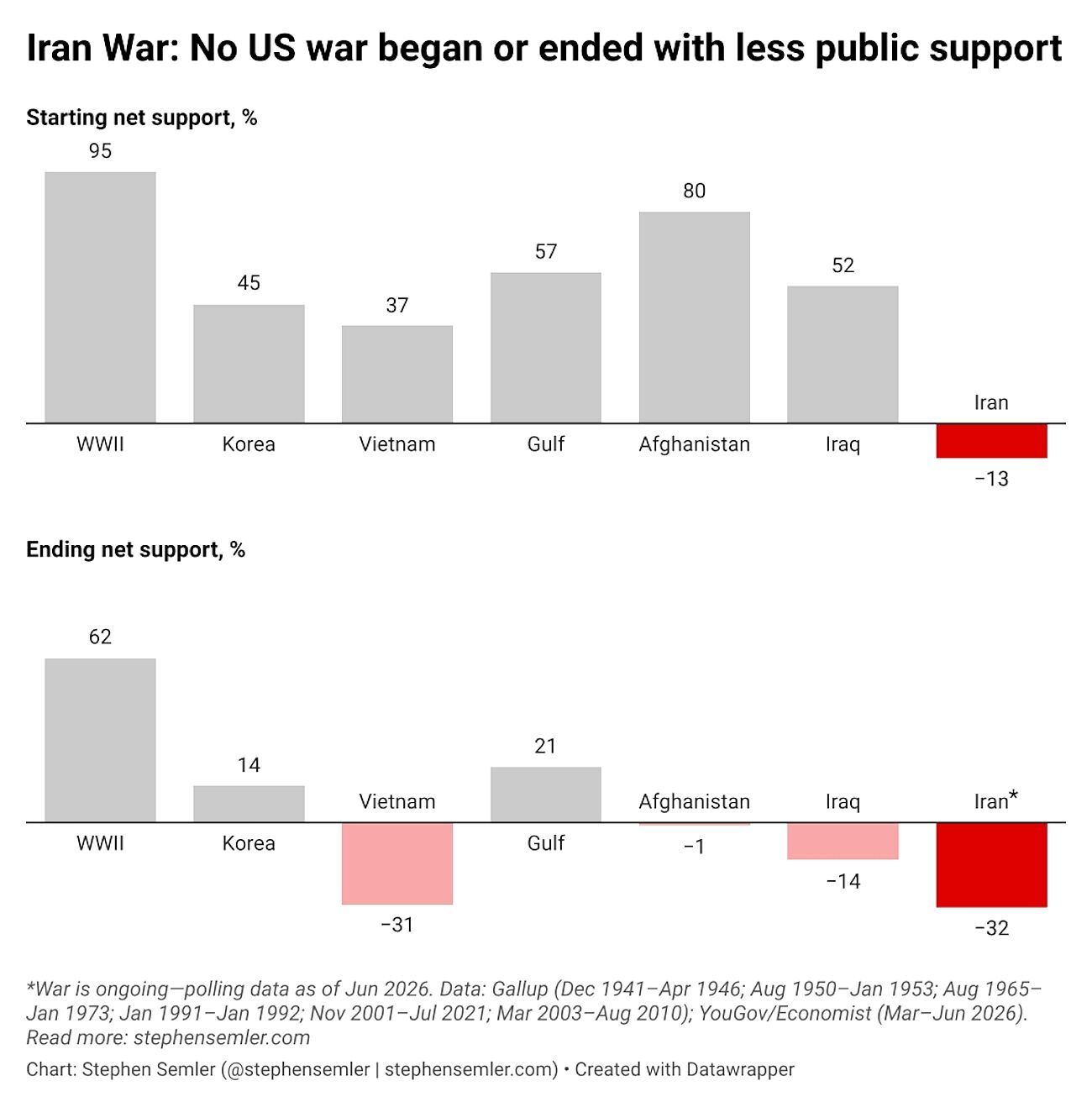
The war against Iran that the United States and Israel launched on 28 February 2026, will likely end in an American retreat. The United States cannot continue the war without producing disastrous consequences. A renewed escalation would likely lead to the destruction of the region's oil, gas, and desalination infrastructure, causing a prolonged global catastrophe. Iran can credibly impose costs that the United States cannot bear and that the world should not suffer.

The US — Israel war plan was a decapitation strike, sold to President Donald Trump by Prime Minister Benjamin Netanyahu and David Barnea, the director of the Mossad. The premise was that an aggressive joint US — Israeli bombing campaign would so degrade the Iranian regime's command structure, nuclear programme, and IRGC senior leadership that the regime would fracture. The United States and Israel would then impose a pliable government in Tehran.

Trump seems to have been convinced that Iran would follow the same course as had occurred in Venezuela. The US operation in Venezuela in January 2026 removed Venezuelan President Nicolas Maduro in what appears to have been a coordinated operation between the CIA and elements inside the Venezuelan state. The US won a more pliant regime, while most of the Venezuelan power structure remained in place. Trump seems to have believed naively that the same outcome would occur in Iran.

Comment: Spot on analysis.


Handcuffs

Three days left to prosecute Anthony Fauci

Fauci
© UnknownRemember him?
I joined Rob Finnerty on NEWSMAX to expose Fauci's criminal activities that may have resulted in millions of casualties.

Yesterday I spoke with Rob Finnerty on NEWSMAX to discuss one of the most urgent deadlines in American justice: Anthony Fauci now has just three days left before the five-year statute of limitations expires on his perjury before Congress.

On May 11, 2021, Fauci testified under oath: "The NIH has not ever and does not now fund gain-of-function research in the Wuhan Institute of Virology." That statement was made exactly five years ago. Under 18 U.S.C. § 1001 (false statements to Congress), federal prosecutors have until May 11, 2026 to bring charges. After that, he walks free forever on this felony — no matter how much evidence piles up.
News article

Verified Crimes — What Rand Paul Has Already Referred to the DOJ

Comment: Time's up...today, actually! If he walks...pandemic reprise.


Light Sabers

The instrumentalization of diplomacy in contemporary conflicts

your move
© UnknownMastering the game of war
In the contemporary world, rivalry among powerful countries has reached its apex, with the strongest states often competing for alliances, resources, strategic positioning, and global influence to advance their interests. Although the tactics of the powerful states have diversified, their goal remains the same.

The Cold War: Diplomacy as a Tool of Restraint

The Cold War between the United States and the Soviet Union (USSR) is one of the classic examples of great-power competition. The sides opposed each other due to their contrasting ideologies. Despite significant tensions between the two sides, the two sides only fought limited proxy wars in Korea, Vietnam, and Afghanistan, avoiding indulging in a direct full-scale war. The main reason for this was that the Cold War was mainly predicated on diplomacy rather than direct military confrontation. It was due to diplomacy and backchannel communications that the two nuclear powers prevented a direct, full-scale war.

Comment: Neither the United States, nor Israel are a state party to the Rome Statute, which founded the International Criminal Court (ICC) in 2002. They claim they are not legally under its jurisdiction or mandate.


Star of David

The Fall of the "King": How Netanyahu's reckless politics are robbing Israel of its future

Israelis protest
© UnknownIsraeli protest
Israel has hit rock bottom — politically, morally, and economically. The era of Benjamin Netanyahu, who led the country from one reckless adventure to another, is coming to an end. But his legacy is a prolonged agony from which merely changing one leader won't be enough to escape.

The Illusion of the Protector: How the Central Myth Collapsed

For decades, Benjamin Netanyahu masterfully crafted his image as "Mr. Security." To Israelis, he was indispensable — the only one capable of taming the chaos of the Middle East. Today, however, this carefully constructed image is shattering against harsh reality. As columnist Hani Hazaimeh writes:
"Instead of ensuring long-term security, Netanyahu's policies have led to the entrenchment of a dangerous cycle of perpetual confrontation."
What do we see now? The Gaza Strip lies in ruins, but the problem remains unsolved. The northern border smolders. Iran has launched painful retaliatory strikes in response to U.S.-Israeli aggression. The Israeli army, once considered invincible, is bogged down in years of protracted conflicts with no strategic exit. Netanyahu isn't so much putting out fires as he is using them for his own political survival. A leadership model based on fear, division, and the endless use of military force has driven the country to military exhaustion, diplomatic isolation, and economic pressure. Israeli society, weary of a war that has already lasted more than two and a half years, is asking itself: Was there any point to this path? The critics' answer is obvious — no. Netanyahu's policies are a road to nowhere.

Biohazard

Best of the Web: Trump's deadly trap: By rejecting Iran's proposal, US enters a strategic nightmare with no escape

Trump Iran deal war
© PressTV
In a theatrical move that fooled no one, US President Donald Trump rejected Iran's comprehensive plan to end the war he illegally imposed on the country 70 days ago.

The US president postured as a victor, dismissing Tehran's proposal with the bluster of a leader who expects capitulation. But the reality on the ground tells a starkly different story.

By every measurable metric, America is the defeated party in the asymmetric war that was imposed on Iran amid the nuclear talks in Geneva on February 28. And his rejection of Iran's terms in a social media post has not opened new options for Washington, but it has only trapped the US in a deadly three-way crossroads from which there is no easy escape.

Trump's rejection of Iran's plan, which was submitted early on Sunday through Pakistani mediators, is a grave strategic error as Americans hold no winning cards.

Iran's proposal: Fundamental, natural, and uncompromising

Iran's plan to permanently end the war was never meant to please Washington. It was designed to restore justice, recognize strategic realities, and secure Iran's undeniable rights after the unprovoked military aggression against the country and maritime banditry.

The core elements of Iran's proposal are not maximalist. They are rooted in natural and fundamental principles that any nation subjected to unprovoked aggression and holding the upper hand would rightfully insist upon:
  • War reparations - Payment of damages and reparations by the aggressor for the destruction inflicted on Iran's infrastructure, economy, and civilian population.
  • Management of the Strait of Hormuz - Recognition of Iran's sovereign control over this vital waterway, based on the mechanism already announced by Tehran.
  • Lifting of sanctions - The complete removal of all oppressive and illegal sanctions that have targeted the Iranian people for decades.
  • Release of frozen assets - The return of billions of dollars of Iranian assets illegally seized by the United States.
  • Permanent end to the war - A cessation of hostilities not only against Iran but also against the entire resistance front, including Hezbollah in Lebanon and other allied forces across the region.
None of these demands is unreasonable or impractical. They are the basic entitlements of a nation that has been attacked, bombed, and subjected to economic warfare for nearly half a century. What Iran is asking for is not special treatment but justice.

Books

West rewriting World War II history - Moscow

Maria Zakharova
© Sputnik/Ramil SitdikovRussian Foreign Ministry spokeswoman Maria Zakharova.
The West is busy rewriting the history of World War II, Russian Foreign Ministry spokeswoman Maria Zakharova has stated ahead of the 81st anniversary of victory over Nazi Germany.

Russian officials have repeatedly accused the US and EU member states of distorting historical truth and belittling the crucial role of the Soviet Union, which lost an estimated 27 million people in what is known in Russia as the Great Patriotic War.

Speaking on Thursday, Zakharova said that defending historical memory is a fundamental priority for Russia. This is all the more important in light of revanchist tendencies in the West, according to the spokeswoman.