Science & TechnologyS


Laptop

The Age Of Telekinetic Cyborg Monkeys Is Upon Us

Last year, a monkey managed to move a robot arm using nothing but its mind. The arm was wired to the monkey's brain, and the simian test subject maneuvered the arm as if it was its own appendage. Where do you go from there? Apparently, you go wireless.

A team at the University of Utah has created a brain chip that uses broadband RF to communicate with machines. Without wires to tangle up with each other, the wireless brain implants can cover more of the brain than their wired counterparts, thus providing more function and more control.

People

Encrypting Messages in Our "How-to-Make-a-Human" DNA Instruction Manual

DNA isn't just a code, it's the ultimate information - the data without which the ability to perceive data wouldn't exist. We now have the ability to write our own messages into this biological blueprint, but there are important factors to consider before you start scribbling cellular graffiti.

The human genome contains about three quarters of a gigabyte of data, and it's pretty unflattering to find out that the "How to make YOU" instruction manual is less than a quarter of the size of an X-Men: Wolverine DVD. (But don't worry - the real "you" in your head is, even by the simplest estimate, at least seventy terabytes). Scientists have so far inserted the equation of relativity, their own names and even Latin poetry into the "junk" DNA of bacteria and plants.

Meteor

Zadunaisky's Math Determined Halley's Comet Orbit

Buenos Aires, Argentina - Pedro Elias Zadunaisky, an Argentine astronomer and mathematician whose calculations helped determine the orbit of Saturn's outermost moon, Phoebe, as well as Halley's Comet, died Wednesday. He was 91.

Zadunaisky was a pioneer in celestial mechanics, applying mathematical models to determine how gravity and other forces alter the orbits of other objects in the solar system.

Zadunaisky also was a Senior Astronomer at the Smithsonian Astrophysical Observatory and in the 1960s researched the orbits of celestial bodies at NASA's Goddard Space Flight Center, calculating the orbits of the first U.S. Earth satellite, Explorer I, as well as other satellites during the U.S. space race against Russia.

Born in the Argentine city of Rosario on Dec. 10, 1917, Zadunaisky earned a civil engineering degree at the National University of Rosario, then pursued applied mathematics and specialized in celestial mechanics. He earned three Guggenheim fellowships for research at Columbia University in 1957, Princeton University in 1958 and at the University of Texas at Austin in 1977.

Robot

A.I. For The Next Video Game Generation - Meet Milo

Peter Molyneaux gives us a look at Milo, which uses Project Natal for amazing interaction with an on-screen character.


Comment: Incredible technology for the home market, no doubt. But isn't this newly developed 'science' removing participants further and further away from reality with this level of AI interaction?


Info

UA scientists discover quantum fingerprints of chaos

Image
© Lori Stiles, University of Arizona Usage Restrictions: NoneProfessor Poul Jessen of the UA College of Optical Sciences runs an experiment that provides long-sought evidence that two very different worlds of quantum mechanics and classical chaos are connected.
Chaotic behavior is the rule, not the exception, in the world we experience through our senses, the world governed by the laws of classical physics.

Even tiny, easily overlooked events can completely change the behavior of a complex system, to the point where there is no apparent order to most natural systems we deal with in everyday life.

The weather is one familiar case, but other well-studied examples can be found in chemical reactions, population dynamics, neural networks and even the stock market.

Scientists who study "chaos" - which they define as extreme sensitivity to infinitesimally small tweaks in the initial conditions - have observed this kind of behavior only in the deterministic world described by classical physics.

Info

Egypt severs ties with Louvre over artifacts

Image
© AP Photo/Ben Curtis, FileFile - in this Tuesday, Nov. 11, 2008 file photo, Egypt's antiquities chief Zahi Hawass speaks to the media at the site of a newly-discovered pyramid at Saqqara near Cairo, Egypt. Egypt said Wednesday, Oct. 7, 2009 that its antiquities department severed ties with France's Louvre museum because it has refused to return what are described as stolen artifacts, one of the country's most aggressive attempts yet to reclaim relics from some of the world's leading Egyptology collections.
Cairo - Egypt's antiquities czar took his campaign to recover the nation's lost treasures to a new level on Wednesday by cutting ties with one of the world's premier museums, the Louvre, over disputed artifacts.

The Paris museum's refusal to return painted wall fragments of a 3,200-year-old tomb near the ancient temple city of Luxor could jeopardize its future excavations in Egypt.

It was the most aggressive effort yet by Zahi Hawass, Egypt's tough and media savvy chief archaeologist, in his campaign to reclaim what he says are antiquities stolen from the country and purchased by some of the world's leading museums.

Laptop

Smart 'Lego' blocks take touch screens into 3D

Smart building blocks plus Microsoft's Surface interactive table-top computer have taken touch-screen interaction into the third dimension. Engineers or architects could use them to develop designs, or it could become a new kind of building toy.


X

Gmail users latest victims of email scam

Gmail
© GoogleAn industry-wide phishing scam has affected thousands of email users with Gmail, Hotmail, Yahoo and AOL accounts.
Google email users have become the latest victims in an "industry-wide" phishing attack scheme, which has affected thousands of people across several web based services.The search engine company confirmed that fewer than 500 of its Gmail users have been affected and immediate action has been taken to force all of those attacked to reset their passwords.

A Google spokesperson said: "We recently became aware of an industry-wide phishing scheme through which hackers gained user credentials for web-based mail accounts including Gmail accounts. As soon as we learned of the attack, we forced password resets on the affected accounts. We will continue to force password resets on additional accounts when we become aware of them."

Bad Guys

Artificial ionosphere creates bullseye in the sky

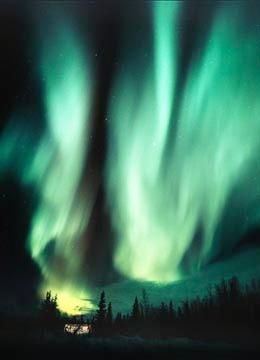
Natural aurorae light up the northern skies.
© Chris Madeley / Science Photo Library
An experiment that fires powerful radio waves into the sky has created a patch of 'artificial ionosphere', mimicking the uppermost portion of Earth's atmosphere. The research has not only caused glowing dots to appear around these patches - it could also provide a new way to bounce radio signals around the globe.

The High Frequency Active Auroral Research Program (HAARP), near Gakona, Alaska, has spent nearly two decades using radio waves to probe Earth's magnetic field and ionosphere. One of the most obvious results of the experiments is that they can create lights in the sky that are similar to auroras, the glowing curtains of light that naturally appear in the polar skies when electrons and other charged particles pour down from Earth's protective magnetosphere into the upper atmosphere. There, at an altitude of about 250 kilometres, the charged particles collide with molecules of oxygen and nitrogen and make them emit light, similar to the process inside a fluorescent light bulb.

HAARP's high-frequency radio waves can accelerate electrons in the atmosphere, increasing the energy of their collisions and creating a glow. The technique has previously triggered speckles of light while running at a power of almost 1 megawatt. But since the facility ramped up to 3.6 megawatts - roughly three times more than a typical broadcast radio transmitter - it has created full-scale artificial auroras that are visible to the naked eye.

Comment: For more information, read The Canary in the Mine.


Saturn

New ring detected around Saturn

Image
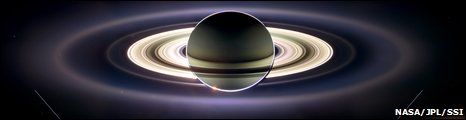
© NASA/JPL/SSIThe outer E-ring on Saturn extends about 240,000km into space
A colossal new ring has been identified around Saturn.

The dusty hoop lies some 13 million km (eight million miles) from the planet, about 50 times more distant than the other rings and in a different plane.

Scientists tell the journal Nature that the tenuous ring is probably made up of debris kicked off Saturn's moon Phoebe by small impacts.

They think this dust then migrates towards the planet where it is picked up by another Saturnian moon, Iapetus.