
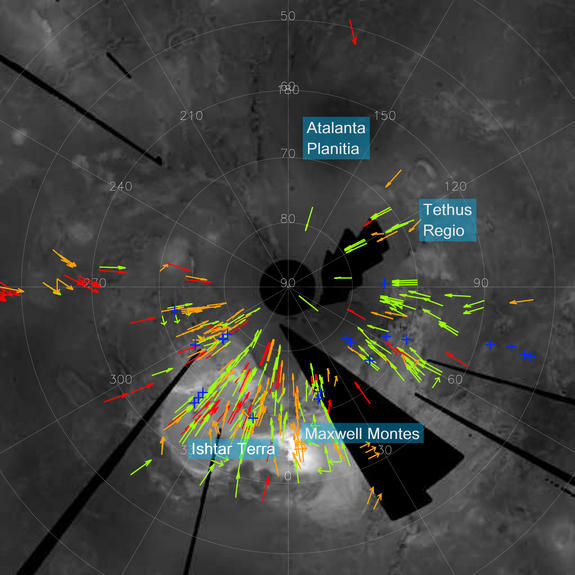
© UnknownThe European Space Agency's Venus Express orbiter have has spotted many small-scale 'gravity' wave trains in the planet's clouds. The waves are mostly found at high northern latitudes, particularly above Venus' Ishtar Terra
On Venus, mountains and volcanoes rise above vast lava plains and temperatures are hot enough to melt lead. But this hostile landscape is largely obscured by the planet's dense, toxic atmosphere with clouds blown by winds up to 186 to 248 mph (300 to 400 km/h).
The European Space Agency's Venus Express snapped images of gravity waves in those clouds. Not to be confused with ripples in space and time known as gravitational waves, the gravity waves in a planet's atmosphere can occur when winds whip over geological features like a mountain's face or crater wall and the updraft rises and sinks in a layer of stable air above. Condensation in the rising air can produce clouds, creating a pattern of waves moving in the same direction, spaced at regular intervals.
Scientists looking at Venus Express data confirmed that gravity waves in Venus' clouds are concentrated near the planet's high northern latitudes, especially above Ishtar Terra, one of two continental landmasses on Venus, which is about the size Australia. These patterns occur in the planet's uppermost clouds, some 37 to 43 miles (60 to 70 km) high.
"We believe that these waves are at least partly associated with atmospheric flow over Ishtar Terra, an upland region which includes the highest mountains on Venus," researcher Silvia Tellmann of the University of Cologne said in a statement from ESA. "We don't yet fully understand how such topographic forcing can extend to high levels, but it seems likely to be one of the key processes for the generation of gravity waves at high northern latitudes on Venus. The waves may form when a stable air flow passes over the mountains."











Comment: Back in 2004 another team of scientists came to this conclusion and gave even more information: