
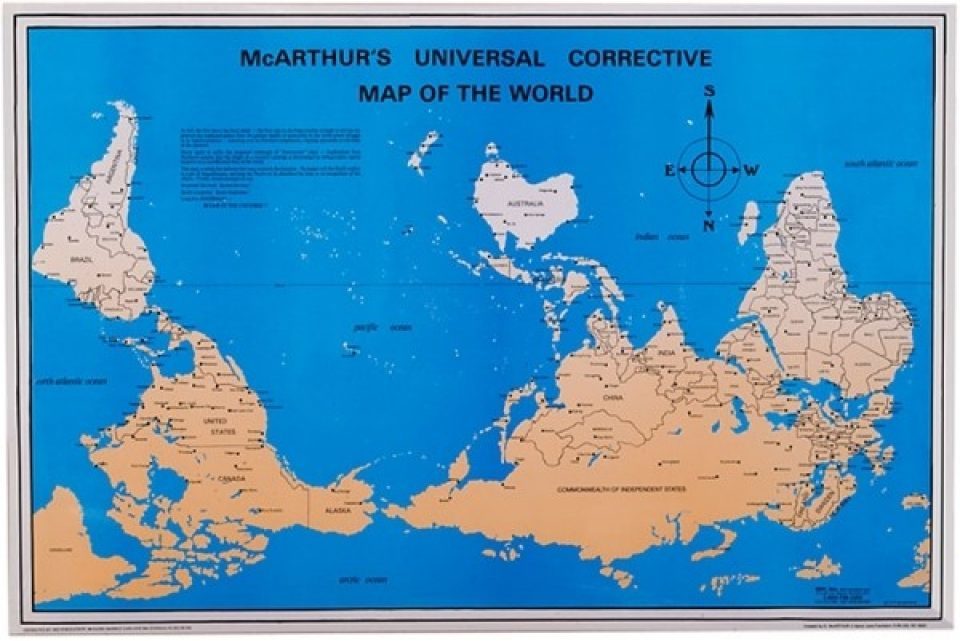
© FlickrMcArthur’s Universal Corrective Map of the World.
The profound arbitrariness of our current cartographic conventions was made evident by McArthur's Universal Corrective Map of the World, an iconic "upside down" view of the world that recently celebrated its 35th anniversary. Launched by Australian Stuart McArthur on Jan. 26, 1979 (Australia Day, naturally), this map is supposed to challenge our casual acceptance of European perspectives as global norms. But seen today with the title "Australia: No Longer Down Under," it's hard not to wonder why the upside-down map, for all its subversiveness, wasn't called "Botswana: Back Where It Belongs" or perhaps "Paraguay Paramount!"
The McArthur map also makes us wonder why we are so quick to assume that Northern Europeans were the ones who invented the modern map - and decided which way to hold it - in the first place. As is so often the case, our eagerness to invoke Eurocentrism displays a certain bias of its own, since in fact, the north's elite cartographic status owes more to Byzantine monks and Majorcan Jews than it does to any Englishman.
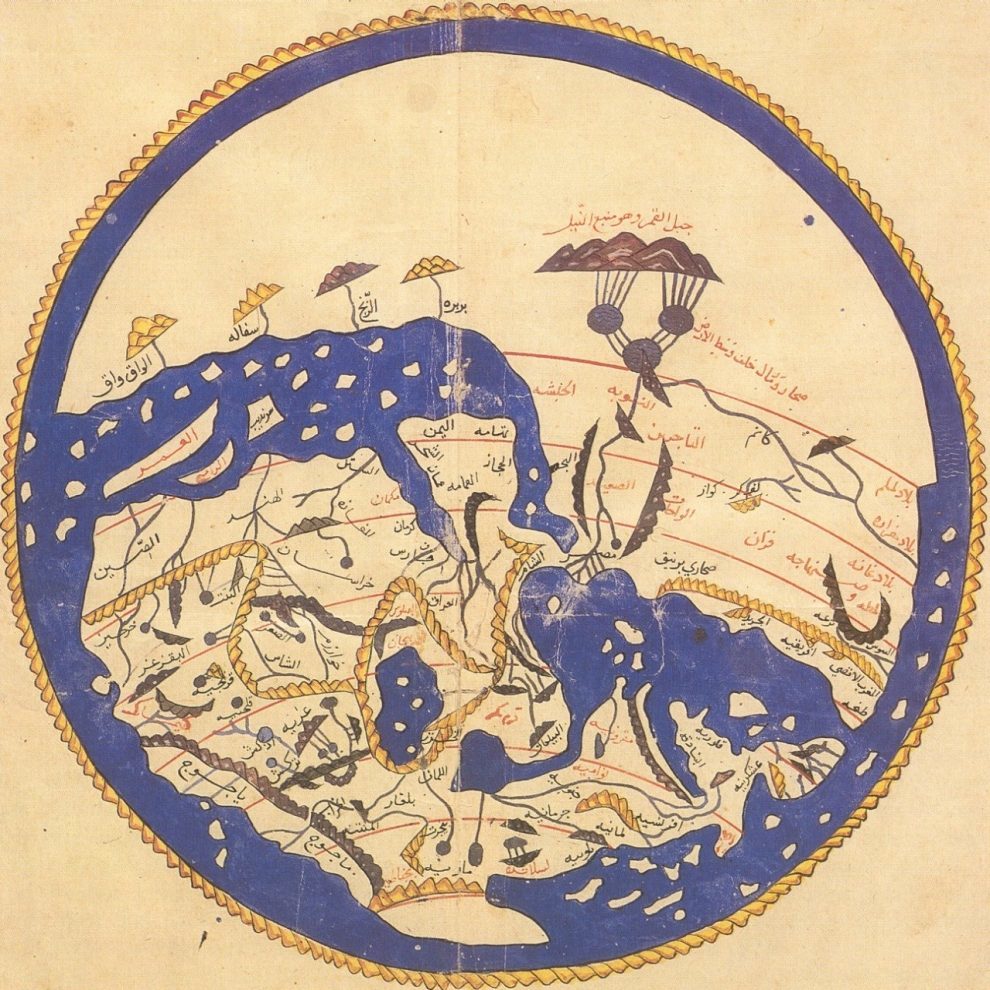
© WikipediaA world map drawn by the Moroccan cartographer Muhammad al-Idrisi for King Roger of Sicily, 1154.
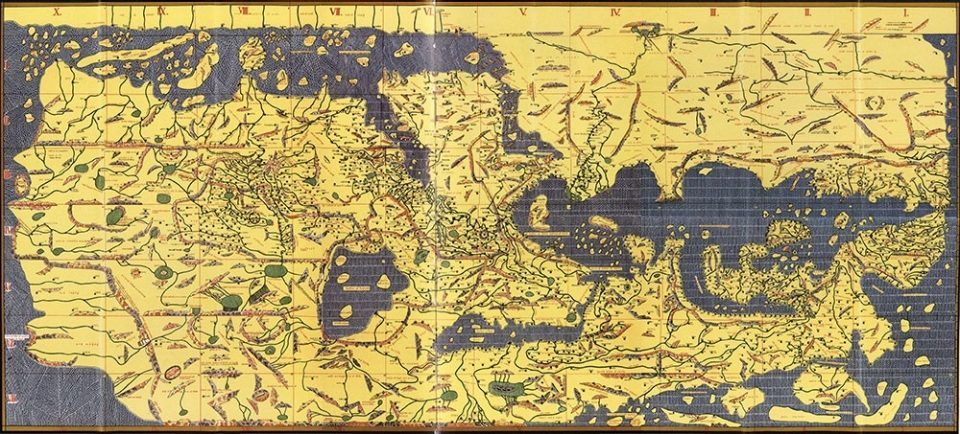
© Bibliotheque nationale de France/WikipediaKonrad Miller's 1929 re-creation of al-Idrisi's famous Tabula Rogeriana from 1154.
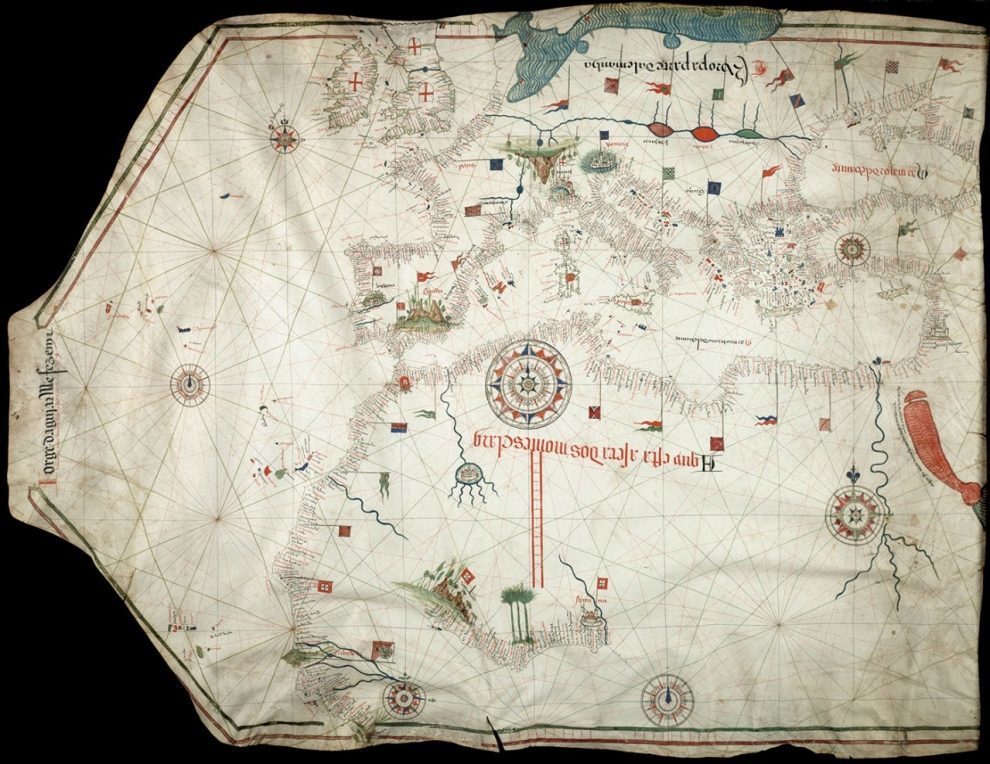
© Beinecke Rare Book and Manuscript Library/WikipediA reproduction of Jorge de Aguiar's chart of the Mediterranean, Western Europe and African coasts, 1492.
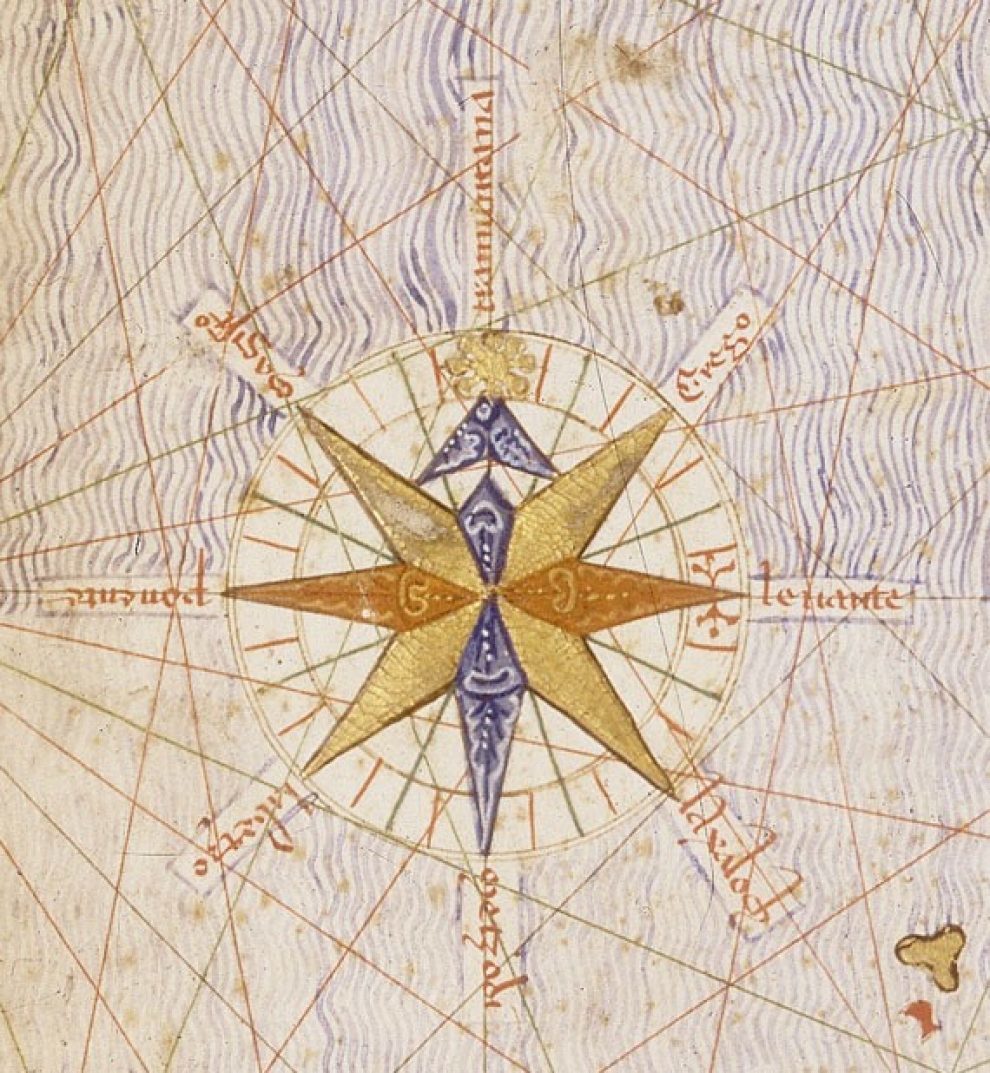
© Bibliotheque national de France/WikipediaThe first known compass rose depicted on a map, in a detail from the Catalan Atlas from 1375, attributed to cartographer Abraham Cresques of Majorca.
Members of the Italian Cartographic School preferred to mark north with a hat or embellished arrow, while their equally influential colleagues from the Spanish-ruled island of Majorca used an elaborate rendering of Polaris, the North Star. These men, who formed the Majorcan Cartographic School, also established a number of other crucial mapping conventions of the era, including coloring in the Red Sea bright red and drawing the Alps as a giant chicken foot. Among other hints of the school's predominantly Jewish membership was the nickname of one of its more prominent members: "el jueu de les bruixoles," or "the Compass Jew."
But this is only part of the explanation. The arrow of the compass can just as easily point south, since the magnetized metal needle simply aligns with the earth's magnetic field, with a pole at each end. Indeed, the Chinese supposedly referred to their first compass magnets as south-pointing stones. Crucially, the Chinese developed this convention before they began to use compasses for navigation at sea. By the time Europeans adopted the compass, though, they were already experienced in navigating with reference to the North Star, the one point in the heavens that remains fixed anywhere in the Northern Hemisphere. Many mariners saw the compass as an artificial replacement for the star on cloudy nights and even assumed it was the pull of the star itself that drew the needle north.
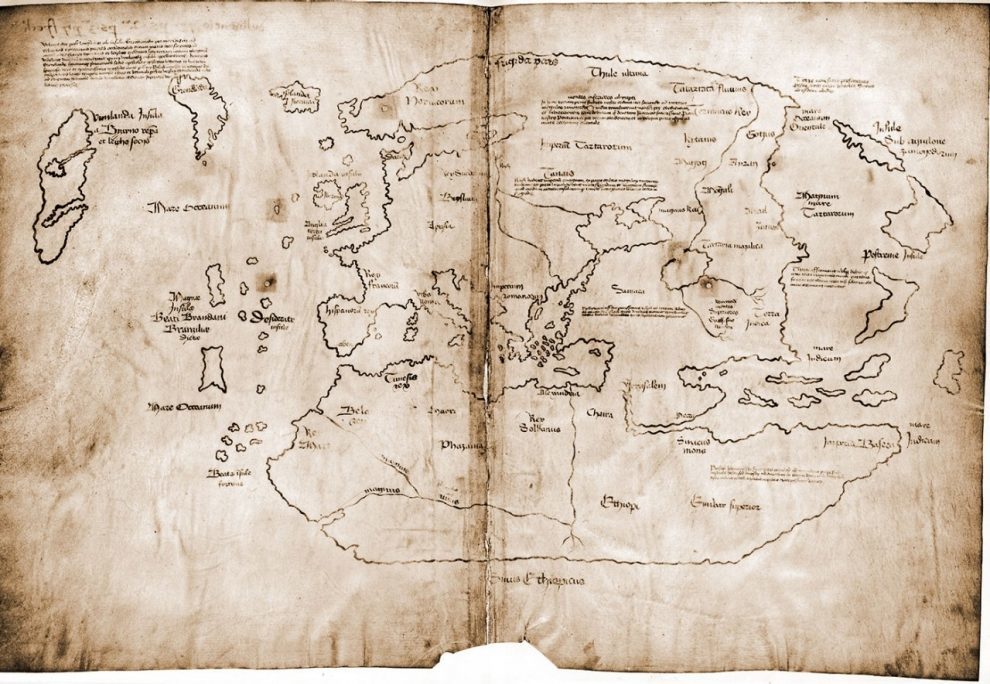
© Yale University/WikipediaThe Vinland map, a 15th century world map purportedly based on a 13th century original. If authentic, it is the first known depiction of the North American coastline.
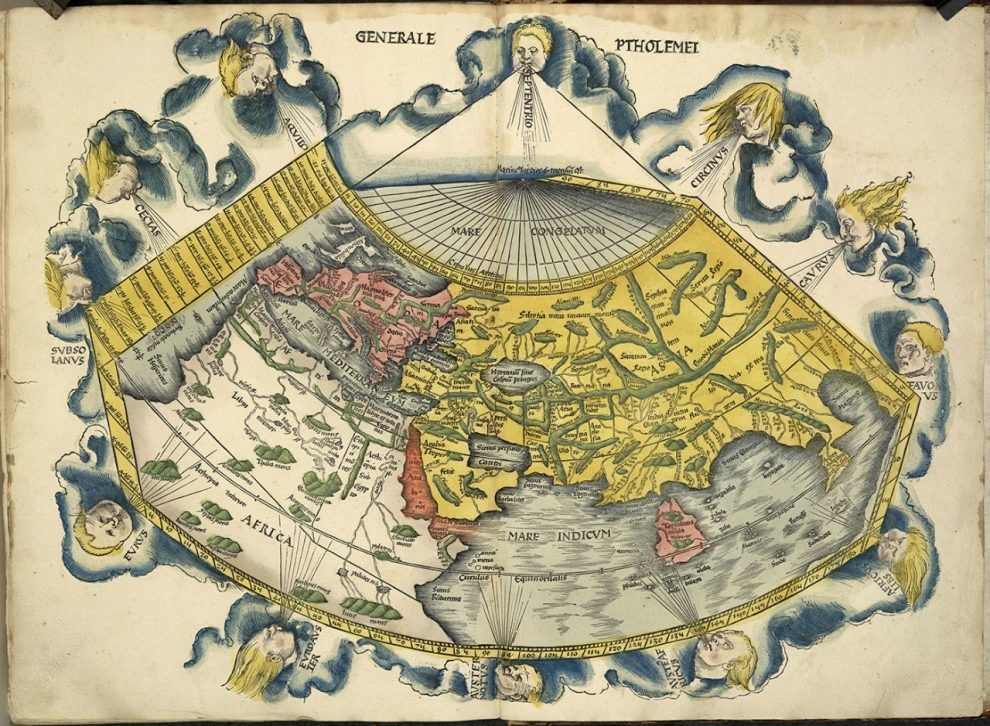
© The British Library Board/Getty ImagesPtolemy's map.
For reasons that have been lost to history, Ptolemy put the north up. Or at least that's the way it appears from the only remaining copies of his work, made by 13th century Byzantine monks. On the one hand, Ptolemy realized that, sitting in Alexandria, he was in the northern half of a very large globe, whose size had been fairly accurately calculated by the ancient Greeks. On the other hand, it put Alexandria at the very bottom of the inhabited world as known to Ptolemy and all the main civilizational centers in the Greco-Roman Mediterranean.
Even if compasses and Ptolemy had both pointed to the south, northerners could still have come along and flipped things around. In fact, with north seemingly settled at the top of the page in the 16thcentury, there were still some squabbles over who in the Northern Hemisphere would end up left, right or center. The politics of reorientation are anything but simple. For Americans, it's easy to think that our position, at the top-left of most maps, is the intrinsically preferable one; it certainly seems that way if you happen to be from a culture that reads from left to right. But it's unclear why Arabs or Israelis, who read from right to left, would necessarily think so. And while map makers usually like to design maps with the edges running through one of the world's major oceans, it is certainly possible to put North America in the very center by splitting the world in half through Asia.
As the United States was just beginning to emerge on the world stage in the 19th century, American cartographers made some earnest efforts to give the U.S. pride of place. While there is something endearing about the idea of an Indiana map maker in 1871 preparing an atlas with Indiana squarely in the center of the world, the unfortunate side effect was that most of the Midwest disappeared into the gaping crease between atlas pages. Nepal, of course, gets a bit cut off on the sides, but that is nothing compared with what happens to Nebraska. And ironically, accepting the United States' position in the top left leaves Africa at the very center of the map, which is hardly in line with the politics of the time. Though this puts Africa in what was once considered the map's prime real estate, it also reduces the continent's relative size on the standard Mercator projection - another source of complaint for carto-critics.
The orientation of our maps, like so many other features of the modern world, arose from the interplay of chance, technology and politics in a way that defies our desire to impose easy or satisfying narratives. But at a time when the global south continues to suffer more than its share of violence and poverty, let's not dismiss McArthur's Universal Corrective Map of the World too quickly. It continues to symbolize a noble wish: that we could overturn the unjust political and economic relationships in our world as easily as we can flip the maps on our walls.
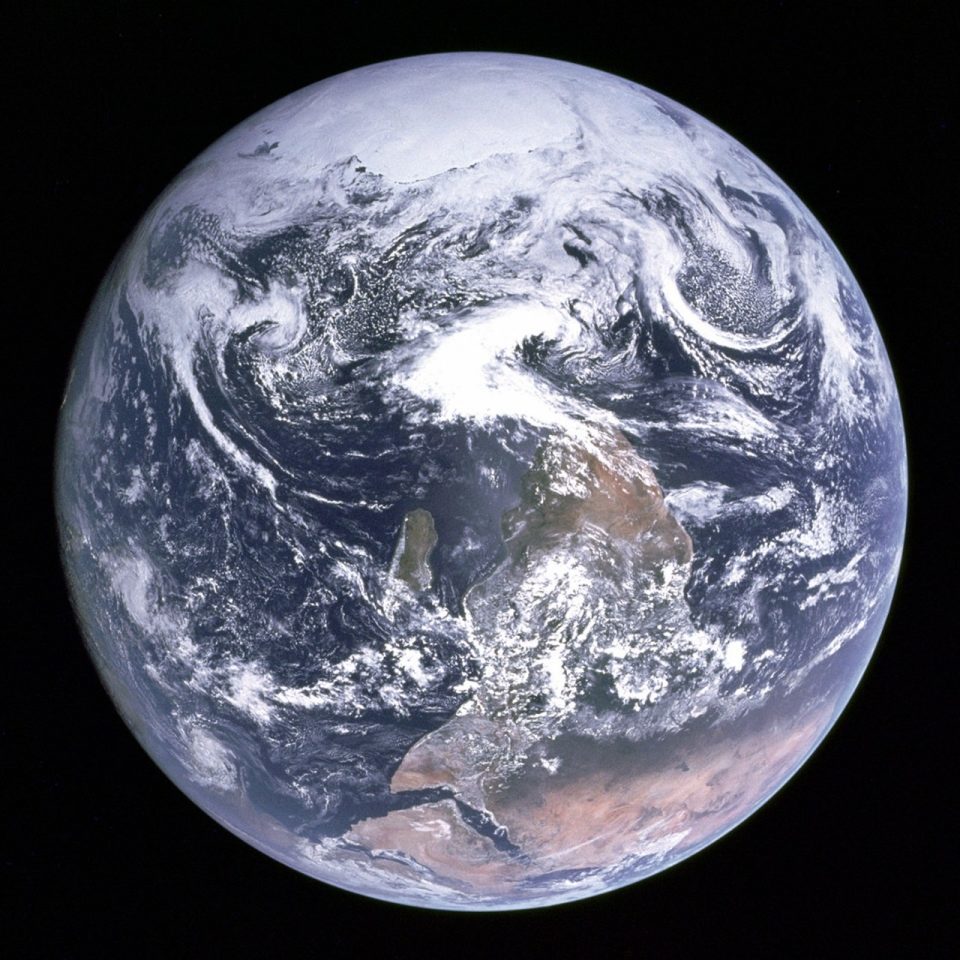
© NASAEarth seen from Apollo 17.
Nick Danforth is a Ph.D. candidate at Georgetown University. He writes about Middle East maps, history and politics at Midafternoon Map.

Reader Comments
[Link]
But your star-map photo would do the same thing in the Southern hemisphere looking south - so in itself then the heads or tails may have flipped to the dominance or survival currency of northern hemisphere cultures.
The 'anthropomorphic' presumption could be at the centre of all things - as in Egyptians merely assigning 'the Land' (Greek for which is Egypt) to place and at least some ancient kings assuming the title King of The World - but not of course uncontested or to any lasting effect.
It is notable that above and below are not without subjective associations. So the willingness to look at any convention upside down is part of re-cognising it is a convention and not itself the Fact.
I believe the north pole of a freely moving magnet orients to ward the South magnetic pole of the Earth (if free of any other magnetic field interference). We call it the North Pole - but it is in fact the magnetic south pole of Earth.
There's a small island to the West of Ireland which shows up on other ancient maps, as well as the Vinland one ... it is believed to have been submerged at the end of the last ice-age, so how old is the source document of some of these maps?
Did some digging - its the island called "Brasil" - https://en.wikipedia.org/wiki/Brasil_(mythical_island)
There is also another island called Demar to the south ... they are about 300m below sea level today
[Link]
Paint South, instead of North, red, and the compass will 'point south'!
R.C.
simple