
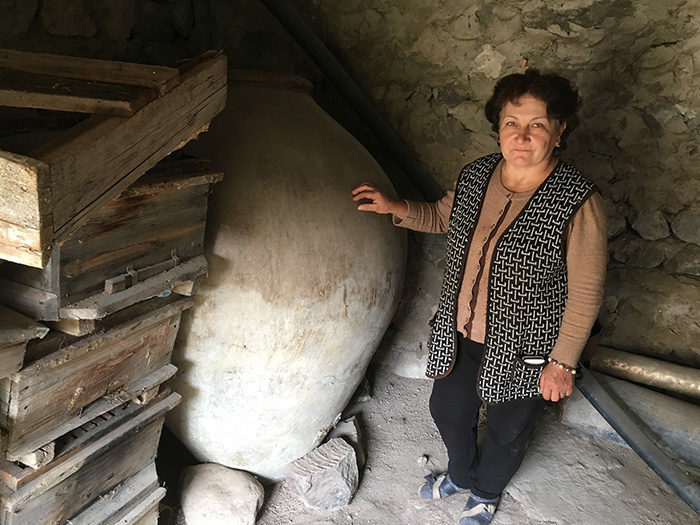
© Karine Vann/SmithsonianAsli Saghatelyan stands next to her father-in-law’s 240-gallon karas, a clay vessel traditionally used in Armenia, until recently, for storing and fermenting homemade wine.
The Saghatelyans no longer use this forlorn family heirloom, the girth of which exceeds the width of the door's frame. It belonged to the family's now-deceased patriarch, who used it to make homemade wine through a traditional process of fermentation and storage that people in this region have used for millennia. At one point, the family possessed at least five of them. Today only two are still intact.
This scene of giant karases, now sitting dusty and idle for decades in the basements of Armenia's villagers, is a strangely common one in this particular region. The villagers don't use them anymore, but the pots are so large they cannot be transported it out of their homes without the karas being smashed, or the wall of the basement being demo-ed. You can imagine the residents of Chiva rarely choose the latter option.
Not even a half hour into my visit, a neighbor stopped by to investigate my foreign presence in the village. "Oh, that's what you're looking for? We also have karases. They're in our basement!"
The karases I saw that day date back to mid-twentieth century, but it's not the age of the Minasyans' and the Saghatelyans' pots that made them so interesting to me. It's the threat of their extinction in the region. Karases have had an uninterrupted six millennia presence in this part of the world, but only in the last few decades, they've fallen into obscurity.
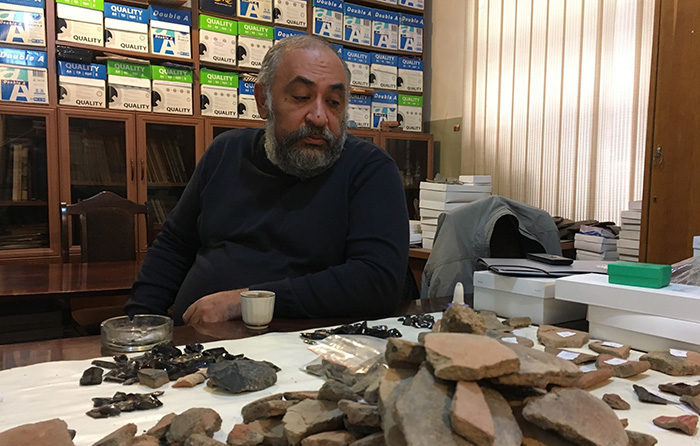
© Karine Vann/SmithsonianBoris Gasparyan, researcher at the Institute of Archaeology and Ethnography, led the excavations of Areni-1.
His interest intensified after he and his team discovered one of the world's oldest wine production facilities in Areni-1. The numerous clay pots uncovered at the site once held some of mankind's earliest experiments in viticulture. Chemical analyses even allowed researchers to speculate that ancient peoples mixed wine and blood together, leading wine expert Tim Atkin to joke in 2012 when he visited the site, that it "gives a whole new meaning to the term 'full-bodied wine.'"
The value of karases across millennia appears to be, judging by its morphology and physical evolution, defined primarily by their intimate relationship to wine. Gasparyan says that any other functions were secondary, though "people used them even as coffins!"
In the first millennium BC, in the Kingdom of Van (also known as the Urartian Kingdom), karases reached their peak—in size, technology, and quality. Wine had become a valuable commercial commodity since many neighboring empires lacked the ideal climates for growing grapes. "We can even compare wine to U.S. dollars," Gasparyan said. "Wine was circulating. It had great value. It was money. It was not only for consumption."
Urartian kings grew desperate to develop methods of storing their precious commodity in large quantities. Experimenting with clay forms, which had been the material used for storing liquids in many ancient civilizations, provided an immediate solution. Pottery eventually developed into a separate and thriving industry in Urartu, second only to agriculture, and just as the history of wine is critical to understanding karas, its relationship to clay is just as important.

© Institute of Archaeology and Ethnography in Armenia’s National Academy of SciencesWhen kingdoms were plundered, large karases were carried on carts pulled by war prisoners. This is depicted in ancient bronze carvings on the doors of Balavat in Urartu.
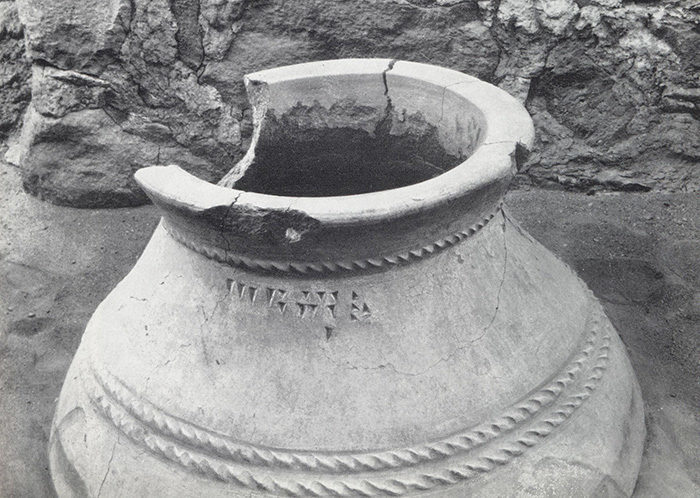
Cuneiform inscriptions near the rims of each Urartian karas indicate its volume. Photo from Karmir Blour excavations from 1950s
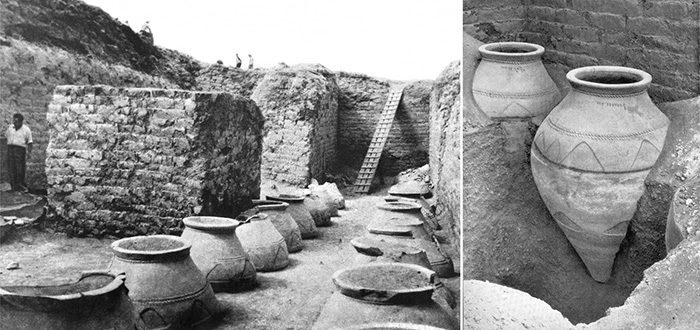
The citadel of Karmir Blour, an Urartian fortress which contains hundreds of karases, half buried into the ground as per best-practice winemaking techniques of the time. Photos from Karmir Blour excavations from 1950s
Karases maintained value long after Urartian rule. By the early twentieth century, one karas was worth an estimated three or four hundred rubles, about the cost of a cow. Since this was a large sum for most villagers, it was important to regulate an insurance policy. In 1184, Mkhitar Gosh devoted a chapter to karases in Datastanagirk, Armenia's first legal document, providing purchasers with a clause that reads eerily similar to a one-year warranty.
When Armenians moved toward industrial winemaking in the twentieth century, demand for these traditional storage vessels inevitably decreased. Mass production in Soviet factories meant wine was now available in grocery stores. Domestic winemaking—and by association, karases—spiralled into obsolescence in Armenia's developed areas.
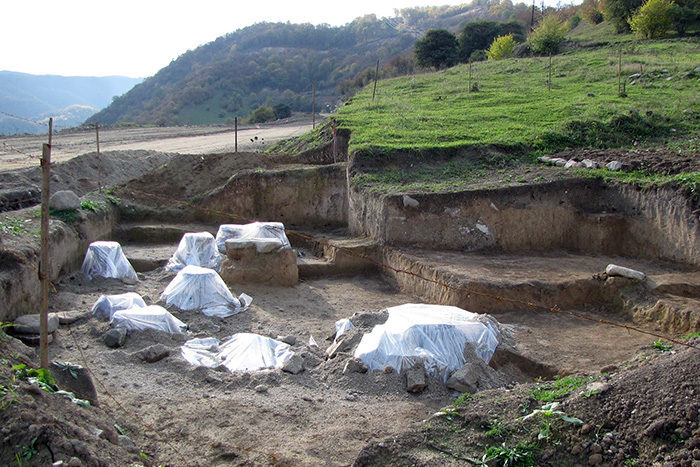
© Dr. Suren HobosyanExcavations in Shnogh, Lori Province, in 2009 revealed a thirteenth century winery.
Professor Suren Hobosyan, head of the ethnography department at the IAE, can attest to those difficulties. In addition to the karas, he says there was an elaborate "kit" of vessels and instruments for domestic wine production. It takes forty days to make wine in the karas, and once it is sealed it will stay good for years. However, when you open it, you have to consume it very quickly—approximately ten to fifteen days—before it spoils.
For this reason, opening a karas became a ceremonial ritual. Many rural communities saved karas openings for weddings and other joyful events. Sometimes the opening was its own cause for celebration, and villagers would invite their friends and family to partake in the festivities.
Which brings us back to the last generation of giant egg-shaped pots waiting to be disposed of in villagers' basements. Who, if anyone, still uses the karas today? How were Armenia's Georgian neighbors able to retain this tradition and go on to gain international recognition for it? And, perhaps most importantly, is there anyone alive in Armenia who still knows how to make them?
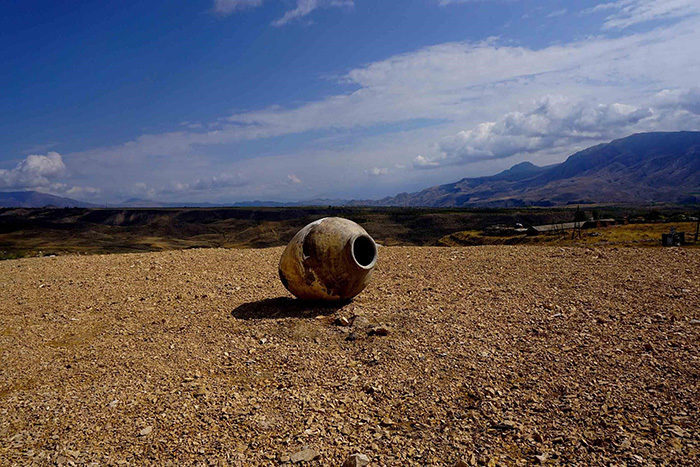
© drinktheworld.com
Karine Vann is a freelance writer based in Brooklyn and a storytelling contributor to My Armenia, where she writes about Armenia's rich natural and cultural heritage.


Reader Comments
to our Newsletter