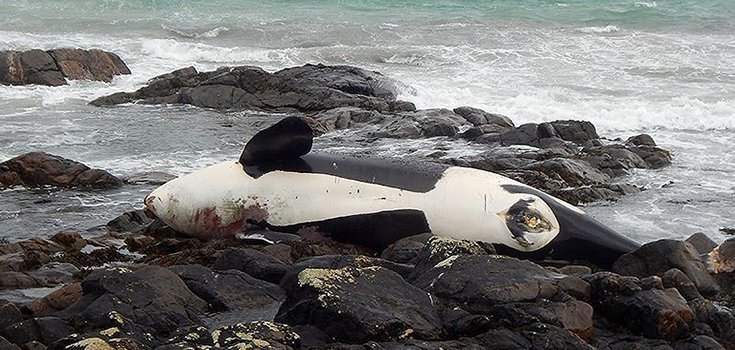
A challenging rescue operation in Russia's Far East was declared a success after four orcas, including a pup, were freed from an ice trap in the Sea of Okhotsk off Sakhalin Island.
The killer whales' plight triggered a unique eight-hour rescue mission, which was carried out by the Russian Emergencies Ministry with the help of a local fishing company. As the bay where the orcas got stuck was shallow and filled with ice and rocks, a traditional fishing boat was enlisted for the job, in place of a rescue vessel.
Rescuers used hooks to move pieces of ice out of the way of the animals, but they turned out to be no match for the largest chunks. Undeterred by the obstacle, however, they used some ingenuity and attached a thick rope to a vehicle on the shore that towed the bigger slabs of ice out of the path of the whales.
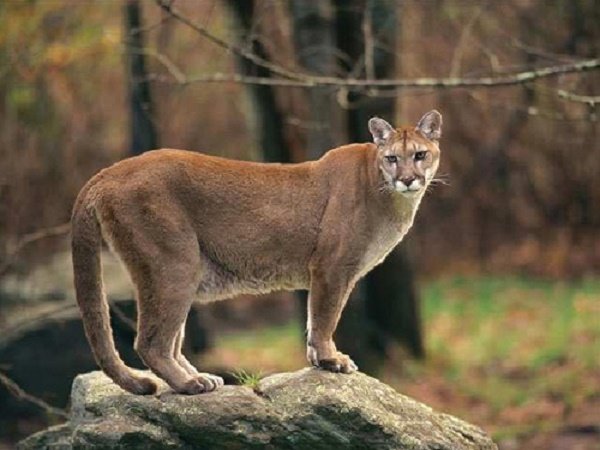
Students at John F. Kennedy High School in Los Angeles got an unusual visitor on Friday when a mountain lion began prowling around the premises during lunch break, causing teachers and students to secure themselves inside the building.
Comment: We're reporting more and more strange and uncharacteristic behaviour by animals each month. For just a few reports so far this month, see:
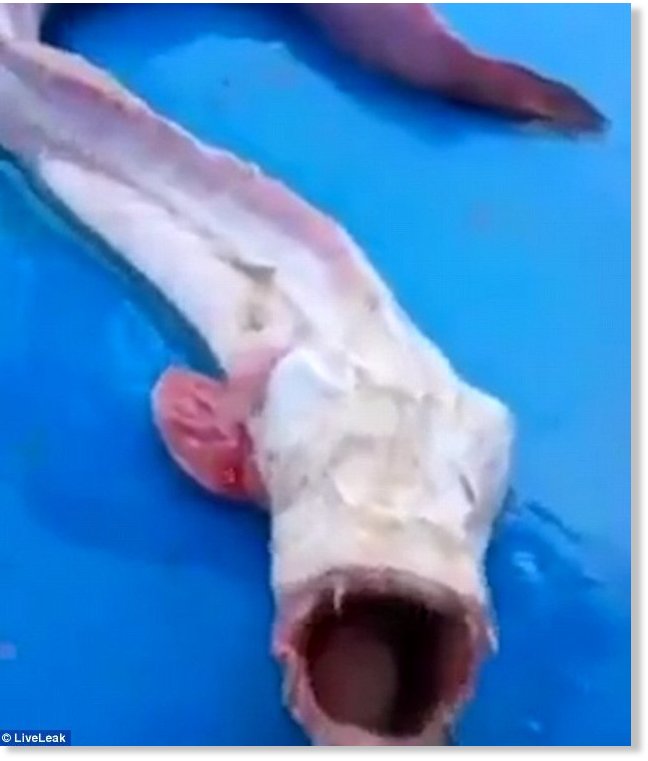
Fishermen were left stunned when they caught this bizarre creature of the deep during a fishing trip in Thailand
Fishermen were left stunned when they caught this bizarre creature of the deep during a fishing trip in Thailand.
Video captured aboard the boat shows the large fish writhing around after it was captured in the fishermen's net.
With razor-sharp teeth and a pale, eel-like body, footage of the animal has now gone viral, leaving viewers baffled as they attempt to guess what species it could be.
In the clip, the fish can be seen squirming and even clamping its gasping jaws around the stick.
Despite being pulled from the sea, the fish survives the ordeal, opening its mouth each time it is poked by the crew aboard the boat.
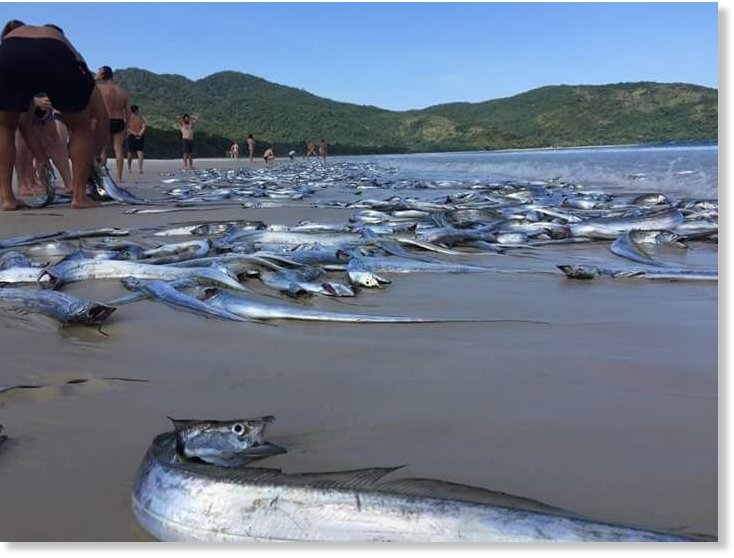
The Lopes Mendes Beach is considered the 8th most beautiful of the world, and 2nd most beautiful in Brazil.
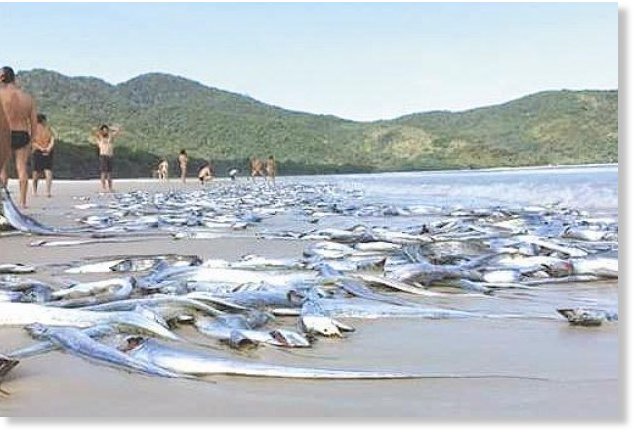
But on Monday, April 11, 2016, this idyllic place turned into a horror scenario as thousands of swordfish were found dead on the beach sands.
The killing was first attributed to water pollution.
As many of the swordfish had a broken neck, officials however say that the probable cause of this dead fish appearing on this paradisiac beach is overfishing.
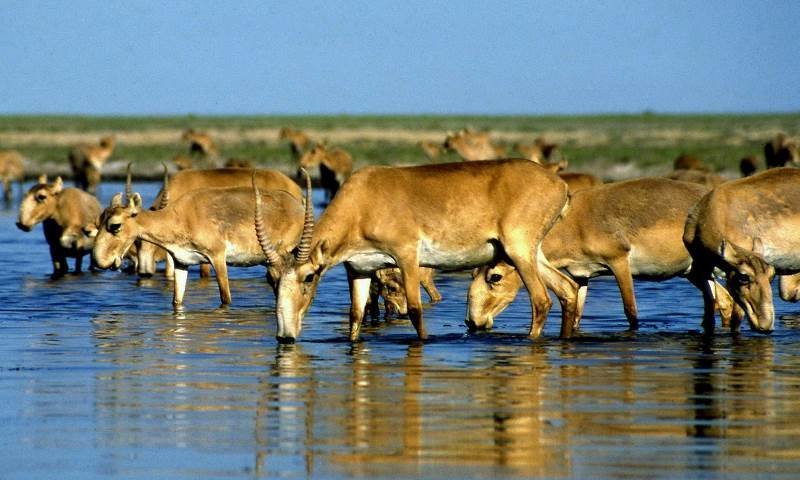
Almost total decimation of Betpak-Dala's population of 200,000 saiga antelopes in 2015 caused by pathogen that led to hemorrhagic septicemia, say scientists
The mysterious mass deaths of about 200,000 saiga antelopes in Kazakhstan last year was caused by a bacterial infection.
As news emerged in May last year of the near-total decimation of the Betpak-Dala population of saiga antelope, there was plenty of speculation but few concrete answers as to what might have been responsible.
Kazakhstan's mass antelope deaths mystify conservationists
One idea was that rainfall had resulted in widespread, mortal bloat. Perhaps there had been some infectious disease that had wiped out herd after herd. Some even blamed poisoning by toxic rocket fuel spread around Kazakhstan's Baikonur Cosmodrome.
Comment: Mass die-offs of species large and small are becoming increasing common, does it speak to a fundamental shift in the environment?
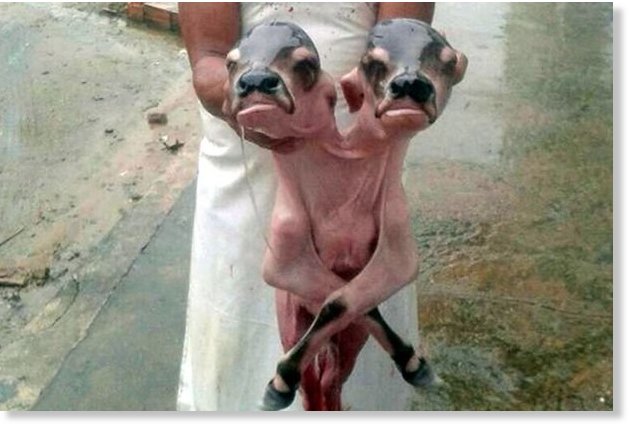
Gruesome remains of a malformed two-headed calf have stunned slaughterhouse staff in Brazil.
The freak creature was discovered in the womb of a slaughtered cow thought to have been too old to produce anymore offspring.
Each fully formed head had a pair of eyes, ears, nostrils and a muzzle, and each sat on separate necks attached to a single body with four legs and a shared tail.
The still born calf, weighing around 5kg and aged around seven months old, was also completely hairless .
The eighth biblical plague that tortured Egypt was a plague of locusts.
As described in Exodus 10:5, "And they shall cover the face of the earth, that one cannot be able to see the earth: and they shall eat the residue of that which is escaped, which remaineth unto you from the hail, and shall eat every tree which groweth for you out of the field."
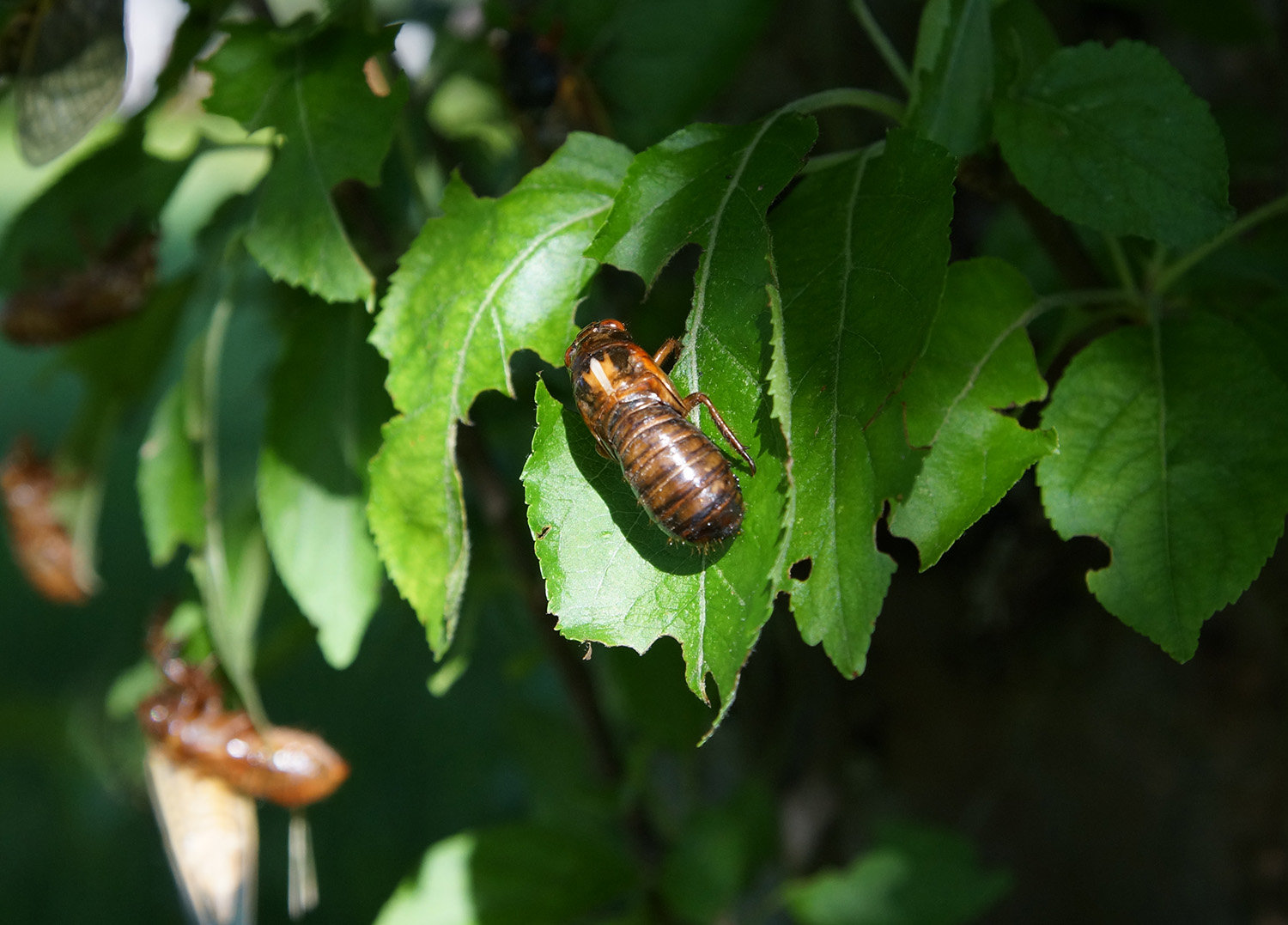
Flip the aforementioned "they" from locusts to cicadas, and that's actually a pretty apt description of what residents in some parts of Ohio, New York, Pennsylvania, Maryland, Virginia and West Virginia will experience next month when the soil warms to 64 degrees and billions of cicadas rise from the ground to mate. Fortunately, cicadas can't chew so they don't devour our plants and trees. If they manage to avoid predators long enough they suck up plant sap but not enough to any real damage.
Officials say a diver was bitten by a 7-foot bull shark off South Florida's coast.
Local media outlets report that rescuers responded to the injured diver Wednesday at the Sailfish Marina. The bite had occurred about 2 miles offshore as three people were spearfishing in 60 feet of water.
Riviera Beach Fire Rescue says in a Twitter post that the diver was bitten several times on the arm and was taken to a nearby hospital with significant wounds.
The International Shark Attack File at the University of Florida says bull sharks average between 200 and 290 pounds and can grow up to 8 feet long.
The diver's name and condition weren't immediately released.
It has been highly reported that biotechnology company Monsanto made attempts to hide the true impact thattoxic polychlorinated biphenyls (PCBs) have on the environment, which has led numerous cities to file lawsuits against the company. Now, new research has surfaced on the true effects behind Monsanto's PCBs and their impact on wildlife.
The PCBs have been putting European killer whales and bottlenose striped dolphins at risk.
A recently-released study says that the PCB-contamination of the dolphin and whale's habitats have caused entire populations to suffer. The exposure to PCBs is causing them to become reproductively-stagnate. In other words, the chemicals are causing reproductive impairment. Some scientists warn that some of these animals could experience serious damage if something isn't done. A pod of killer whales off the coast of the UK has dwindled to just 8 individuals and has reportedly not given birth to a calf since 1992.
Comment: We're reporting more and more strange and uncharacteristic behaviour by animals each month. For just a few reports so far this month, see: