Comets
Professor Robert Fox of the university's Hilo campus says the device can fit into a garage-size building and will search for comet-like objects beyond Neptune.
Fox says it will not be placed atop Mauna Kea, site of several telescopes. He says other Big Island sites are being considered.
Comets that take longer than 200 years to orbit the Sun come from all directions in the sky. That has long led scientists to believe that they were nudged out of a diffuse halo of icy objects that surrounds the solar system - the Oort Cloud.

Oort Cloud objects orbit the Sun in a spherical outer shell shown here, as well as in an inner cloud that might be more disc-like. If the inner cloud is squashed enough, it could be detected in radiation left over from the big bang.
The objects probably formed from the same disc of material that gave rise to the planets but were scattered outwards by Jupiter and Saturn a few hundred million years after their birth.
The Oort Cloud is too dim to be seen by telescopes, but astronomers believe it has two components. Based on observations of long-period comets, an outer portion seems to extend from 20,000 to 200,000 astronomical units from the Sun (where 1 AU is the Earth-Sun distance).
We can't directly measure the rate of comet collisions in other solar systems but we can detect signs of the dust that such smashes kick up because the dust gets warmed by the star and so gives off infrared radiation. That radiation shows up as extra infrared in the spectrum of light coming from the star. Because such dust should dissipate quickly, it is thought to provide a good snapshot of the recent collision rate.
Jane Greaves of the University of St Andrews, UK, analysed observations by the Spitzer Space Telescope and found that the vast majority of sun-like stars near us have more dust than our solar system does and therefore have had more collisions in their vicinity. Our solar system may be one of the few that have been safe for life. Greaves presented her results at the Cosmic Cataclysms and Life symposium in Frascati, Italy, this month.

Pan-STARRS 1 prototype, part of the Panoramic Survey Telescope and Rapid Response System, Haleakala mountain, Maui
Silicon chips developed at MIT Lincoln Laboratory are at the heart of a new survey telescope that will soon provide a more than fivefold improvement in scientists' ability to detect asteroids and comets that could someday pose a threat to the planet.
The prototype telescope installed on Haleakala mountain, Maui, will begin operation this December. It will feature the world's largest and most advanced digital camera, using the Lincoln Laboratory silicon chips. This telescope is the first of four that will be housed together in one dome. The system, called Pan-STARRS (for Panoramic Survey Telescope and Rapid Response System), is being developed at the University of Hawaii's Institute for Astronomy.
These convulsions flung primordial material billions of miles from the hot, inner regions of the gas cloud that later collapsed to form the sun, out into the cold, nether regions of the solar system, where they became incorporated into an icy comet.

A transmission electron microscope image (magnified 5,000 times) of a slice of the Inti particle, which NASA’s Stardust spacecraft collected in 2004 and returned to Earth two years later. Preparation of the sample caused some breakage. Scale bar is one micron, or one millionth of a meter.
"If you take a gas of solar composition and let it cool down, the very first minerals to solidify are calcium and aluminum-rich," said Steven Simon, Senior Research Associate in Geophysical Sciences at the University of Chicago. And comet Wild 2 does contain these and other minerals formed at high temperatures. "That's an indication of transport from the inner solar system to the outer solar system, where comets are thought to have formed," he said.
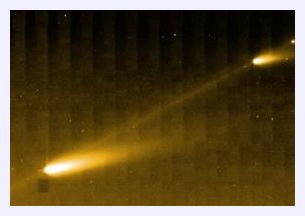
Observations taken of the comet by Spitzer deepen the mystery, showing oddly behaving streamers in the shell of dust surrounding the nucleus of the comet.
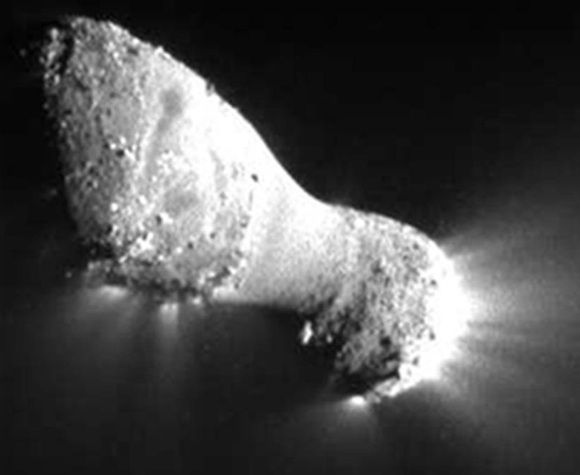
The data also offer a rare look at the material liberated from within comet Holmes' nucleus, and confirm previous findings from NASA''s Stardust and Deep Impact missions.
"The data we got from Spitzer do not look like anything we typically see when looking at comets," said Bill Reach of NASA''s Spitzer Science Center at the California Institute of Technology, Pasadena, California.
"The comet Holmes explosion gave us a rare glimpse at the inside of a comet nucleus," he added.
Every six years, comet 17P/Holmes speeds away from Jupiter and heads inward toward the sun, traveling the same route typically without incident.
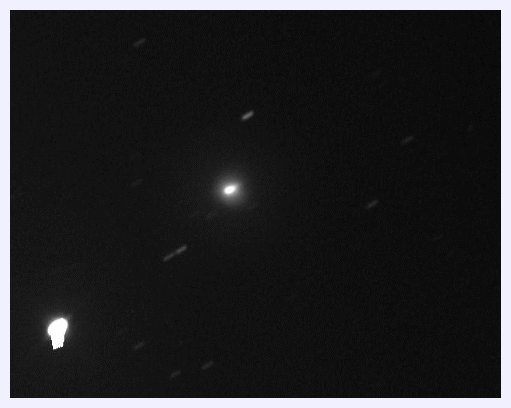
Andrea Boattini, who is currently working at Mount Lemmon Infrared Observatory in Arizona, said he spotted the comet while scanning near-Earth objects, the Italian news service ANSA reported Wednesday.
The comet, technically named P/2008 T1, will also be known as Boattini T1. The astronomer said it was easy to spot because of its unusual blaze and fan-like tail.
But days later, his computer was telling him there had been some unusual movement through the telescope - motion that Mr. Cardinal hadn't detected while gazing through it.
But after some sleepless nights peering through cloud cover and finally spying what he'd missed, Mr. Cardinal is now the confirmed finder of C2008 T2, a never-before-identified comet travelling through the solar system.
Or, as it will also be known, Comet Cardinal.
The Hubble Space Telescope observed the comet, but provided few clues. And now, observations taken of the comet after the explosion by NASA's Spitzer Space Telescope deepen the mystery, showing oddly behaving streamers in the shell of dust surrounding the nucleus of the comet. The data also offer a rare look at the material liberated from within the nucleus. "The data we got from Spitzer do not look like anything we typically see when looking at comets," said Bill Reach of NASA's Spitzer Science Center at Caltech.
Nearly a month ago two Japanese amateur astronomers re-discovered Comet Giacobini which had been lost for 111 years. Now this weekend comes word that an object found by professional astronomer Andrea Boattini of the Catalina Sky Survey is also a re-discovery of a long-lost comet. After Boattini's find was officially announced, Maik Meyer of Limburg, Germany suggested that this comet was actually the same as a comet last seen on 1892 Dec 8.
Comet Barnard 3 was found by Edward Emerson Barnard of Nashville, TN on 1892 Oct 13. It was the first comet to be discovered with the then new technique of astro-photography. Before this, all comets were discovered by astronomers using only their eyes though many were found while looking through a telescope. The comet was as bright as 12th magnitude in 1892 which is much brighter than its current brightness of 17th magnitude. It is possible that similar to Comet Giacobini, this comet was experiencing an outburst in 1892 that made it brighter than usual. The reason it wasn't found during the next 116 years was because its usual brightness was too faint for most of the comet searchers. Today thanks to computers and CCD (digital) cameras, the current generation of comet and asteroid surveys can cover a good fraction of the sky to very faint brightnesses.
Since the comet was already credited to Boattini before the identification with Comet Barnard 3 was noticed, the comet will be officially named Comet Barnard-Boattini. Its official designation is Comet P/2008 T3 (Barnard-Boattini) though that will be shortened to 206P/Barnard-Boattini in a few weeks since it has been observed during 2 orbits.
Analysis published by the Central Bureau for Astronomical Telegrams on IAUC 8995 find that the comet's current orbit takes it from near the orbit of Jupiter (sun-comet distance of 5.33 AU) to just outside the Earth's orbit (sun-comet distance of 1.15 AU). Back in 1892 the comet only got as close to the Sun as 1.43 AU. The comet has made 20 orbits of the Sun between 1892 and 2008. It will make its closest approach to the Sun on Oct 24 and to the Earth around Oct 22 at a distance of 0.19 AU. Unfortunately the comet will not become bright enough for backyard observers.
Comet Barnard-Boattini was one of three new comets announced today. Comet C/2008 T2 (Cardinal) was found by Rob D. Cardinal of the University of Calgary. This long-period comet may become a nice binolcular comet next spring and summer. Rik Hill, also of the Catalina Sky Survey, found Comet C/2008 T4 (Hill) which is a faint short-period comet that will come no closer to the Sun than 2.45 AU.


Comment: While comet impacts may be "much rarer" in our solar system than others, it certainly does not mean they do not strike ours. For a more enlightening and detailed study, read Forget about Global Warming, We are One Step From Extinction!