Volcanoes
S


Arrow Up

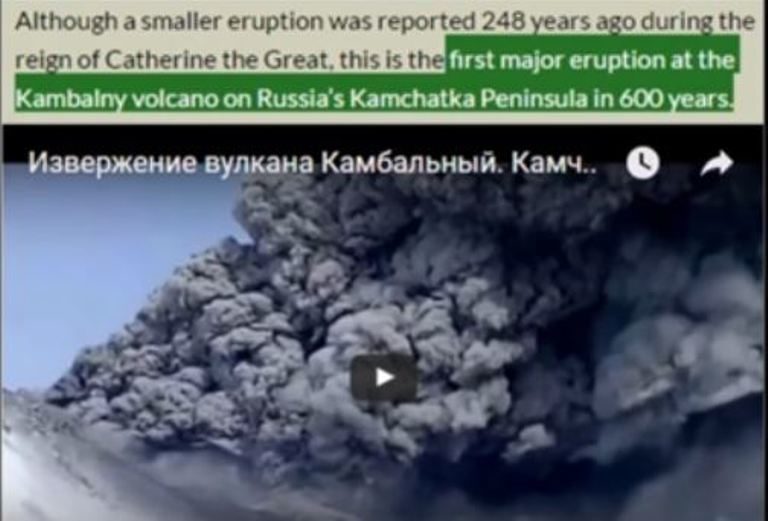
First Major Eruption of Russia's Kambalny Volcano in 600 Years; Following Mini Ice Age Cycles

Kambalny Volcano eruption
© YouTube/Adapt 2030 (screen capture)
Unexpected eruption in the southern tip of Kamchatka Peninsula, Russia of the Kambalny Volcano. Ash already up above 26,000 feet and the eruption continues. This follows the pattern of increased volcanism as the Earth descends into a grand solar minimum. There is a direct relationship to the amount of galactic cosmic rays bombarding Earth and mega-quakes and volcanic eruptions.


Comment: A few days after this unexpected volcanic eruption a powerful 6.6-magnitude earthquake rocked the Kamchatka peninsula.


Bizarro Earth

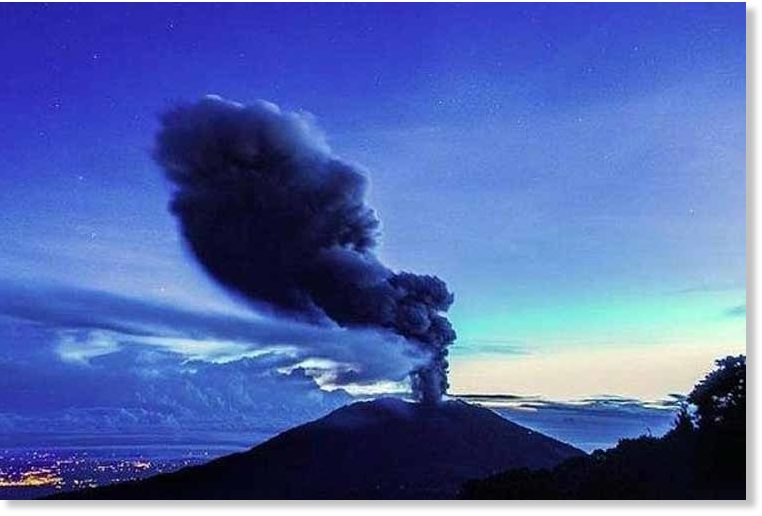
Costa Rica's Turrialba volcano keeps throwing ashes, gases

Turrialba volcano
Turrialba volcano
The Turrialba volcano has continued to release ash, gases and water vapor after its eruption shortly after 24 hours ago, the Volcanological and Seismological Observatory of Costa Rica reported. The report indicates that from 01:33 local time last Sunday, the colossus began releasing a small continuous column of ashes that has become constant. At 07:52 local time Wednesday explosions from the Turrialba were heard after almost two months of relative calm, volcanologist Eliécer Duarte recalled.

The volcano's behavior in recent days confirms that since last year it has been going through periods of calm and active stages. After remaining quiet for over 130 years, the Turrialba woke up in 2007 and from January 5, 2010, it has been erupting, being the one in October of 2014 and of March 12, 2015 the most serious. An eruption last September forced the authorities to suspend air traffic in San José.

Bizarro Earth

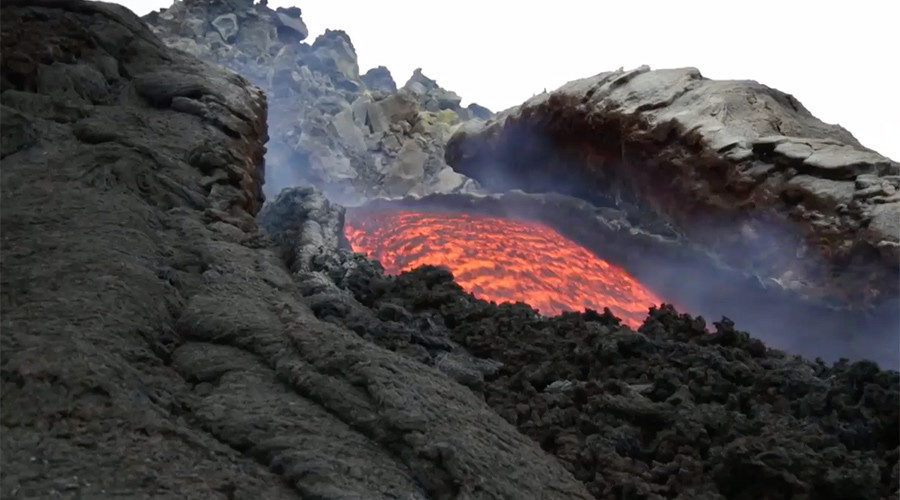
Rivers of lava flow onto slopes of Mount Etna after eruption

Mount Etna lava flow
© Ruptly
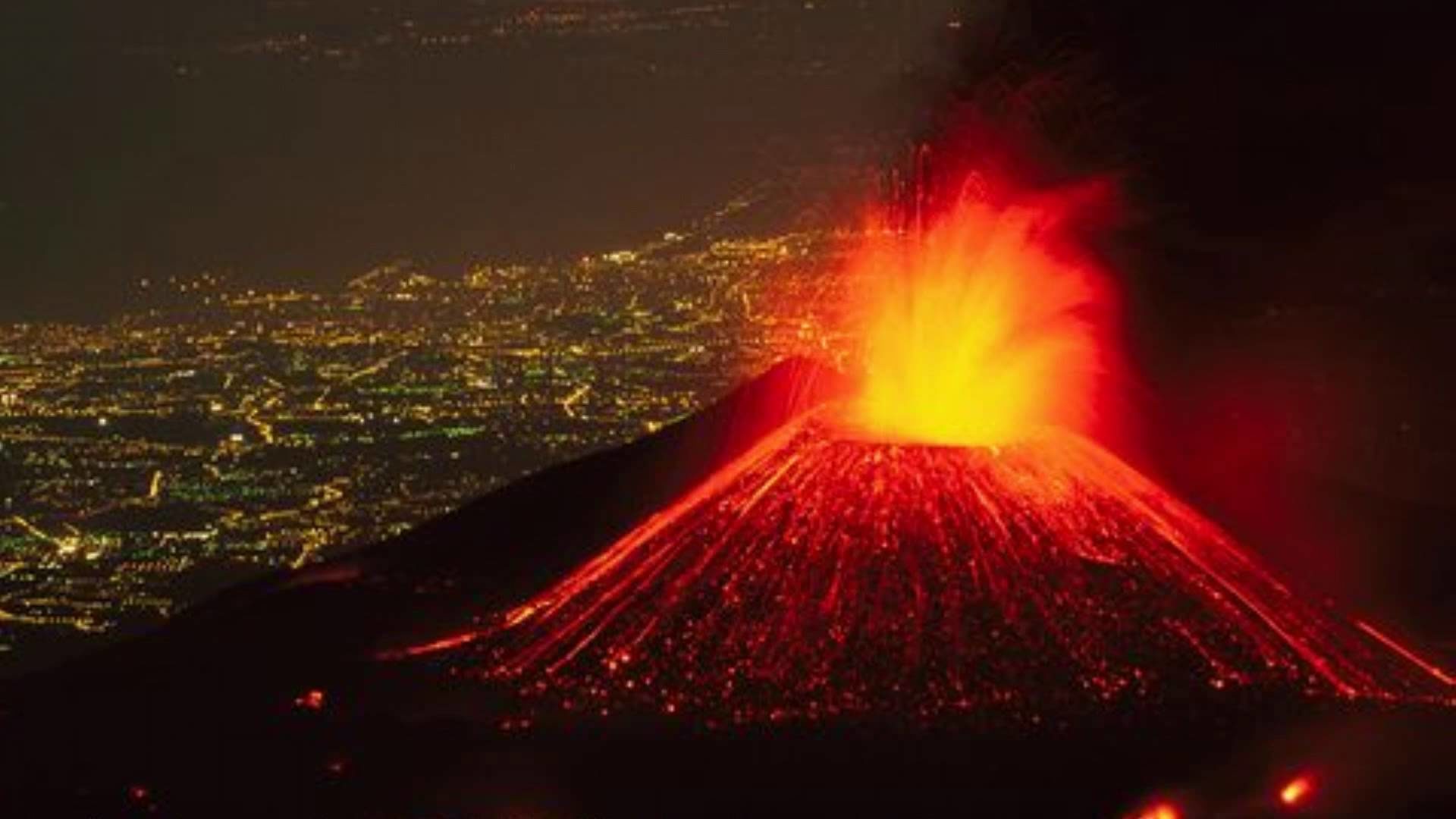
Scorching lava can still be seen flowing onto the slopes of Mount Etna, more than one week after the Italian volcano dramatically erupted. Stunning Ruptly footage shows huge amounts of magma oozing from the 3,329 meter-high mountain.

The fast-flowing lava was filmed on Tuesday, seemingly proving that Europe's most active volcano has little desire to settle down after erupting twice in less than one month.

Attention

Japan issues eruption warning for undersea volcano off Aogashima Island

Deadly eruption of Beyonesu Rocks, Japan in 1952
© Smithsonian InstitutionDeadly eruption of Beyonesu Rocks, Japan in 1952.
The Meteorological Agency on Friday warned that an underwater volcano about 400 km south of Tokyo could erupt soon, spurring the Japan Coast Guard to issue an alert to ships in the area.Coast guard aircraft found that the color of the ocean surface recently changed apparently due to volcanic activity in the Beyonesu Rocks about 65 km south-southeast of Aogashima Island, part of the Izu Island chain off Tokyo, the agency said.

But an eruption is unlikely to seriously affect any of the inhabited islands, including Aogashima, the agency said.If the eruption occurs around the Beyonesu Rocks, it will be the first since 1970, where a change of color in the ocean was last observed in 1988, the agency said.In 1952, an eruption in the area killed 31 crew members of a coast guard ship.

Bizarro Earth

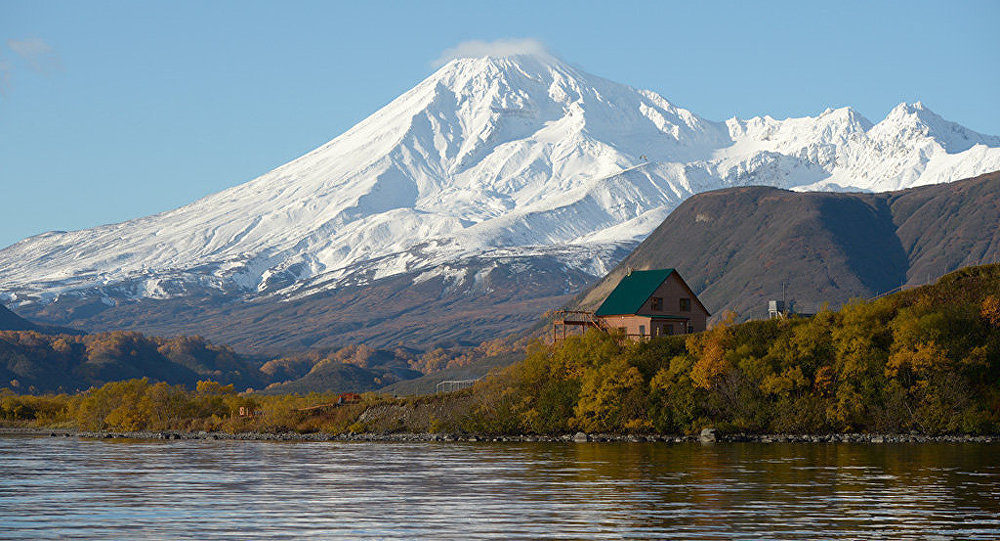
Kambalny volcano wakes from 250-year slumber spewing massive ash cloud

Kambalny volcano
© Igor ShpilenokKambalny volcano
The Kambalny volcano on the Kamchatka peninsula has started spewing ash after waking from a 250 year period of inactivity.

The area around the Kambalny volcano in Kamchatka has been put on alert after the volcano started spewing ash for the first time in over 200 years, RIA Novosti reported on Saturday.

Kambalny, which has a height of 2,156 meters above sea level, began spewing ash on Friday evening. The ash rose to a height of 7,000 meters above sea level and traveled a distance of 255km in a south-westerly direction.

Telescope

Planetary scientists are discovering volcanoes everywhere they look

Jupiter’s moon Io is volcanically active
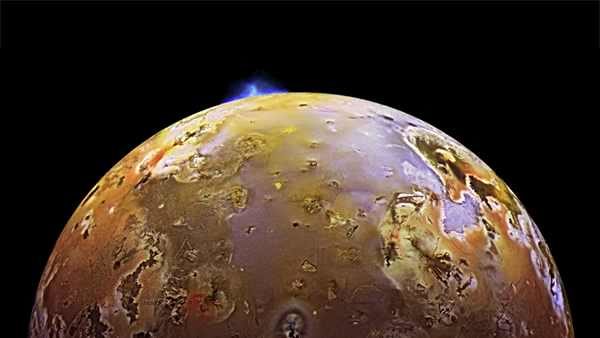
© NASAJupiter’s moon Io is the most volcanically active place in the solar system thanks to a rough tug from mighty Jupiter that warps the planet’s interior structure.
Our closest planetary neighbor shares a surprising feature with Earth: volcanoes. A new study, published February 1st in the journal Science Advances, revealed interesting new details about the volcanic history of Mars. Thomas Lapen, first author of the paper and Professor of Geology at the University of Houston, told Astronomy that their analysis of Martian meteorites showed that volcanic activity on Mars has been ongoing since at least 2.4 to 0.15 billion years ago—and likely continues today.

Given that the meteorites Lapen and his group studied came from a single ejection site on Mars, they reveal over 2 billion years of stacked lava flows, Lapen said. The discovery could help scientists decipher more about how often volcanoes erupted on Mars, as well as time periods when they were most active.

Lapen explained that the type of volcanic activity that occurs on Mars is called basaltic volcanism, which is similar to the type of volcanism seen, for example, in volcanoes in Hawaii. These types of volcanoes produce fluid lava and are rarely explosive.

But Mars isn't the only extraterrestrial body with volcanoes. Volcanoes—in various forms—are also found on other planets, moons, and even asteroids. Take, for instance, Jupiter's moon Io, which has active volcanoes that spew gas and melted rock, or Venus, which is covered with over 1,000 volcanoes, according to NASA. It's not yet determined whether these venusian volcanoes are active or not.

Fire

Ten people injured after Italy's Etna crater explodes

Mount Etna volcano eruption
Ten people were injured Thursday by an explosion from one of the craters of Etna which is currently active, local sources said. None are in serious condition, the sources said. Six of them will be taken to hospitals in Catania and Acireale. The explosion took place on Etna's Belvedere near Nicolosi when lava touched the snow on the volcano's peak, sparking a so-called "phreatic explosion" at an altitude of 2,700 metres, sources said.

Pyroclastic material sent flying like shrapnel hit a group of trekkers.

Etna, Europe's tallest active volcano, has shown lava spouts and ash plumes in recent days.


Comment: Further reading: Is something strange happening deep inside the Earth?
Why are "giant fountains of lava" suddenly pouring out of some of the most dangerous volcanoes on the entire planet, and why are so many long dormant volcanoes suddenly roaring back to life? The spectacular eruption of Mt. Etna in Italy is making headlines all over the world, but it is far from alone. According to Volcano Discovery, 35 major volcanoes either are erupting right now or have just recently erupted, and dozens of others are stirring. So what is causing this upsurge in volcanic activity? Is something strange happening inside the Earth?


Info

Earth's past volcanic eruptions revealed

Deccan Traps
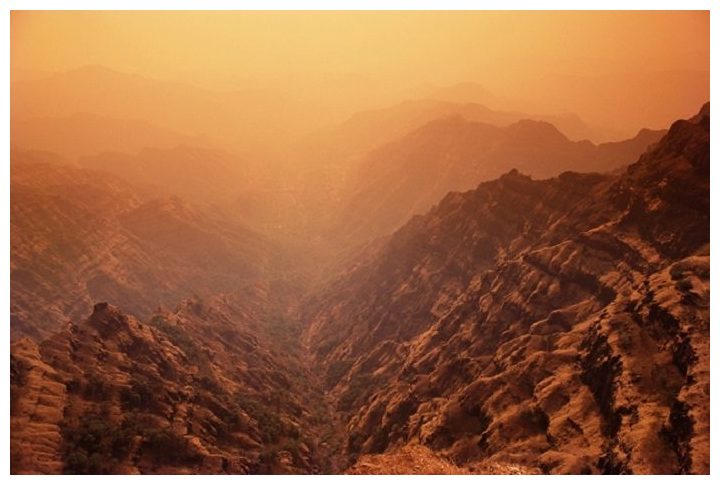
© Dinodia Photos/GettyIndia’s Western Ghats mountains contain igneous rock deposited 66 million years ago by a volcanic eruption in the Deccan Traps.
Enormous volcanoes vomited lava over the ancient Earth much more often than geologists had suspected. Eruptions as big as the biggest previously known ones happened at least 10 times in the past 3 billion years, an analysis of the geological record shows.

Such eruptions are linked with some of the most profound changes in Earth's history. These include the biggest mass extinction, which happened 252 million years ago when volcanoes blanketed Siberia with molten rock and poisonous gases.

"As we go back in time, we're discovering events that are every bit as big," says Richard Ernst, a geologist at Carleton University in Ottawa, Canada, and Tomsk State University in Russia, who led the work. "These are magnificent huge things."

Knowing when and where such eruptions occurred can help geologists to pinpoint ore deposits, reconstruct past supercontinents and understand the birth of planetary crust. Studying this type of volcanic activity on other planets can even reveal clues to the geological history of the early Earth.

Ernst presented the findings this month to an industry consortium that funded the work (see 'Earth's biggest eruptions'). He expects to make the data public by the end of the year, through a map from the Commission for the Geological Map of the World in Paris.

Bizarro Earth

3-hour volcanic eruption in Alaska threatens villages with ash

Bogoslof Volcano
© Wikipedia
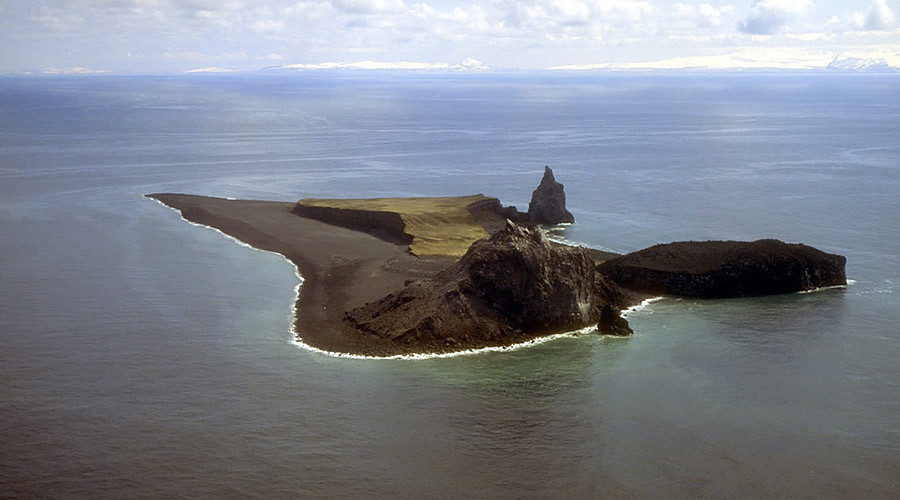
An Alaskan volcano experienced its largest eruption to date and created a large ash cloud. For the past several months, Bogoslof Volcano has had minor eruptions, but the most recent was its strongest, sending ashes 35,000 feet above sea level.

Residents of the Aleutian Islands are under ash advisory after Bogoslof Island's volcano had its strongest recorded eruption Tuesday night. The National Weather Service warned that the fishing communities could see a trace amount of ash following the powerful eruption.

This isn't the first time the volcano has erupted. Tuesday was the 36th recorded eruption over the last three months, with the next most recent one occurring February 19, CNBC reported. However, the length of the eruption and intensity were unexpected.

"It was the most significant event for the entire eruption," US Geological Survey geologist Kristi Wallace told CNBC.

Arrow Up

Powerful eruption of Bezymianny volcano, Russia; ash ejected up to 10 km (33,000 feet)

Russia's Bezymianny volcano eruption
© KB GS RASBezymianny eruption on March 9, 2017.
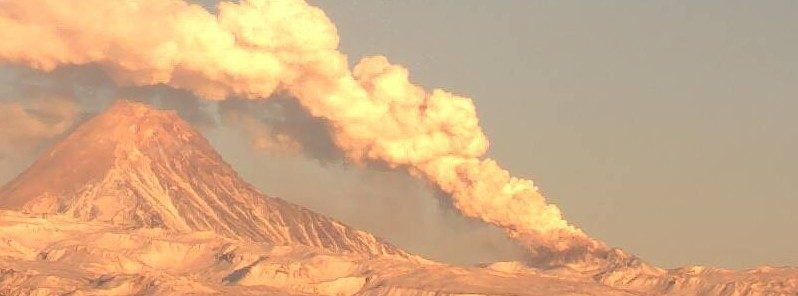
A powerful eruption took place at Bezymianny volcano, Kamchatka, Russia around 03:00 UTC on March 9, 2017. The Aviation Color Code was first raised to Orange, then to Red.

Tokyo VAAC said at 03:42 UTC, that an eruption at Bezymianny at 03:00 UTC sent ash up to 10 km (33 000 feet) extending N-NW.

According to satellite data by KVERT, ash plume at the height about 7 km (23 000 feet) a.s.l. drifts for about 112 km (70 miles) to the northwest from the volcano, KVERT said at 05:11 UTC. The width of ash plume is about 14 km (8.7 miles). Strong gas-steam activity of the volcano continues, it said.

Strong ash explosions up to 15 km (49 200 feet) a.s.l. could occur at any time. Ongoing activity could affect international and low-flying aircraft.

Based on KB GS RAS (Kamchatka Branch of Geophysical Services, Russian Academy of Sciences) data, KVERT noted that seismicity at Bezymianny began to increase on November 18, 2016. The temperature of a thermal anomaly detected in satellite images increased on December 5, and then significantly increased on December 13, which was likely caused by lava-dome extrusion. The Aviation Color Code was raised to Orange.