Researchers at the U.S. Department of Energy's (DOE) Argonne National Laboratory, in conjunction with scientists from China and Singapore, have crystallized and characterized the structure of one of the most important protein complexes of the H5N1 virus, the most common strain of bird flu.
|
| ©DOE/Argonne National Laboratory |
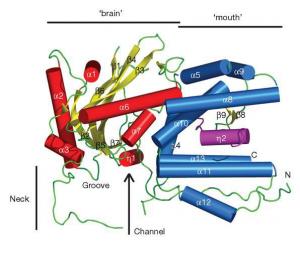
| The overall structure of the PAC--PB1 N complex. The structure is colored according to secondary structure and elements are labeled. Helices are shown as cylinders and are red in the brain domain and blue in the mouth domain; strands are yellow and loops are green. The PB1 N peptide is magenta. |
All viruses, including H5N1, contain only a small number of proteins that govern all of the viruses' functions. In H5N1, perhaps the most important of these proteins is RNA polymerase, which contains the instructions that allows the virus to copy itself along with all of its genetic material. The Argonne study focused on H5N1's RNA polymerase protein, which contains three subunits: PA, PB1 and PB2.