Puppet MastersS


Target

The seven mysterious preludes to FBI's Trump-Russia probe

#TrumpRussia
© Pinterest
The Federal Bureau of Investigation formally opened its Trump investigation after Western intelligence assets and Clinton-affiliated political operatives repeatedly approached the Trump campaign and tried but failed to damage it through associations with Russia, a growing body of evidence suggests.

Before the FBI began investigating the Trump campaign in an operation code-named "Crossfire Hurricane," there were at least seven different instances when campaign advisers were approached with Russia-related offers. Most of those contacts - including Donald Trump Jr.'s much-publicized meeting with a Russian lawyer and others in June 2016 - offered the prospect of information damaging to Donald Trump's Democratic opponent, Hillary Clinton.

Two of these approaches were made by one U.S. government informant already publicly identified as such, Stefan Halper. Another was made by a man who swore in court that he had worked as an FBI informant. Two others were made by figures associated with Western intelligence agencies. Another two approaches included political operatives, one foreign, with ties to the Clintons.

Comment: Pieces of the puzzle are falling into place. Speaks to a very coordinated, however ineffectual, operation.
See also: Roger Stone: My recently recalled contact with a Russian FBI informant


Chess

US considers offering THAAD system to block India's S-400 deal with Russia

Trump THAAD argument
© Unknown
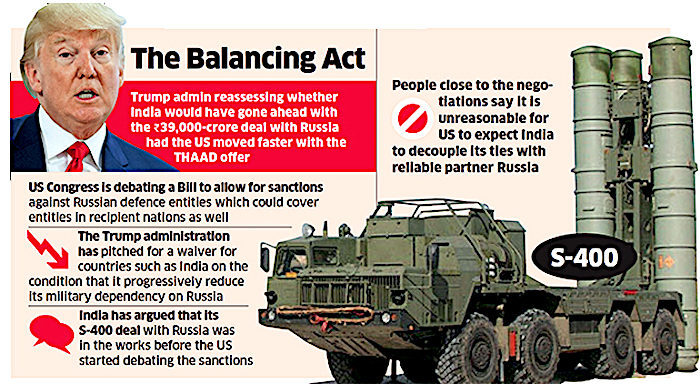
The United States may try to persuade India to consider its ballistic missile defence options in an attempt to keep it from pressing ahead with the S-400 deal with Russia.

ET has learnt that the US could make ballistic missile defence an agenda point in the upcoming Indo-US 2+2 dialogue on July 6 for which external affairs minister Sushma Swaraj and defence minister Nirmala Sitharaman will be in Washington.

The likely option on the table would be the Terminal High Altitude Area Defense (THAAD) system. It is a sophisticated missile defence system which is believed to be particularly effective against long-range missiles.

The S-400 missile defence system is, however, said to be effective against a larger array of aerial attacks, particularly fighter aircraft such as the F-18s and F-35s. The latest version of the Russian made S-400 has a longer range but the jury is out on whether it's more effective than the THAAD against intermediate range and intercontinental ballistic missile systems.

ET has gathered that India's proposed S-400 purchase from Russia has prompted a reassessment within Trump administration on whether India would have gone ahead with the nearly Rs 39,000-crore deal with Russia had the US moved faster with the THAAD offer.

Now, the S-400 deal has become a politically sensitive issue with the US. The US Congress is debating a Bill to allow for sanctions against Russian defence entities which could cover entities in recipient nations as well.

Comment: The US is placing India in a prime negotiating spot - two offers, one threat, one deal. Late to the game, Trump's proposal should be a super 'rupee-saver'. Should India proceed with Russia, it will argue US sanctions won't apply as the deal with Russia predates CAATSA. The US, if true to form, will not agree.


Jet1

NATO wants air superiority, better tech and more infowars against 'peer adversary' Russia

NATO target
© Unknown
Facing the prospect of fighting someone who might fight back, NATO has adopted a new air power strategy, short on specifics but long on calls for better technology, cyber and information warfare.

The document, published on Tuesday, calls joint air power (JAP) a "key instrument in achieving NATO's three core tasks and other political objectives." It is the first such document since the NATO naval strategy was formulated in 2011.
"For almost 70 years, airpower has been a core part of NATO's military capabilities. From deterring the Soviet Union during the Cold War, to operations in the Balkans in the 1990s and the fight against international terrorism in the deserts of Afghanistan, air power has helped to protect our people and achieve our political objectives," NATO spokesperson Oana Lungescu said in a statement.
The new strategy will "help ensure that allied air forces remain world class, flexible and ready for any possible contingencies," Lungescu added.

The eleven-page document consists mostly of broad generalizations and is written in dry political and military language. Some of the contents, however, provide clues as to what NATO's air priorities will be, going forward.

One of the first contingencies brought up in the strategy is the stark warning that
"for the first time since the end of the Cold War, the Alliance has to be able to conduct operations against any peer-state actor." As a result, the "future operating environment may be one in which air superiority can neither be assured at the onset of operations nor, once obtained, be an enduring condition."

Comment: Loftier statements, but the same old bullpucky in thought and practice. Nothing learned; nothing gained; more is lost; none the better for it.


Star of David

Israel targets Gaza, intercepts Hamas missiles

Gaza Strip
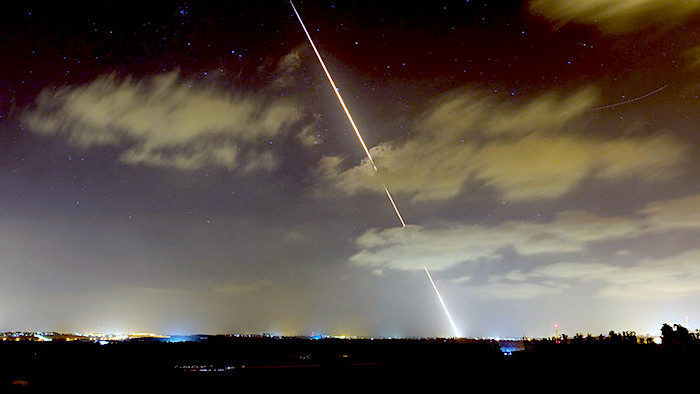
© Amir Cohen/ReutersStreak of light over Gaza Strip.
A vehicle and two Hamas "observation posts" have been targeted and destroyed by Israeli Defense Forces, while the Iron Dome anti-missile system has intercepted at least three rockets fired at Israel from Gaza.

A "barrage of projectiles" was launched towards southern Israel after IAF aircraft and IDF tanks shelled the militant organization's targets inside the enclave. The destroyed targets included a vehicle allegedly belonging to a Hamas operative, believed to have been "heavily involved" in explosive balloon attacks. In addition, the IDF struck two Hamas observation posts. "The Hamas terror organization will bear the consequences for facilitating terror and instability," the IDF said.

On Tuesday night sirens sounded in Hof Ashkelon, Sha'ar HaNegev and Eshkol Regional Councils when nine rockets were launched from the Gaza strip, the IDF said. One of the projectiles was intercepted by the IDF's Iron Dome Aerial Defense System. Afterwards, Israel detected three more incoming rockets, two of which were tackled by the air defense system. There were no reports of injuries or damage from the other eight projectiles, which usually strike uninhabited areas.

Earlier in the day, an Israeli jet destroyed another car and an observation post used by Palestinians to launch arson balloons. Over the last couple of weeks, Israel has intensified its effort to stop balloon and kite launches of homemade incendiary devices, which have become a symbol of Arab resistance during the Great March of Return protests along the Gaza-Israeli border since late March.

Comment: See also:


Dig

The sexy metals: The missing elements in the North Korean negotiation?

Mineral Mining
© Subcontinental wind - AltervistaMining the Elements
US Secretary of State Mike Pompeo knows the importance of rare earth elements, and North Korea has reportedly found one of the world's biggest deposits 150km from Pyongyang; is this another factor behind the recent thaw with the US?

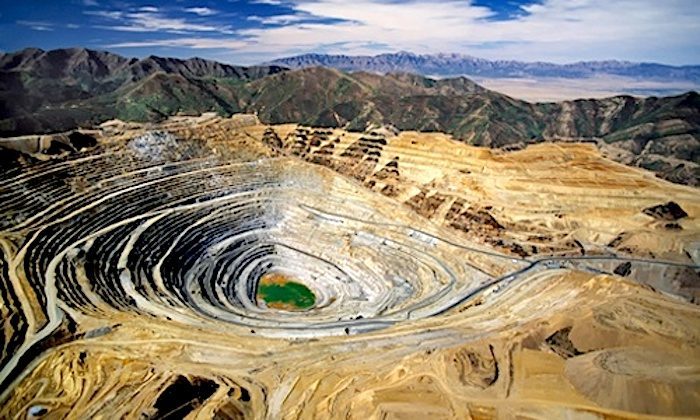
This may not be about condos on North Korean beaches after all. Arguably, the heart of the matter in the Trump administration's embrace of Kim Jong-un has everything to do with one of the largest deposits of rare earth elements (REEs) in the world, located only 150 km northwest of Pyongyang and potentially worth billions of US dollars.

All the implements of 21st century's technology-driven everyday life rely on the chemical and physical properties of 17 precious elements on the periodic chart also known as REEs.

Currently, China is believed to control over 95% of global production of rare earth metals, with an estimated 55 million tons in deposits. North Korea for its part holds at least 20 million tons.

Rare earth elements are not the only highly strategic minerals and metals in this power play. The same deposits are sources of tungsten, zirconium, titanium, hafnium, rhenium and molybdenum; all of these are absolutely critical not only for myriad military applications but also for nuclear power.

Comment: Perhaps North Korea is finally being seen as a value...sadly it is 'sexy' minerals as another trade war item.


Star of David

Israel targeted Iraqi militias fighting ISIS in Eastern Syria, 20-50 dead

Israeli Jets
© Unknown
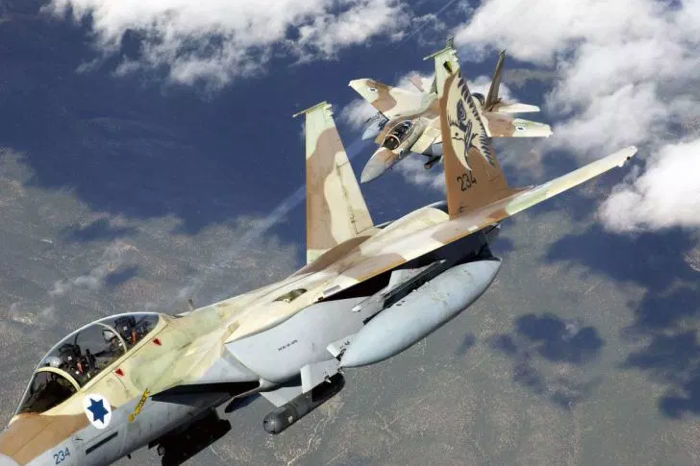
According to Americans, Israeli jets, drones or missiles flew over 500 kilometers all the way to the other side of Syria to make themselves an air force for ISIS

ISIS remains a threat in eastern Syria. It holds a stretch of land on the eastern bank of the Euphrates which the US has appropriated for itself and the Kurdish-dominated SDF coalition yet refuses to clear. The group also has numerous hiding places in the desert to the west of river which due to its vastness and lack of infrastructure is difficult to control.

June 8-10 ISIS fighters came out of these desert bases in a raiding counter-offensive. In the surprise attack it was able to take over part of the outskirts of the city of Abu Kamal which lies on the Syrian side of the border with Iraq, but were then forced to fall back.

Involved in repelling the ISIS were not just the Syrian army and local tribes organized in the NDF militia units, but also volunteer Iraqi militias of Kata'ib Hezbollah. Since this week this Syrian-Iraqi coalition has a new enemy.

On the night from June 17 to 18 air strikes hit Syrian military bases at Abu Kamal. They killed 22 Kata'ib Hezbollah fighters and an unknown number of Syrians. The Syrians first accused the Americans of hitting them - this was logical since the US hit the Syrian army in eastern Syria four times in May-June 2017, twice in February 2018, and again in April 2018. However Americans denied carrying out any such strikes, and Pentagon denials of this type are credible, as they did not deny any of the previous ones.

Comment: Israel is - more and more - showing its hand and intent. Every raid that goes unaddressed creates the impetus for another.


Hammer

House Judiciary Committee approves resolution demanding FBI documents in response to stonewalling

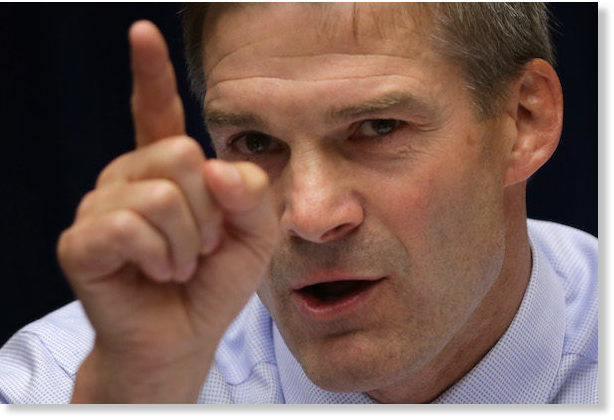
Rep. Jim Jordan, R-Ohio
Rep. Jim Jordan, R-Ohio on the frontlines
Remedy: 'Contempt or Impeachment'

The House Judiciary Committee approved for the first time a resolution Tuesday demanding that Deputy Attorney General Rod Rosenstein turn over all requested documents regarding the FBI's handling of the Russia investigation during the presidential election after seven days or face possible impeachment or contempt.

The decision to move forward with the resolution came after a year of battles with the Justice Department and FBI to turn over requested documents. The committee voted on party lines 15-11 to pass the resolution directing Rosenstein to comply within the next seven days or face the consequences.

Rep. Jim Jordan, R-Ohio, who has been one of the lawmakers at the frontlines of the committee's investigation, said the resolution is the result of the frustration felt among lawmakers conducting oversight. He noted that it will be up to House Republican leaders to decide whether or not to take it to the full House for a vote.

Comment: While the FBI and Justice Dept. are fighting tooth and nail to keep incriminating info out of the public eye, The House Judiciary Committee has been absolutely relentless at resolving the bogus collusion accusations against Trump for good:


Stop

US threats to sanction countries failing to reduce Iranian oil imports met with resistance

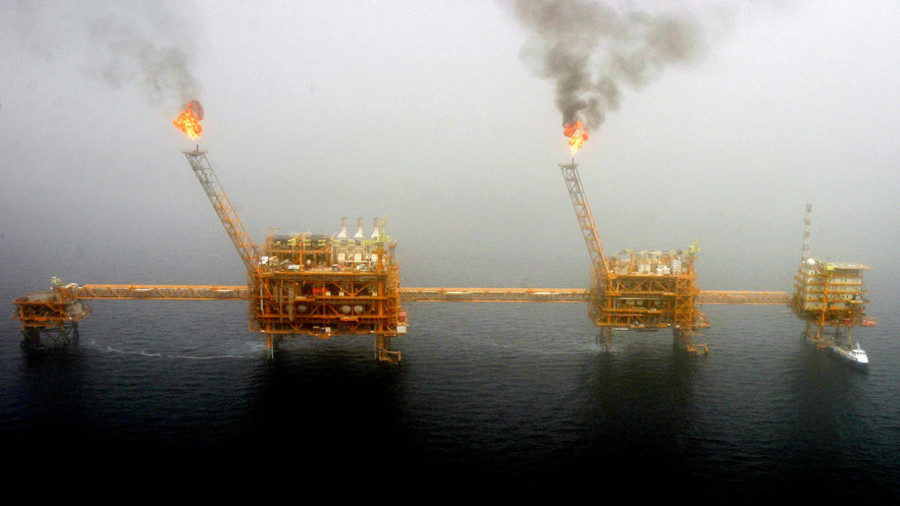
Oil platform Soroush oil fields near Tehran
© Raheb Homavandi / ReutersOil production platform at the Soroush oil fields in the Persian Gulf, south ofTehran.
Washington may slap sanctions on governments that fail to reduce Iranian oil imports to "zero" by early November, a senior State Department official has warned. But some partners seem reluctant to follow the demand.

The US administration has been pushing its allies to follow US President Donald Trump's lead after he decided to pull out of the landmark nuclear agreement between Iran and six world powers. A senior State Department official told reporters on Tuesday he had been traveling to Europe and Asia to convince allies to isolate the "stream of Iranian funding."

Washington's allies, including those dependent on Iran's oil, should ultimately refuse the imports by November 4 or else face secondary US sanctions. It was stressed that there are no waivers planned.

This mean that the Trump administration will not allow countries to gradually phase out Iran's oil exports over the duration of many months like the Obama White House did.

Comment: The US is pushing its 'allies' into a corner and may eventually find itself irrelevant as they find partners who are willing to conduct business on mutually beneficial terms without threats and intimidation:


Light Saber

Hungary's Foreign Minister to BBC on migration crisis: 'You are unbalanced & one-sided'

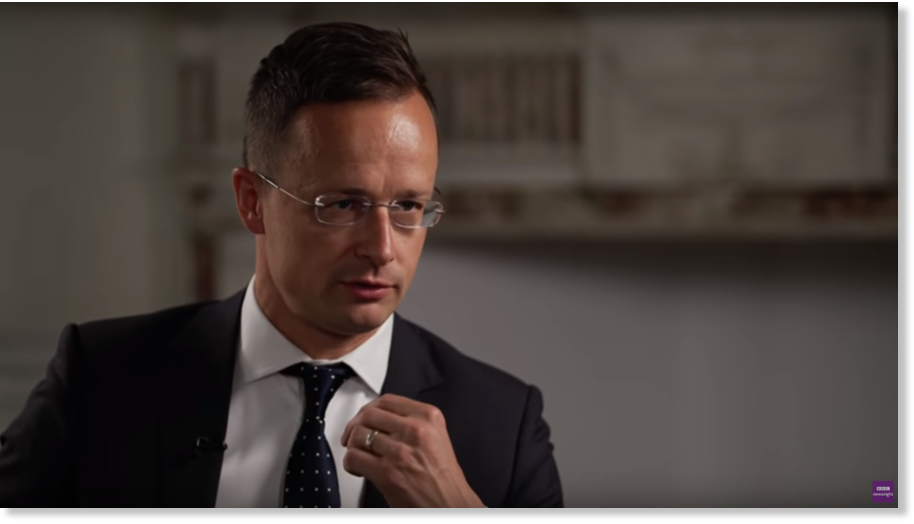
Peter Szijjarto
© BBC Newsnight / YouTubePeter Szijjarto on BBC Newsnight. June 26, 2018.
Hungary's Foreign Minister Peter Szijjarto hit back at a BBC reporter who suggested his government is xenophobic and authoritarian during an intense interview, in which the politician defended his country's immigration record.

As Hungary's foreign affairs chief sat down for an interview with BBC Newsnight on Tuesday, the talk quickly turned heated. Reporter Emily Maitlis recalled how the Hungarian parliamentary election, which happened two months ago, was criticized by the nation's opposition parties.

"There is a sense of erosion of the rule of law. This is no longer a democracy. It is creeping authoritarianism," she told Szijjarto, whose conservative Fidesz party won over 70 percent of votes in April. The minister rebuffed the allegations.

"You echo lies on this television. And I don't think it's fair. You are unbalanced, you are one-sided," he responded. "You look only at the opinion of those who are frustrated because they lost the election."


Comment: Peter Szijjarto hit the nail on the head. Bought-and-paid-or corporate news outlets like the BCC are all too ready to accuse nations and leaders of being authoritarian, xenophobic, right wing, etc. - if they don't fall into line on destructive left-leaning and Globalist ideologies and policies. Well, newsflash, common sense is prevailing among many of these same leaders - in the name of sovereignty and survival in a world gone mad, and to hell with the know-nothing propagandizing and egregious words of the elite-hired brainwashers.

See also:


Vader

Trump's trade rep claims US has the right to impose tariffs but it's against the rules for other countries to do the same

steel manufacturer
© Christian Charisius / Reuters
America has the right to impose trade tariffs to protect its national interests. But when countries retaliate, they break the rules, says US Trade Representative Robert Lighthizer.

"President [Donald] Trump has taken actions on trade in steel and aluminum to protect our national security interests. These actions are wholly legitimate and fully justified, both as a matter of US law and WTO rules," Lighthizer said in a statement on Tuesday. "By contrast, the European Union has concocted a groundless legal theory to justify immediate tariffs on US exports. Other WTO Members, including China, have adopted a similar approach.

"These retaliatory tariffs underscore the complete hypocrisy that governs so much of the global trading system. For months, the EU, China, and others have criticized the trade policy of the United States, while claiming to champion the WTO. But their recent tariffs prove that they simply ignore WTO rules whenever doing so is convenient," he added.