Science & TechnologyS


Display

Don't let cyberspite destroy your good name and make identity profiling easier for the spooks

You buy a television on eBay. When it arrives, you eagerly unwrap it, only to find it is badly scratched. You return it, and leave a negative comment about the seller on the site. The next day, you find the seller has retaliated by posting a nasty comment about you, branding you as a time-waster. Suddenly, no one wants to sell to you and your reputation is in tatters.

Until now eBay's rating system, which allows users of the auction and trading site to leave good or bad comments about their trading partners, has worked well. Sellers who ship out damaged goods, or items that do not match their online description, rightly get a black mark against their name. However, this system has recently come under increasing pressure from an all-too-human failing: spite. Sellers can easily retaliate against buyers who have named and shamed them, leaving unwarranted but highly visible comments - perhaps claiming that the buyers do not follow through with purchases, or needlessly return items they have bought.

Fear of this retaliatory "negging" can deter buyers from posting negative comments about their trading experiences. In turn, this threatens to undermine the trust that buyers place in sellers' ratings.

So severe has the negging problem become that this month eBay was forced to change its rating system, preventing sellers from posting negative comments about bad buyers on the site.

Star

A scientific first: A supernova explosion is observed in real time

An ordinary observation with NASA's Swift research satellite recently led to the first real-time sighting of a star in the process of exploding. Astronomers have surveyed thousands of these supernova explosions in the past, but their observations have always begun some time after the main event is underway. The information gained from catching a supernova at the very onset is already being hailed as the 'Rosetta Stone' of star explosion, and it is helping scientists to form a detailed picture of the processes involved.

A typical supernova is preceded by the burn-out of a massive star. When the nuclear fuel at its core runs out, the star collapses under its own weight. The resulting body, now known as a neutron star, is so dense that one teaspoonful of its core material weighs as much as all the humans on earth. This extreme compression is followed by a rebound, creating a shock wave that bounces off the surface of the newly-formed neutron star and rips through its outer, gaseous layers. These layers are ejected, flying off the surface in rapidly expanding shells.

Bulb

Why do astronauts suffer from space sickness?

Rotating astronauts for a lengthy period provided researcher Suzanne Nooij with better insight into how 'space sickness' develops, the nausea and disorientation experienced by many astronauts. Nooij will receive her PhD from TU Delft on this subject on Tuesday 20 May.

Gravity plays a major role in our spatial orientation. Changes in gravitational forces, such as the transition to weightlessness during a space voyage, influence our spatial orientation and require adaptation by many of the physiological processes in which our balance system plays a part. As long as this adaptation is incomplete, this can be coupled to motion sickness (nausea), visual illusions and disorientation.

This 'space sickness' or Space Adaptation Syndrome (SAS), is experienced by about half of all astronauts during the first few days of their space voyage. Wubbo Ockels, the first Dutchman in space in 1986, also suffered from these symptoms. In his capacity as TU Delft professor, Ockels is PhD supervisor for Suzanne Nooij's research.

Arrow Down

'We have an explanation; Move along': Soyuz bumpy re-entry caused by technical glitch

A technical glitch caused the ballistic landing of Russia's Soyuz TMA-11 capsule in April this year, the head of the Federal Space Agency's department for manned flights said on Wednesday.

On April 19, the Soyuz-TMA-11 capsule, carrying U.S. astronaut Peggy Whitson, Russian flight engineer Yuri Malenchenko, and Korean bioengineer Yi So-yeon from the International Space Station, made a bumpy re-entry, landing 420 km (260 miles) off-target in the steppes of northern Kazakhstan.

"The cause has been established," said Alexei Krasnov. "The equipment bay failed to separate from the capsule in the designated time, causing a ballistic landing of the spacecraft."

Better Earth

Flashback Soyuz spacecraft lands off-target

A Russian Soyuz spacecraft has returned to Earth, but came down more than 400km (250 miles) away from its planned touchdown point, say Russian officials.

The crew are safe, but were subjected to severe G-forces during re-entry, said a spokesman for mission control.

He said they were examined at the landing site by medical staff.

Telescope

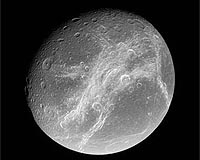
Scientists Produce An Atlas Of Saturn's Moon Dione

Like the cartographers of old, scientists working with images from the Cassini spacecraft of Saturn"s icy airless moons have carefully crafted detailed maps that one day may guide future explorers across the surfaces of these remote bodies.

Dione third densest of Saturns moons
©NASA/JPL/Space Science InstituteUnknown
Dione is composed primarily of water ice, but as the third densest of Saturn's moons (aside from Enceladus and Titan, whose density is increased by gravitational compression) it must have a considerable fraction (~ 46%) of denser material like silicate rock in its interior. Though somewhat smaller and denser, Dione is otherwise very similar to Rhea. They both have similar albedo features and varied terrain, and both have dissimilar leading and trailing hemispheres.
Dione's leading hemisphere is heavily cratered and is uniformly bright. Its trailing hemisphere, meanwhile, contains an unusual and distinctive surface feature: a network of bright, wispy streaks on a dark background that overlay the craters, indicating that they are newer. These are now known to be ice cliffs.

A team of DLR scientists alongside colleagues from the Freie Universität Berlin has produced an atlas of Dione, a moon of Saturn released today, 20 May 2008, by NASA.

Info

Clue To Mystery Crustacean In Parasite Form

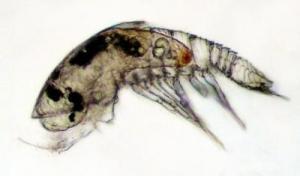
First identified in 1899, y-larvae have been one of the greatest zoological mysteries for over a century. No one has ever found an adult of these puzzling crustaceans, despite the plethora of these larvae in plankton, leading generations of marine zoologists to wonder just what y- larvae grow up to be. A new study reports the transformation of the larvae into a previously unseen, wholly un-crustacean-like, parasitic form.

Y larvae
©Hoeg et al, BMC Biology
Y larvae.

Sherlock

First dinosaur tracks found in Arabian Peninsula

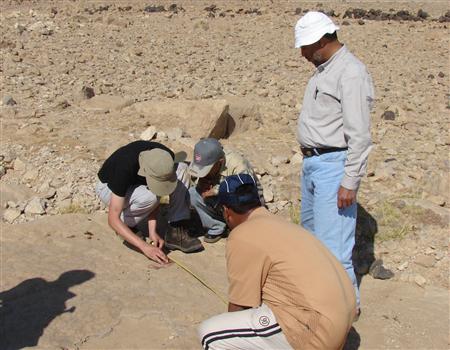
LONDON - Scientists have discovered the tracks of a herd of 11 long-necked sauropods walking along a coastal mudflat in what is now the Republic of Yemen, the first discovery of dinosaur footprints on the Arabian peninsula.

Sauropods, the largest land animals in earth's history, walked on four stout legs and ate plants.

dinosaur footprints on the Arabian peninsula
©REUTERS/Nancy Stevens/Handout
Researchers at the site of a newly-discovered sauropod in the Republic of Yemen in an undated photo. Scientists have discovered the tracks of a herd of 11 long-necked sauropods walking along a coastal mudflat in what is now the Republic of Yemen, the first discovery of dinosaur footprints on the Arabian peninsula.

"The nice thing is we finally filled in a bit of a blank spot in the dinosaur map," said Anne Schulp, a palaeontologist at the University of Maastricht in the Netherlands, who worked on the study.

Bulb

Sleep-deprived Brains Alternate Between Normal Activity And 'Power Failure'

Neuroscience researchers at the Duke-NUS Graduate Medical School in Singapore have shown for the first time what happens to the visual perceptions of healthy but sleep-deprived volunteers who fight to stay awake, like people who try to drive through the night.

The scientists found that even after sleep deprivation, people had periods of near-normal brain function in which they could finish tasks quickly. However, this normalcy mixed with periods of slow response and severe drops in visual processing and attention, according to their paper, published in the Journal of Neuroscience on May 21.

Info

New Meaning For The Term 'Computer Bug': Genetically Altered Bacteria For Data Storage

US researchers have created 'living computers' by genetically altering bacteria. The findings of the research demonstrate that computing in living cells is feasible, opening the door to a number of applications including data storage and as a tool for manipulating genes for genetic engineering.

Three-dimensional computer-rendered E. coli bacteria
©iStockphoto/Sebastian Kaulitzki
Three-dimensional computer-rendered E. coli bacteria.

A research team from the biology and the mathematics departments of Davidson College, North Carolina and Missouri Western State University, Missouri, USA added genes to Escherichia coli bacteria, creating bacterial computers able to solve a classic mathematical puzzle, known as the burnt pancake problem.