Science & TechnologyS


Rocket

Researchers will study ways to deflect asteroids

An Asteroid Deflection Research Center (ADRC) has been established on the Iowa State campus to bring researchers from around the world to develop asteroid deflection technologies. The center was signed into effect in April by the Office of the Executive Vice President and Provost.

Magnify

New Image-recognition Software Could Let Computers 'See' Like Humans Do

It takes surprisingly few pixels of information to be able to identify the subject of an image, a team led by an MIT researcher has found. The discovery could lead to great advances in the automated identification of online images and, ultimately, provide a basis for computers to see like humans do.

Image
©Antonio Torralba
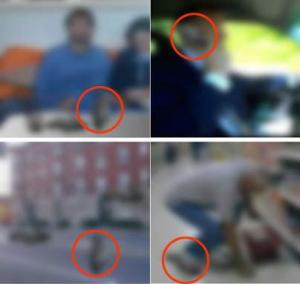
Question: What do you see in the red circles? A bottle, a cell phone, a person, a shoe? The answer: They're all the same. Professor Antonio Torralba created these low-resolution images, in which the circled shapes were inserted and are all identical, to demonstrate how context affects our recognition of objects. Even the 'car' in the lower left image is the same object.

Info

Scientists test brain pacemakers for depression

It's a new frontier for psychiatric illness: Brain pacemakers that promise to act as antidepressants by changing how patients' nerve circuitry fires.

Scientists already know the power of these devices to block the tremors of Parkinson's disease and related illnesses; more than 40,000 such patients worldwide have the implants.

But psychiatric illnesses are much more complex and the new experiments with so-called deep brain stimulation, or DBS, are in their infancy. Only a few dozen patients with severe depression or obsessive-compulsive disorder so far have been treated in closely monitored studies.

Newspaper

Brain activity reveals mother tongue

ROME: No one can read our thoughts, for now, but some scientists believe they can at least figure out in what language we do our thinking.

Before we utter a single word, experts can gauge our mother tongue and the level of proficiency in other languages by analyzing our brain activity while we read, scientists working with Italy's National Research Council say.

For more than a year, a team of scientists experimented on 15 interpreters, revealing what they say were surprising differences in brain activity when the subjects were shown words in their native language and in other languages they spoke.

Telescope

NASA probe sends first pictures from Martian arctic

WASHINGTON - A NASA probe sent back never-seen pictures of Mars' north pole Monday after a near perfect landing in the most ambitious mission to date to find life-sustaining minerals on the Red Planet.

Pictures from the Phoenix probe provided the first glimpse of the planet's Arctic plains -- a desolate landscape of stony, frozen ground.

Phoenix Mars Lander
©AFP/NASA
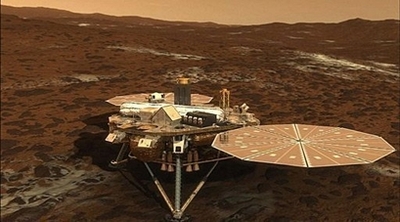
Artist's illustration obtained from NASA shows the Phoenix Mars Lander. A NASA probe has sent back never-seen pictures of Mars' north pole after a near perfect landing in the most ambitious mission to date to find life-sustaining minerals on the Red Planet.

Cow Skull

Australia: Landmark new fossil discovery at Burra


Marsupial lion skeleton
©SA Museum
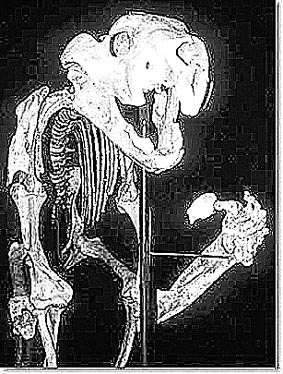
Marsupial lion (thylacoleo carnifex) skeleton

New evidence at Redbanks Conservation Park near Burra has confirmed that large marsupial lions roamed the area during the Ice Age.

Ark

Stonehenge builders had geometry skills to rival Pythagoras

Stone Age Britons had a sophisticated knowledge of geometry to rival Pythagoras - 2,000 years before the Greek "father of numbers" was born, according to a new study of Stonehenge.

Five years of detailed research, carried out by the Oxford University landscape archaeologist Anthony Johnson, claims that Stonehenge was designed and built using advanced geometry.

stonehenge
©Dan Chung/Reuters
The Stone Age Britons who built Stonehenge had a knowledge of advanced geometry, 2,000 years before Pythagoras

Binoculars

Scientists begin hunt for mysterious "God particle"

Washington -- Scientists are hoping that the Atlas detector, which is one of six particle physics experiments part of the Large Hadron Collider, will help unlock some deep scientific mysteries and perhaps even lead to discovery of the Higgs boson, dubbed as "the God particle".

The Large Hadron Collider is located at the European Organization for Nuclear Research, known as CERN, near Geneva, Switzerland.

Laptop

Internet to run out of addresses 'within 3 years'

If you thought it was hard finding the email address that some other john.smith hasn't already bagged, that's nothing compared with the difficulty you'll have getting an internet connection for your computer after 2011.

Bizarro Earth

Earthquake prediction from space is more accurate

Space-based predictions have been correct for 44 of 47 registered quakes. It has the ability to survey huge territories for seismically hazardous areas. Harbingers of powerful quakes appear around five days before the main shock.

China's deadly earthquake in the Sichuan province has again showed that ground-based earthquake prediction methods and systems are not reliable.

Traditional seismology does its best, sometimes succeeding, but more often only saying something like, "California will be destroyed in the next 30 years."

Remote sensing from space can provide more accurate data about locations, and even dates of expected disasters.

The majority of earthquakes happen in two long narrow stripes, one around the Pacific and the other running from the Azores to southeast Asia. There are several other earthquake-prone regions.