Science & TechnologyS


Telescope

Swift Makes Best-ever Ultraviolet Portrait of Andromeda Galaxy

Image
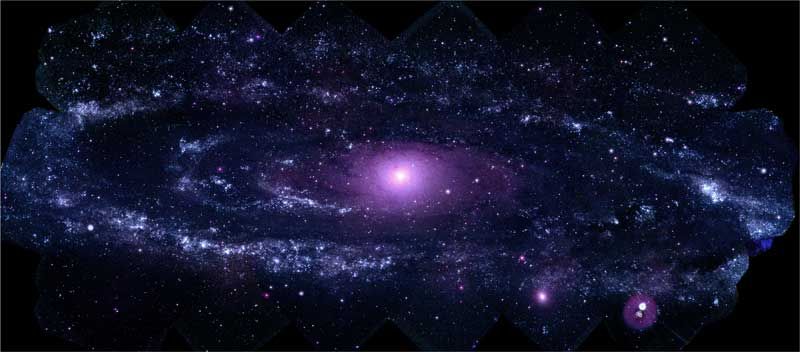
© NASA/Swift/Stefan Immler (GSFC) and Erin Grand (UMCP)This mosaic of M31 merges 330 individual images taken by the Ultraviolet/Optical Telescope aboard NASA's Swift spacecraft. It is the highest-resolution image of the galaxy ever recorded in the ultraviolet. The image shows a region 200,000 light-years wide and 100,000 light-years high (100 arcminutes by 50 arcminutes).
In a break from its usual task of searching for distant cosmic explosions, NASA's Swift satellite has acquired the highest-resolution view of a neighboring spiral galaxy ever attained in the ultraviolet. The galaxy, known as M31 in the constellation Andromeda, is the largest and closest spiral galaxy to our own.

"Swift reveals about 20,000 ultraviolet sources in M31, especially hot, young stars and dense star clusters," said Stefan Immler, a research scientist on the Swift team at NASA's Goddard Space Flight Center in Greenbelt, Md. "Of particular importance is that we have covered the galaxy in three ultraviolet filters. That will let us study M31's star-formation processes in much greater detail than previously possible."

Binoculars

At Last! First Real Evidence for a Rocky Exoplanet

Image
Artist’s impression of COROT-7b, ESO/L. Calcada. Image 2: The planet-hosting star COROT-7, located 500 light years away near the constellation of Monoceros, ESO/Digitized Sky Survey.
There's finally proof that Earth-like planets can exist outside our solar system: Scientists have managed to measure the mass of exoplanet COROT-7b, revealing that it's the first exoplanet with a confirmed density similar to our own.

"This is a day we've been waiting for for a long time," said exoplanet researcher Sara Seager of the Massachusettes Institute of Technology, who was not involved in the research. "It's the first definitive rocky world beyond our solar system, and it's opening a new gate for our research. We're really, really excited about it."

When astronomers discovered COROT-7b in February, they couldn't determine its mass because they didn't have precise enough measurements of the velocity of its star. Now, using 70 hours of observation data from the High Accuracy Radial velocity Planet Searcher (HARPS) spectrograph, scientists from the European Southern Observatory have calculated that the exoplanet is only about five times more massive than Earth.

Combined with the planet's known radius, which is almost twice that of Earth, the new mass measurement makes COROT-7b the first exoplanet with a known density similar to Earth's.

Telescope

Mini-Comets Within a Comet Lit Up 17P/Holmes During Megaoutburst

Image
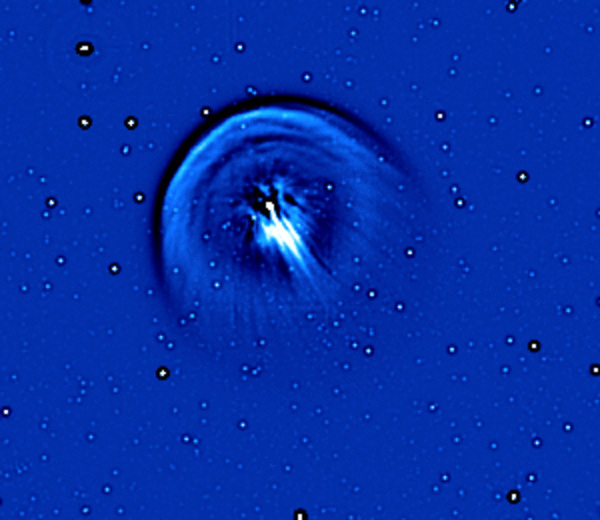
© Jewitt/Stevenson/KleynaReveals the expansion of the coma of comet Holmes over 9 nights in 2007 November.
Astronomers from the University of California, Los Angeles and the University of Hawaii have discovered multiple fragments ejected during the largest cometary outburst ever witnessed. Images and animations showing fragments rapidly flying away from the nucleus of comet 17P/Holmes will be presented by Rachel Stevenson at the European Planetary Science Congress in Potsdam, Germany, on Wednesday 16 September.

Stevenson, together with colleagues Jan Kleyna and David Jewitt, began observing comet Holmes in October 2007 soon after it was reported that the small (3.6 km wide) body had brightened by a million times in less than a day. They continued observing for several weeks after the outburst using the Canada- France- Hawaii Telescope in Hawaii and watched as the dust cloud ejected by the comet grew to be larger than the Sun.

The astronomers examined a sequence of images taken over nine nights in November 2007 using a digital filter that enhances sharp discontinuities within images. The filter, called a Laplacian filter, is particularly good at picking out faint small-scale features that would otherwise remain undetected against the bright background of the expanding comet. They found numerous small objects that moved radially away from the nucleus at speeds up to 125 metres per second (280 mph). These objects were too bright to simply be bare rocks, but instead were more like mini-comets creating their own dust clouds as the ice sublimated from their surfaces.

Magnify

African Origin Of Anthropoid Primates Called Into Question With New Fossil Discovery

Image
© Rodolphe Tabuce, CNRSImage of an Algeripithecus mandible, showing the scale of the specimen.
Well-preserved craniodental fossil remains from two primate species have been discovered during excavations at an Algerian site. They reveal that the small primate Algeripithecus, which is 50 million years old and until now was considered as the most ancient African anthropoid, in fact belonged to another group, that of the crown strepsirhines.

This research was carried out by a team of French researchers from the Institut des Sciences de l'Evolution (Université de Montpellier/CNRS), working with Algerian paleontologists from the universities of Tlemcen, Oran and Jijel. The resulting publication, published online on the website of the Proceedings of the Royal Society B (Biological Sciences) on September 9, 2009, reopens the debate on the African origin of anthropoids, the group to which humans and apes belong.

Magnify

Appalachian geologist investigates Homo sapiens' oldest known trackways

Image
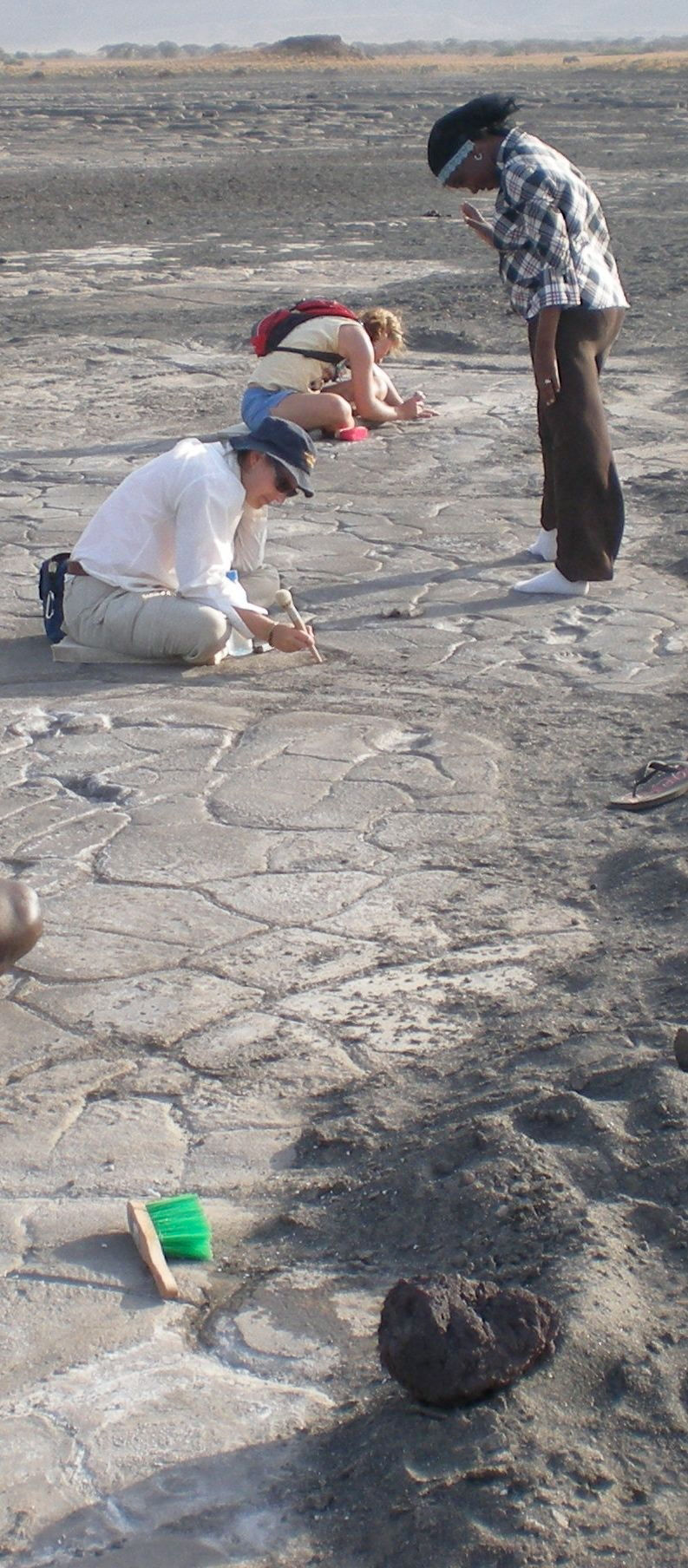
© Michael ManyakDr. Cynthia Liutkus, foreground, and Kate McGinnis use brushes and small picks to clean sediment and debris out of footprint impressions in Tanzania. The footprints are approximately 120,000 years old. Liutkus is an assistant professor in Appalachian State University’s Department of Geology and McGinnis is a senior geology major. Christowaja Ntandu from the Tanzanian Department of Antiquities watches their work. While the footprints of the modern humans have been preserved in hardened ash, Liutkus and McGinnis used a “no shoes” rule to avoid any possible damage while they worked.
Boone - An Appalachian State University geology professor and an undergraduate student assistant spent several weeks this summer uncovering the footprints of human ancestors in Tanzania, East Africa. The footprints, 58 in all, may represent the oldest known and best-preserved trackways of modern humans (Homo sapiens) in the world.

"While the site has been known for years, our team was the first to begin an organized investigation of these footprints. They are amazing,' said Dr. Cynthia Liutkus, an assistant professor in Appalachian's Department of Geology.

Sherlock

Giant Stone-Age Axes Found in African Lake Basin

Stone Axes
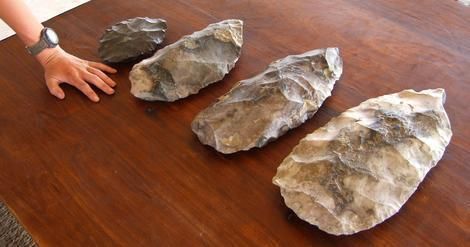
© University of OxfordFour giant stone hand axes were recovered from the the dry basin of Lake Makgadikgadi in the Kalahari Desert.
A giant African lake basin is providing information about possible migration routes and hunting practices of early humans in the Middle and Late Stone Age periods, between 150,000 and 10,000 years ago.

Oxford University researchers have unearthed new evidence from the lake basin in Botswana that suggests that the region was once much drier at certain times and wetter at other times than it is today.

They have documented thousands of stone tools on the lake bed, which sheds new light on how humans in Africa adapted to several substantial climate change events during the period that coincided with the last Ice Age in Europe.

Researchers from the School of Geography and the Environment at the University of Oxford are surveying the now-dry basin of Lake Makgadikgadi in the Kalahari Desert, which at 66,000 square kilometres is about the same size of present day Lake Victoria.

Chalkboard

Fossils From Animals And Plants Are Not Necessary For Crude Oil And Natural Gas, Swedish Researchers Find

Image
© Image courtesy of Vetenskapsrådet (The Swedish Research Council))There is no doubt that our research proves that crude oil and natural gas are generated without the involvement of fossils. All types of bedrock can serve as reservoirs of oil," says Vladimir Kutcherov.
Researchers at the Royal Institute of Technology (KTH) in Stockholm have managed to prove that fossils from animals and plants are not necessary for crude oil and natural gas to be generated. The findings are revolutionary since this means, on the one hand, that it will be much easier to find these sources of energy and, on the other hand, that they can be found all over the globe.

"Using our research we can even say where oil could be found in Sweden," says Vladimir Kutcherov, a professor at the Division of Energy Technology at KTH.

Together with two research colleagues, Vladimir Kutcherov has simulated the process involving pressure and heat that occurs naturally in the inner layers of the earth, the process that generates hydrocarbon, the primary component in oil and natural gas.

Camera

ESO Unveils Interactive 360-Degree Panoramic View Of Entire Night Sky

Image
© ESO, Serge Brunier and Frederic TapissierThis magnificent 360-degree panoramic image, covering the entire southern and northern celestial sphere, reveals the cosmic landscape that surrounds our tiny blue planet.
The first of three images of ESO's GigaGalaxy Zoom project - a new magnificent 800-million-pixel panorama of the entire sky as seen from ESO's observing sites in Chile - has just been released online. The project allows stargazers to explore and experience the Universe as it is seen with the unaided eye from the darkest and best viewing locations in the world. This 360-degree panoramic image, covering the entire celestial sphere, reveals the cosmic landscape that surrounds our tiny blue planet.

This gorgeous starscape serves as the first of three extremely high-resolution images featured in the GigaGalaxy Zoom project, launched by ESO within the framework of the International Year of Astronomy 2009 (IYA2009). GigaGalaxy Zoom features a web tool that allows users to take a breathtaking dive into our Milky Way.

Saturn

Thunderstorm on Saturn is a record-buster

Image
© Unknown
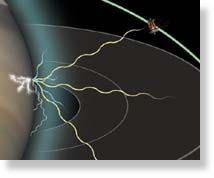
A tempest that erupted on Saturn in January has become the Solar System's longest continuously observed lightning storm, astronomers reported on Tuesday.

The storm broke out in "Storm Alley," a region 35 degrees south of the ringed giant's equator, researchers told the European Planetary Science Congress in Potsdam, near Berlin.

Thunderstorms there can be as big as 3,000 kilometers (nearly 2,000 miles) across. The powerful event was spotted by the US space probe Cassini, using an instrument that can detect radiowaves emitted by lightning discharge.

"The reason why we see lightning in this peculiar location is not completely clear," said Georg Fischer of the Austrian Academy of Sciences in a press release.

Magnify

Ancient Aphrodite Figures Hint at Pagan Resistance

Aphrodite statue
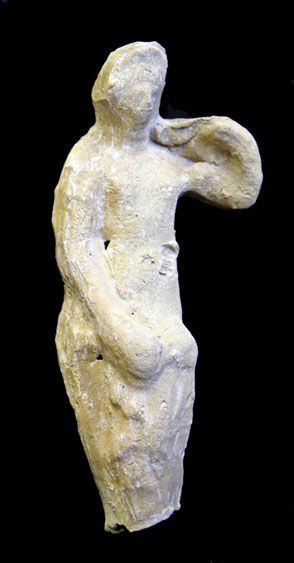
© University of HaifaOne of the three figurines of Venus pudica ("the modest Venus") found in the ancient Roman city of Sussita. Venus is the Roman name for the goddess of love, Aphrodite to the ancient Greeks. Credit:
Three figurines of Aphrodite, the ancient Greek goddess of love, have been found buried underground in the remains of a shop in a Roman city built in the second century B.C.

The hidden figures hint at the reluctance of some denizens of the Roman Empire to give up their pagan beliefs despite the spread of Christianity.

The ancient treasure, buried for more than 1,500 years, was uncovered during the tenth season of excavations that are being carried out by researchers of the Zinman Institute of Archaeology at the University of Haifa.

The hidden statues were discovered when the researchers exposed a shop in the southeastern corner of the forum district of Sussita, which is the central area of the mountaintop Roman city that existed through the Roman and Byzantine periods and destroyed in the great earthquake of 749 A.D. Sussita, also known as Hippos, is located in Israel and sits on a hill overlooking the Sea of Galilee. The city was originally built by Greek colonists, but later came under Roman rule.