

© Stefan Brakhane / University of BonnIllustration of the experimental apparatus - , with in the center the vacuum cell and the objective lens embedded within. Two of the four laser beams are drawn (not to scale). Inset: fluorescence image of two atoms.
Such a conveyor belt of light contains countless pockets, each of which can hold a single atom. These pockets can be moved back and forth at will, allowing an atom to be transported to a specific location in space. If you want to move the atoms in different directions, you usually need many of these conveyor belts. When more atoms are transported to the same location, they can interact with each other. In order for this process to take place under controlled conditions, all pockets of the conveyor belt must have the same shape and depth. "To ensure this homogeneity, the lasers must overlap with micrometer precision," explains Gautam Ramola, the study's lead author.
A bean in a soccer stadium
This task is less trivial than it sounds. For one thing, it requires great accuracy. "It's kind of like having to aim a laser pointer from the stands of a soccer stadium to hit a bean that's on the kickoff spot," Alberti clarifies. "But that's not all — you actually have to do it blindfolded." This is because quantum experiments take place in an almost perfect vacuum, where the laser beams are invisible.
The researchers in Bonn therefore used the atoms themselves to measure the propagation of laser beams. "To do this, we first changed the laser light in a characteristic way — we also call it elliptical polarization," Alberti explains. When the atoms are illuminated by a laser beam prepared in this way, they react changing their state in a characteristic way. These changes can be measured with a very high precision. "Each atom acts like a small sensor that records the intensity of the beam," Alberti explains. "By examining thousands of atoms at different locations, we can determine the location of the beam to within a few thousandths of a millimeter."
In this way, the researchers succeeded, for example, in adjusting four laser beams so that they intersected at exactly the desired position. "Such an adjustment would normally take several weeks, and you would still have no guarantee that the optimum had been reached," Alberti says. "With our process, we only needed about one day to do this."
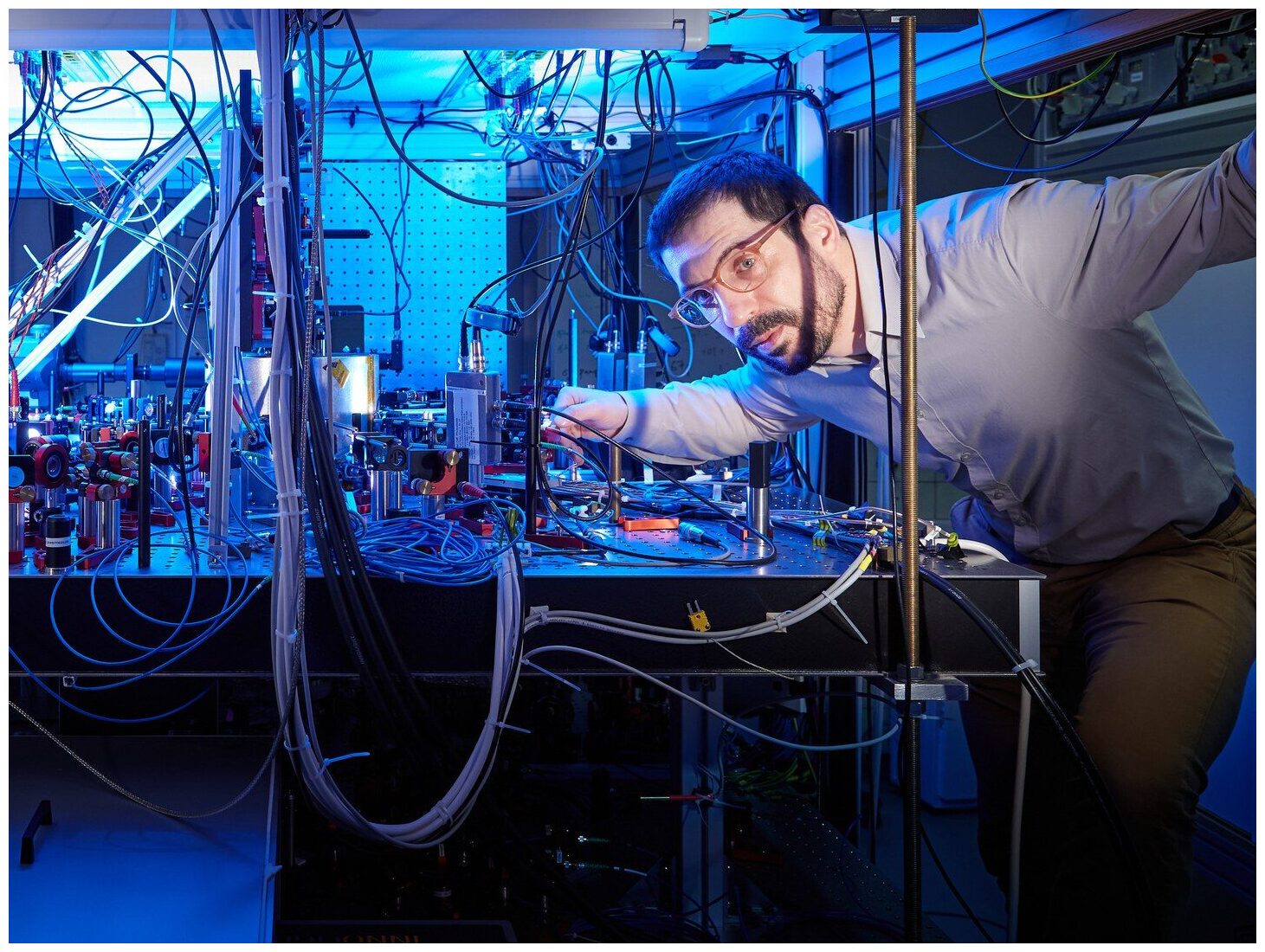
© Volker Lannert / University of BonnStudy leader Dr. Andrea Alberti - from the Institute of Applied Physics at the University of Bonn
The study was funded by the German Research Foundation (DFG).
Publication:
Gautam Ramola, Richard Winkelmann, Karthik Chandrashekara, Wolfgang Alt, Peng Xu, Dieter Meschede and Andrea Alberti: Ramsey imaging of optical traps; Physical Review Applied



Reader Comments
In the micron vacuum scale, we start at 760,000 microns at sea-level atmospheric pressure and work down towards a perfect vacuum of 0 microns or 0″ Hg.
[Link]
if I tell you WHY the entire world measures this value in Hg... (Mercury) do you promise not to call me a white supremacist?
here ya go.
[Link]