
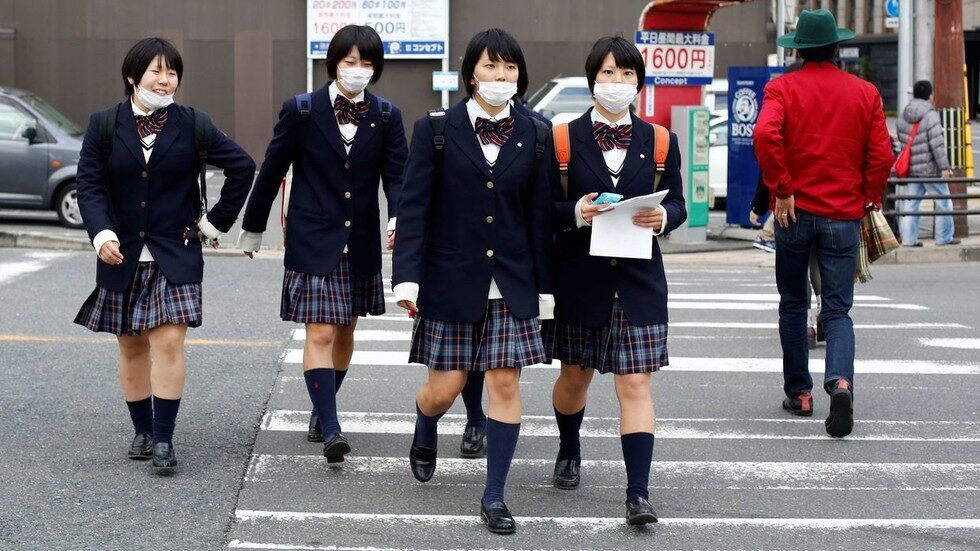
© REUTERS / Thomas PeterSchoolgirls, wearing surgical masks, cross a street in Kyoto.
The findings in part contradict recent recommendations from the U.S. Centers of Disease Control and Prevention (CDC) that two masks were better than one at reducing a person's exposure to the coronavirus.
Researchers used the Fugaku supercomputer to model the flow of virus particles from people wearing different types and combinations of masks, according to a study released on Thursday by research giant Riken and Kobe University.
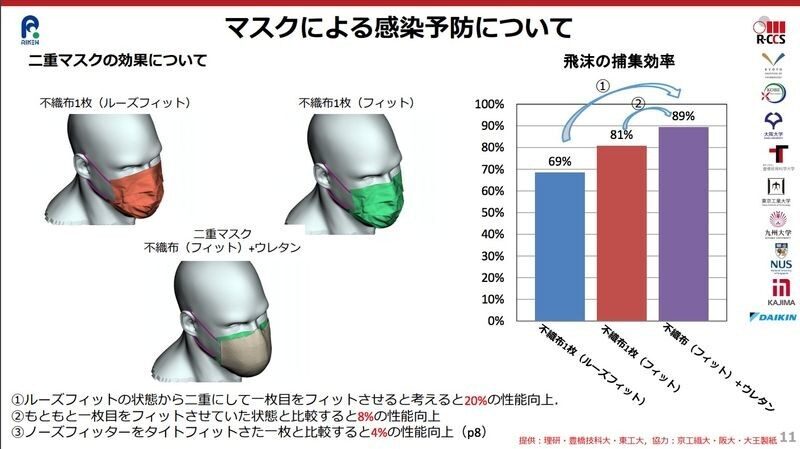
© Riken/Handout via REUTERSRed is a loosely fitted non-woven mask. Green is a fitted non-woven mask. Green and brown are a non-woven mask with a polyurethane one on top. The bar graph illustrates the "droplet collection efficiency". The blue bar shows the results of wearing loose-fit non-woven (surgical) mask. while red shows a fitted non-woven mask, and purple shows a fitted non-woven mask plus polyurethane mask.
Wearing two non-woven masks isn't useful because air resistance builds up and causes leakage around the edges.
"The performance of double masking simply does not add up," wrote the researchers, led by Makoto Tsubokura.
In general, professional grade N95 masks were the best in protecting against infection, followed by non-woven masks, cloth masks, and finally polyurethane types, the study showed.
The Riken research team previously used the Fugaku supercomputer to model how humidity can affect viral contagion and the infection risks in trains, work spaces, and other environments.
As the COVID-19 epidemic has worn on, scientific consensus has grown that the virus is spread through the air and masks are effective in controlling contagion.

















In one sentence, health professionals agree that two and two are four and also they will lose their positions if they contradict the drooling idiot vaxxers' narrative.