
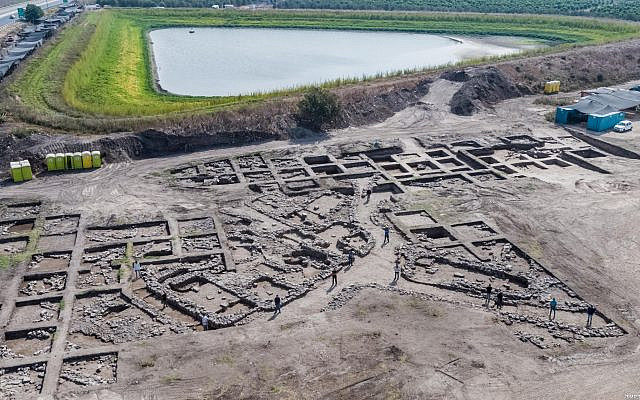
© Assaf Peretz, Israel Antiquities AuthorityAerial photograph of the Early Bronze Age excavation site near modern Harish.
"It is much larger than any known site in the land of Israel — and outside the land of Israel — in the region of Jordan, Lebanon, southern Syria," said excavation co-director Dr. Yitzhak Paz in an IAA video.
In addition, just ahead of the construction of a new interchange over the En Esur (Ein Asawir) archaeological site, IAA archaeologists also discovered an earlier, 7,000-year-old Chalcolithic settlement under several of the 5,000-year-old structures.
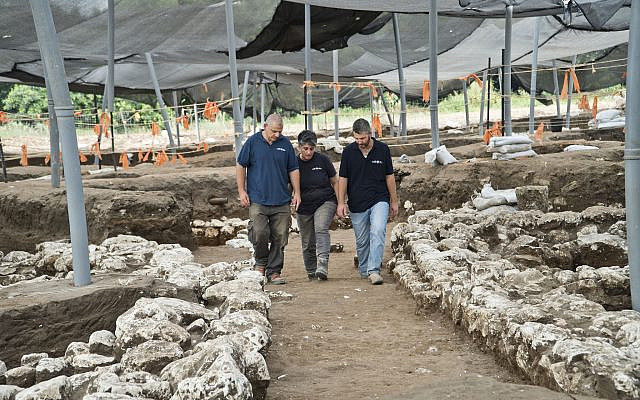
© Yoli Schwartz, Israel Antiquities AuthorityExcavation directors (right to left) Itai Elad, Dr. Dina Shalem, and Dr. Yitzhak Paz, walk in a 5,000-year-old alley at the Early Bronze Age excavation site near modern Harish.
Salvage excavations have been taking place at the site for the past two and a half years, financed by Netivei Israel - the National Transport Infrastructure Company Ltd. Over 5,000 high school students and volunteers from the area have participated in them.
Due to the importance of the site, Netivei Israel has significantly increased the height of the planned interchange and will preserve the excavations through high-tech documentation and physical conservation.
The digs have revealed an Early Bronze Age (end of the 4th millennium BCE) planned city located near Wadi Ara, near two water springs, in the Haifa district of northern Israel. According to Paz, the land is fertile for agriculture and is close to important, central trade routes.
The ancient settlement contained public and private buildings and areas, streets and alleys and was surrounded by a fortification wall.
"The excavation at this site revealed two main settlements," explained Shalem in an IAA video. "The earliest one is about 7,000 years old. It's a very large agricultural settlement. Two thousand years later, another settlement became one of the first cities known in this area of the world."
The layout of the city, said Elad, the third co-director, indicates it was very thoughtfully planned. During the excavation, the team discovered a very large public building that was unlike any of the others. It was, said Elad, most probably a temple or a shrine, inside which was found an area containing burnt animal bones, presumably for sacrifices. In the temple courtyard is large stone basin for liquids, which the archaeologists assume was also used during religious rituals.
"These findings allow us to look beyond the material into the spiritual life of the large community that lived at the site," said the archaeologists.
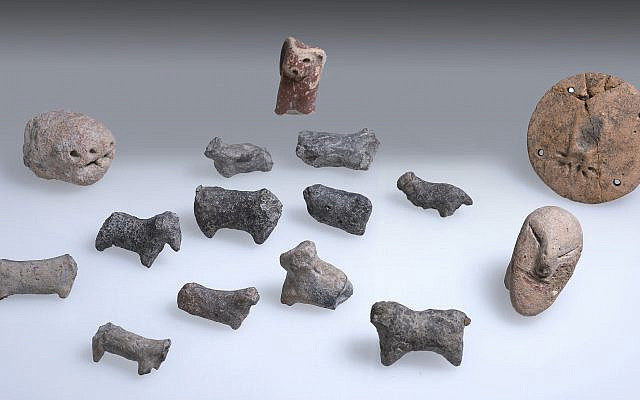
© Clara Amit, Israel Antiquities AuthorityFigurines from the Early Bronze Age excavation site near modern Harish.
© Yoli Schwartz, Israel Antiquities AuthoritySeal impression of a man hands lifted next to an animal from the Early Bronze Age excavation site near modern Harish.
It is during this era, said the statement, that Canaan's populations moved from rural to mostly urban environments.
According to the archaeologists, alongside the more sophisticated construction and city planning, there had to have been complex governance in the site as well.
For the 5,000 Israeli pupils and young adults — Jews and Arabs — who participated in the excavations, their firsthand knowledge and experiences may also change their perspective and their connection to the land of Israel. As history books are rewritten, the students were on the frontlines of early research.
"The study of this site will change forever what we know about the emergence [and] rise of urbanization in the land of Israel and in the whole region," said Paz. "And it means that what we know now will change what is written today in the traditional books when people read about the archaeology of Israel."








Comment: To note: there was no land of Israel before 1948; any claims of Israel's existence in the land of Palestine and elsewhere before then have been well and truly debunked.
See also: