
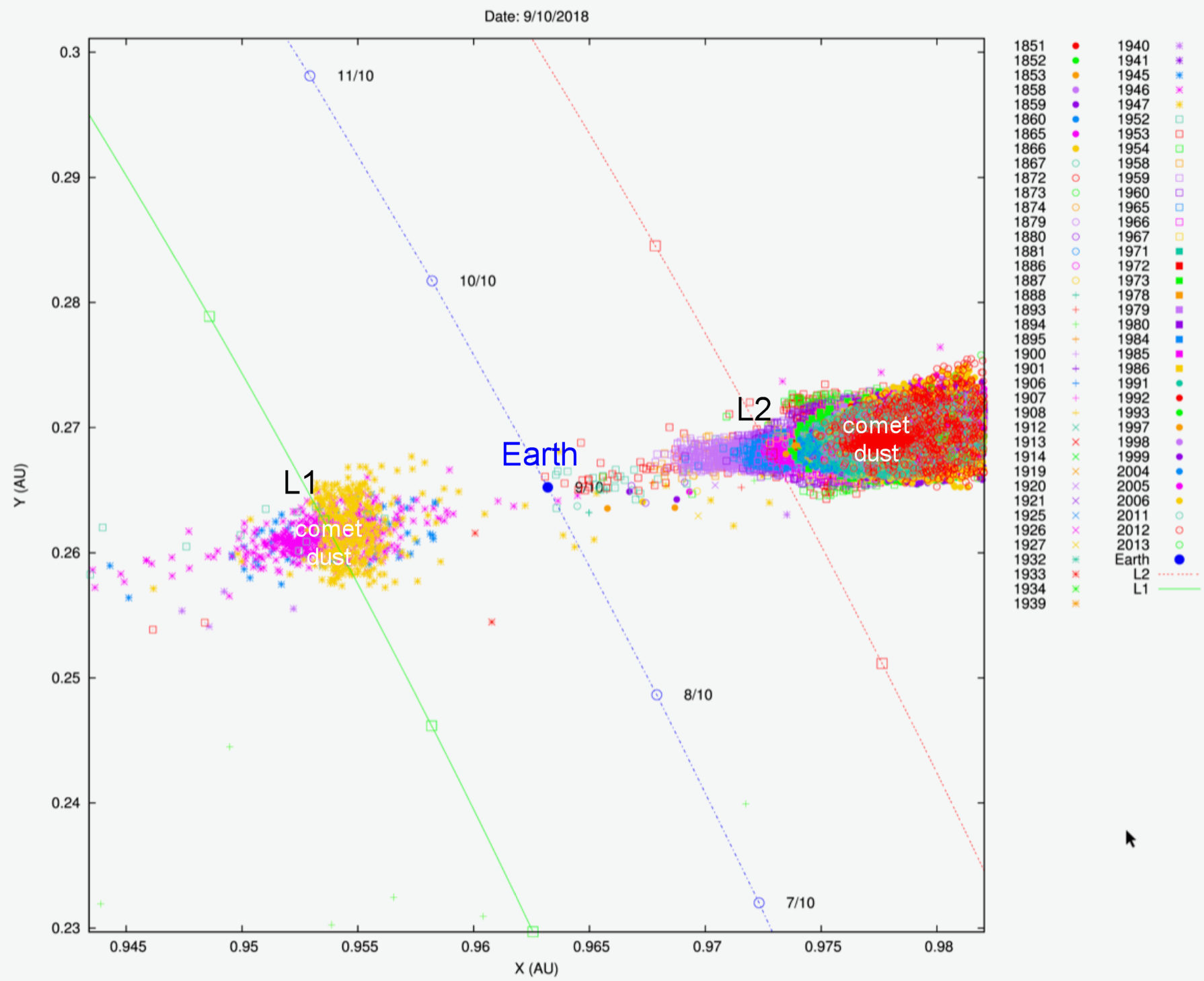
Here it is, showing Earth shooting the gap between two filaments of comet dust
"It was a rare and impressive event," says Atanackov.
It could easily have been 10 times more impressive. In fact, Earth narrowly dodged a meteor storm.
The European outburst occurred as Earth skirted a filament of debris from Comet 21P/Giacobini-Zinner. If that filament had shifted in our direction by a mere 0.005 AU (~500,000 miles), Earth would have experienced a worldwide storm of 1000+ meteors per hour. These conclusions are based on a computer model of the comet's debris field from the University of Western Ontario's Meteor Physics Group.
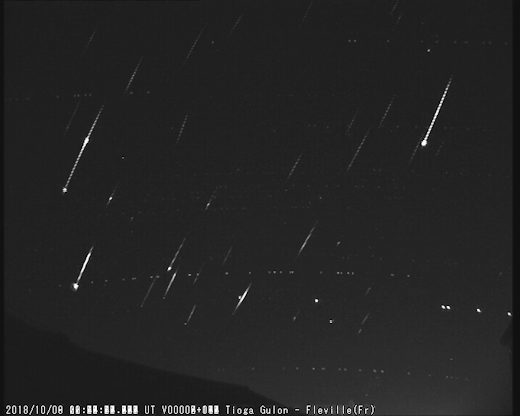
According to the models, Earth's L1 and L2 Lagrange points were both forecast to have storm-level activity--especially L2 which would experience the Earth-equivalent of 4000+ meteors per hour. This prompted NASA to take a close look at the danger to spacecraft.
"The US has four space weather spacecraft at L1: ACE, SOHO, Wind, and DSCOVR," says Bill Cooke of NASA's Meteoroid Environment Office. "There is only one operational spacecraft at L2 - the European Space Agency's GAIA - which was where most of the Draconid activity was expected to take place. GAIA shut down science operations for a few hours around the projected storm peak and re-oriented to turn the hard side of the vehicle towards the incoming debris. All of the spacecraft came through the Draconids without incident, and this shower provided a good test of our ability to forecast meteor activity outside of Earth orbit."
Many readers have wondered if the outburst has anything to do with Comet 21P/Giacobini-Zinner's close approach to Earth last month. "No," says Cooke. "The models show the outburst experienced at Earth was mainly caused by material ejected from the comet from 1945 to the mid 1960's. The meteoroids were more than half a century old."







Comment: We've been relatively lucky up until this point, but there will become a time when the meteor threat will become very real indeed: