
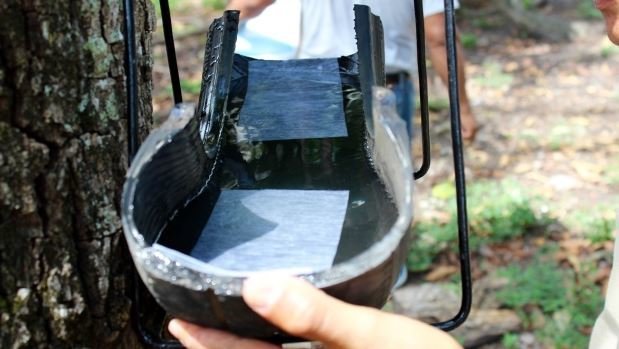
Ovillanta mosquito trap
Researchers developed a highly effective mosquito trap, called an ovillanta, using nothing more than 20-inch cut tire pieces hung in a certain fashion with a pheromone-laden non-toxic solution poured into the bottom, and a piece of floating wood or paper where female mosquitoes are drawn to lay their eggs.
This egg raft is removed twice a week, and the eggs are destroyed. The solution is drained out of a valve on the bottom of the tire piece, filtered and then reused in the tire. The trap is completely environmentally friendly, as no pesticides are sprayed.
The study will prove beneficial to South and Central American communities at higher risk of dengue, chikungunya, and Zika virus transmission.
It also demonstrates how anyone, such as the homesteader, can use old materials and a small amount of mosquito pheromone to control mosquito populations without harming beneficial species.
During the ten month study in a remote community of Guatemala, 18,100 Aedes mosquito eggs were collected and destroyed per month. While the traps were used, researchers trained local health personnel and engaged with the community on mosquito control, such as eliminating other breeding areas with standing water.
There were no new cases of dengue during the study, even though up to three dozen cases would normally be reported.
The tire trap is seven times more effective than standard traps and far less expensive than killing larvae in natural ponds and targeting adult mosquitoes with pesticides, which also harms other wildlife such as bats, dragonflies, and other natural predators.
Instead of bombarding nature with broad-spectrum poisons, the tire trap can be seen as working side-by-side with bats and other valuable species in attacking mosquitoes.
The Aedes mosquito is one of the more difficult to control, as it has become resistant to pesticides and mosquito-friendly environments have increased. But old tires, which are part of the problem, can be made part of the solution.
"We decided to use recycled tires - partly because tires already represent up to 29 percent of the breeding sites chosen by the Aedes aegypti mosquitoes, partly because tires are a universally affordable instrument in low-resource settings, and partly because giving old tires a new use creates an opportunity to clean up the local environment," according to researcher Gerardo Ulibarri of Laurentian University.
Sometimes the best solutions are very simple. Here it tackles more than one problem - waste and mosquito-borne disease - while refraining from adding more environmental destruction to already fragile ecosystems.



Reader Comments
politicians are blood suckers, i wonder if a used tire would work for them too?
You force a tire down, over the politician's head, fill it with gasoline and set it on fire.
It's called "necklacing," and it was used by militant blacks in apartheid South Africa.
No, I'm not suggesting that one should actually do it. At the same time, one cannot be prosecuted for his fantasies.
Creating mosquitoes was a stupid idea.
Mosquitoes spread deadly diseases, a natural form of population control.
I consider it likely that you have the same distorted attitude toward spiders and venomous snakes.
Why create more? It is probable that you mosquitoes would become fertile within generations and cross-breed with another species. This would provide the potential to be even more injurious due to recombination.