Storms
S


Cloud Lightning

Giant hailstones batter Hong Kong as observatory warns of further heavy rain

Image
© SCMP Pictures 'freak' giant hailstones - which are becoming more common. A 'sign of the times'?
Amber Rainstorm warning raised as people warned 'be alert'

Hong Kong was today warned to brace for more bad weather after giant hailstones last night pounded parts of the city and the Black Rainstorm signal was issued for the second time since 2010.

At 8.40am this morning the Amber Rainstorm warning was issued, with more than 30 millimetres of rain falling in just an hour, disrupting rush hour and making journeys to work difficult. The signal was cancelled at 11.40am.

As of 11am, 200 flights had been delayed, 44 cancelled and one diverted, the Airport Authority said.

The Hospital Authority confirmed that there were seven people admitted to accident and emergency departments of public hospitals during the Black Rainstorm signal raised between 8.40pm and 10.30pm on Sunday night. Of the seven casualties, ranging in age from a one-year-old to a 64-year-old, six were in stable condition and one was in serious condition.

A spokesman could only confirm that the patient in serious condition was a 29-year-old male and was currently at Princess Margaret Hospital.


Cloud Lightning

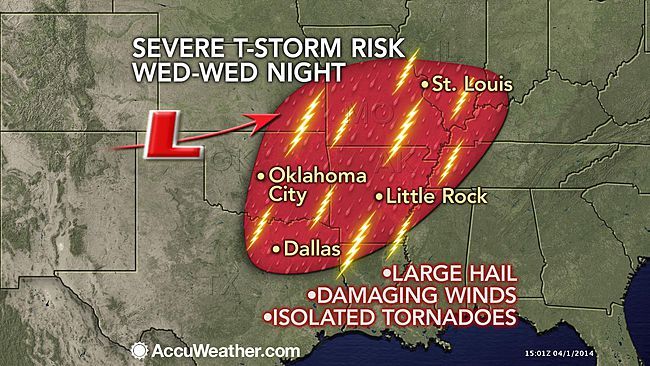
Severe thunderstorms from Dallas to St. Louis - hail, high winds, flash flooding, possible tornadoes

Image
Severe thunderstorms on Wednesday will threaten 18 million people from northern Texas to eastern Kansas, much of Missouri and southern Illinois. The threat on Wednesday includes the potential for a couple of strong tornadoes.

The severe weather on Wednesday is part of a multiple-day severe weather event that will continue through the end of the week and will reach parts of the Midwest, East and South.

Cities in the area of concern for dangerous and disruptive weather conditions Wednesday and Wednesday night include Dallas; Wichita, Kan.; Oklahoma City and Tulsa, Okla.; Little Rock and Fort Smith, Ark.; Kansas City, Springfield, Joplin and St. Louis, Mo.; Shreveport, La.; Memphis, Tenn.; Paducah, Ky.; Evansville, Ind.; and Mt. Vernon, Ill.

Cloud Lightning

Giant hailstorms and heavy rain kill at least 16 people in China

Image
Destruction: This factory workshop was completely destroyed when giant hailstones hit the area of Dongguan in southern China's Guangxi province
Heavy storms and giant hailstones have left at least 16 people dead and caused widespread property damage in southern China.

The poor weather has lasted more than a week, bringing landslides and flooding - particularly in the autonomous Guangxi province, which borders Vietnam.

Local authorities say at least 16 people have been killed, although that figure is likely to rise as the true extent of the devastation cannot be fully assessed until the poor weather subsides.

Yesterday the Civil Affairs Department of Guangxi said at least 70 houses had collapsed, with another 1,716 badly damaged, and more than 2,000 hectares of crops destroyed.

Local weather forecasts said heavy rain and hail is expected to continue to hit parts of Guangxi over the next few days, before subsiding in the latter half of this week.

Landslide and flood warnings are likely to remain in place well into next week.

Image
No protection: A roof in Dongguan is covered in holes after giant hailstones crashed through the ceiling

Cloud Lightning

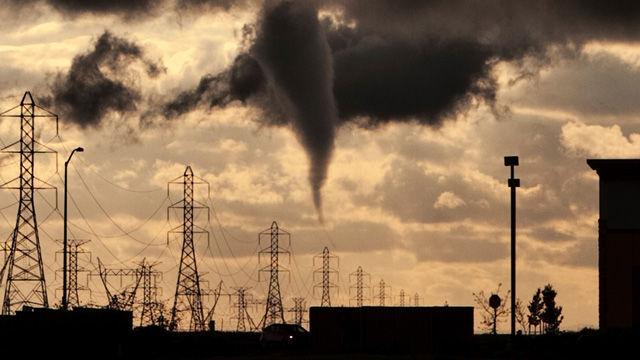
Rare tornado damages dozens of homes in Roseville, California

Image

A rare tornado damaged dozens of homes in Northern California, sending roof tiles and solar panels flying.

Source: CBS News

Windsock

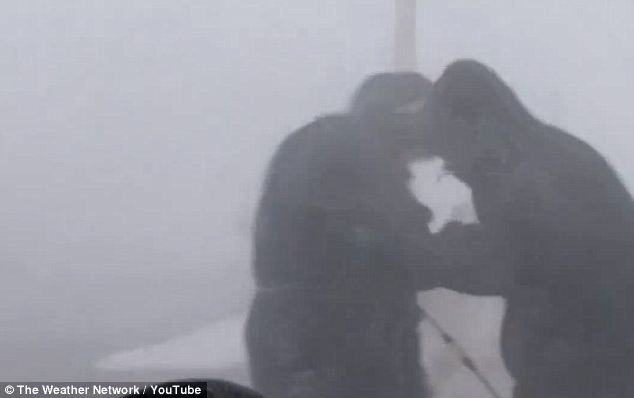
170km/h snowstorm blows two Canadian weathermen off their feet in Nova Scotia, not once but TWICE!

Image
Powerful: The men are being blown off camera by wind gusts that exceeded 100MPH

These two intrepid news reporters certainly earned their money this week.

This incredible video shows the moment severe snow storm conditions actually blew Mark Robinson and Chris Scott out of shot while doing pieces to camera.

Coincidentally the pair were explaining that the winds had got up to 170km/h when they knocked off their feet.

"The only storm I can compare this too is a hurricane," one can be heard saying.

"This has the added bonus of having the snow in the air... like standing in a sand blaster," they say before being literally blown away.

Unsurprisingly the clip has proved popular online with over 85,000 people tuning in less than a day.

Comment: Here's video footage from another location showing these two 'extreme weathermen' being blown over in this snow'icane:


Snowflake Cold

North America's brutal 2014 winter in one minute - watch time-lapse video

As spring arrives - albeit slowly - East Coasters are saying goodbye a to an especially punishing winter.

Those feeling sentimental can relive the endless series of snowstorms and fiendishly cold weather in a new time-lapse video from NASA.

The animation stiches together imagery taken from space by NOAA's GOES-East satellite every day from January 1 to March 24, 2014.


The creator, Dennis Chesters, of the NASA/NOAA GOES Project at the Goddard Space Flight Center in Greenbelt, Md., said in a statement: "The once-per-day imagery creates a stroboscopic slide show of persistent brutal winter weather."

And brutal it was. Cold air escaping the polar vortex repeatedly blasted Canada and the continental United States. Two inches of snow humbled Atlanta in late January, creating epic traffic jams stranding hundreds of people in their cars for hours. Ice storms that followed in February left thousands without power in Georgia and South Carolina. The Great Lakes' ice cover reached historic levels, growing to 91 percent in early March.

Major cities reported astounding tallies of winter snow. Residents of Washington, D.C. saw 30.3 inches (76.9 centimeters) of snow during the 2013-2014 season - nearly double the city's average snowfall of 15.3 inches (38.8 cm), according to the National Weather Service. A whopping 80 inches (203 cm) of snow fell on Chicago, far exceeding the typical 34.4 inches (87.3 cm).

The GOES-East satellite is perched in a geostationary orbit, meaning it hovers over the same part of the globe all the time, moving in tandem with Earth's rotation. The spacecraft captures images of the Northern Hemisphere every half hour and then takes a shot of the entire Western Hemisphere every three hours, according to NOAA.

The images of clouds taken by the GOES satellite are used by the National Weather Service to monitor storms. The 2014 winter weather video also incorporates true-color imagery of the land and sea obtained with NASA's Earth-watching NASA's Aqua and Terra satellites.

Snowflake

Powerful Spring blizzard cuts power to thousands in New England

Image
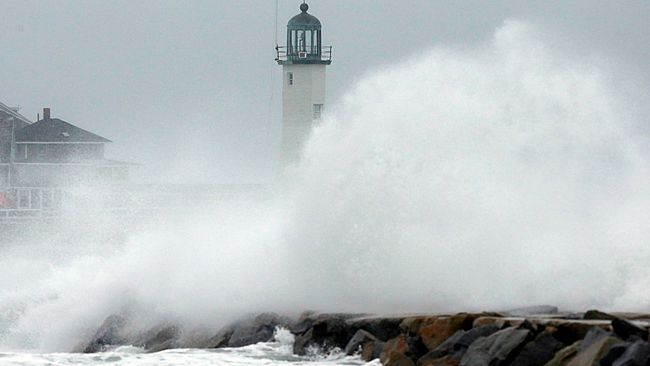
© AP/Michael DwyerWind-driven waves crash on a sea wall in Scituate, Mass., Wednesday, March 26, 2014. Cape Cod and the islands were expected to bear the brunt of the spring storm that struck full force Wednesday.
Mother Nature proceeds to show no mercy, as only a few days after the official start of spring, the East Coast was blasted with yet another major snowstorm.

Spanning from Virginia up through New England and parts of Atlantic Canada, the system brought snow to regions in Maryland and Washington, D.C., before heading up the coast and slamming Cape Cod, Mass., with blizzard conditions.

Grounding flights, causing traffic accidents and knocking out power to nearly 6,000 people throughout Massachusetts, the storm was accompanied by howling winds that gusted up to more than 80 mph in Nantucket.

The severity of the winds also generated dangerous travel conditions, as blowing and drifting snow whipped the island and surrounding areas.

As the storm moves out of the United States and into Atlantic Canada, the Maritimes and western Newfoundland, it will be accompanied by hurricane-force winds, producing treacherous travel conditions.

Comment:
STILL not done - Massive March Nor'easter bigger than Hurricane Sandy expected to bring winds, snow, cold blast to Northeast


Snowflake Cold

STILL not done - Massive March Nor'easter bigger than Hurricane Sandy expected to bring winds, snow, cold blast to Northeast

March came in like a lion, and it looks like the lion isn't leaving, but you can't blame the "polar vortex" this time.

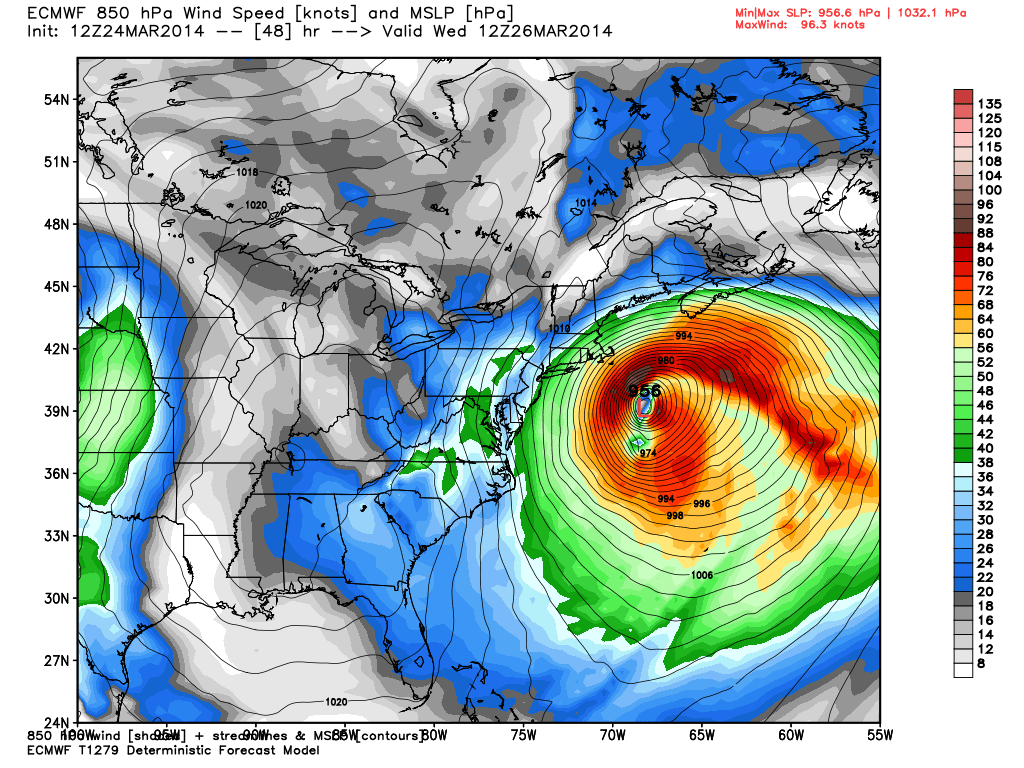
As a massive winter storm at sea known as a Nor'easter prepares to skirts the Northeast coast of the USA, bringing with it high seas and bitterly cold weather in its wake, Dr. Ryan Maue writes:
Massive Nor'easter will develop a warm-core thru a seclusion process.

Compare previous image w/Hurricane Sandy - same 850-mb Wind speed & MSLP. Nor'easter wind field much stronger/larger.

[It is] maybe 4 times more powerful than Sandy based on integrated KE of wind field.
The image of the storm is quite stunning for it's sheer size.
March Nor’easter
© ECMWF

Cow Skull

Aurochs horn discovered at beach after storms in Gwynedd, Wales

Image
Aurochs became extinct when a female animal died in a forest in Poland in 1627
An animal horn thought to be 3,000 years old has been found on a beach in Gwynedd after the recent storms.

Engineer Derfel Hughes from Rhos Isaf made the discovery while walking at Dinas Dinlle, near Caernarfon.

Mr Hughes checked with museum experts who reckon it belonged to giant wild cattle called aurochs which became extinct in the 17th Century.

He gave it to a friend at the Greenwood Forest Park tourist attraction in Y Felinheli where it could go on show.

"Finding it was a total fluke," Mr Hughes told the Daily Post.

"I just happened to be in the right place at the right time

Cloud Lightning

Stunning lightning above mideast seen from space

Image
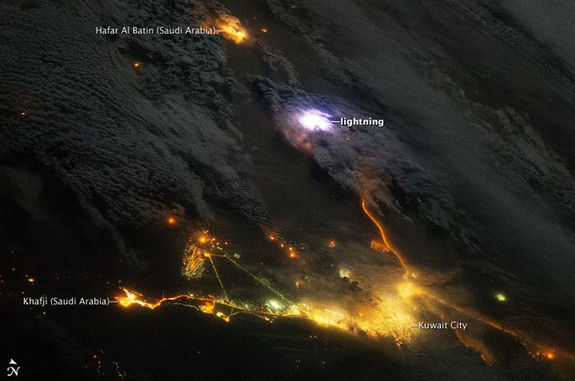
© NASA Earth ObservatoryThis image of lightning over Kuwait was taken by an astronaut aboard the International Space Station on Dec. 12, 2013.
This stunning image of a lightning strike over Kuwait was captured last December by an astronaut aboard the International Space Station (ISS) and released today (March 24) by NASA's Earth Observatory. The ISS recently installed a new instrument to help study the physics and composition of such bolts in detail on a daily basis.

Lightning bolts flash across Earth's atmosphere as often as 50 times per second, which adds up to about 4.3 million times a day and 1.5 billion times a year, NASA officials wrote in an image description. Some of those strikes emit gamma radiation - a type of radiation more commonly associated with exploding stars and nuclear fusion - in bursts known as terrestrial gamma-ray flashes (TGFs). The scientists will use the new lightning imagery and data from the ISS to try to understand what triggers lightning during storms in general, and what causes these rarer bursts of TGFs. [Electric Earth: Stunning Images of Lightning]

"The fact that TGFs exist at all is amazing," Doug Rowland, a space physicist at NASA's Goddard Space Flight Center involved in this new lighting research, said in a statement. "The electron and gamma-ray energies in TGFs are usually the domain of nuclear explosions, solar flares, and supernovas. What a surprise to find them shooting out of the cold upper atmosphere of our own planet."

Comment: Cyclones, Earthquakes, Volcanoes And Other Electrical Phenomena:
These bolts of positive lightning are quite literally "bolts from space". The combination of sprites and positive lightning form a massive dielectric breakdown in the atmosphere, passing electrical energy from the ionosphere to the ground. With this comprehension, the "electrostatic induction hypothesis" is simply absurd.