Sinkholes
S


Arrow Down

Locals troubled by 15 fresh sinkholes in Armala, Nepal

Image
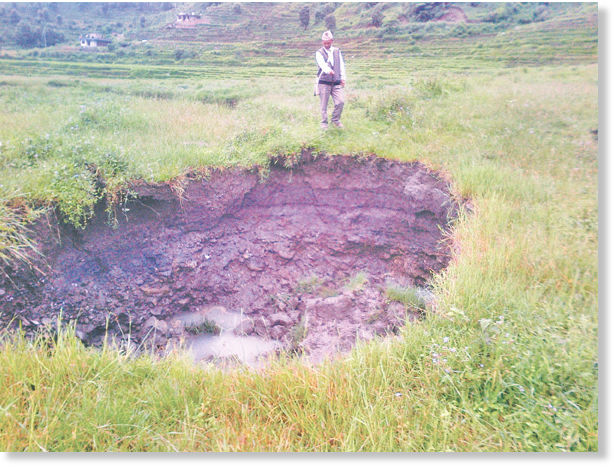
© Post photo Locals say 15 sinkholes appeared at Jumleti settlement of Armala VDC in the last three days.
Sinkholes have once again started to appear at Armala VDC in Kaski district, which has prompted some of the locals to leave their houses.

Fifteen sinkholes have developed at Armala in the last three days. Liladhar Acharya, coordinator of the District Disaster Management Committee, said the recent sinkholes have appeared around Jumleti settlement, many of them near the same areas where they had first emerged in 2013.

"With the onset of monsoon, the situation has become more dangerous," Acharya said.

Several farmers at Armala have also been affected because some of the sinkholes have appeared on their farmland.

"The locals had just started working in their fields for plantation when the holes started appearing," Acharya said.

Arrow Down

Sinkhole opens in area below Manhattan, Kansas dam

Image
© littleapplepost.com
A sinkhole has opened up in an area below the dam at Tuttle Creek Lake in Manhattan.

It happened around 5:00 pm Thursday in a parking lot adjacent to the stilling basin, also known as the tubes.

The U.S. Army Corps of Engineers says the sinkhole developed as a result of sustained high releases from the lake.

They say there is no threat to the safety of the dam.

Releases from the stilling basin continue on the opposite side until the sinkhole can be further investigated.

The area around the stilling basin has been closed to the public until further notice.
Image
© Facebook/Donna Baer

Bizarro Earth

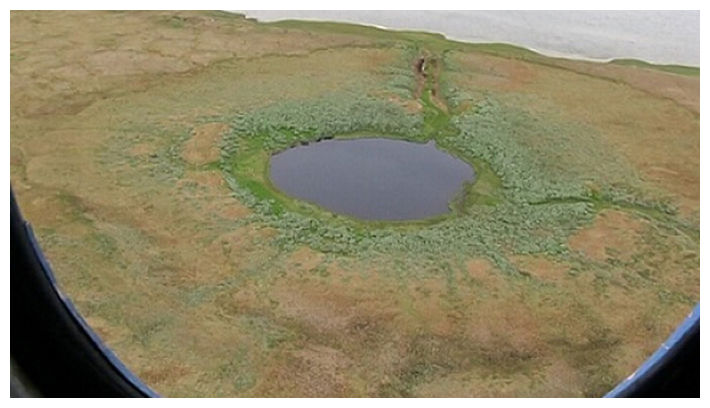
Mysterious giant hole in Siberia gradually filling up with water, expanding

Siberian Sinkhole_1
© RT.com
The mysterious hole-turned-lake in Siberia's Yamal peninsula has expanded to 50 meters in depth, Russian scientists said. Researchers have been puzzled by its origins saying it was likely caused by gas explosions.

The giant sinkhole located not far from Gazprom's Bovanenkovo gas field in Russia's northern Yamal Peninsula has been expanding, scientists said as cited by Yamal region TV. The researchers also discovered additional smaller craters appearing around it, the media said. The whole area is within Russia's key strategic oil and gas region - the Yamalo-Nenets Autonomous Okrug.

The crater, discovered last year, has been gradually filling up with water and turning into a lake. Over the past winter and spring the water level in the crater has risen by 10 meters and it will continue to rise, scientists said, according to the government website of the Yamal-Nenetsky region.

"I am very surprised by the size, it's very big!" Japanese reporter for Asahi Shimbun Terukhiko Nouse, who accompanied the science expedition, told local TV. "And the sound of the glacier melting...this sound amazes me."

Arrow Down

Large sinkhole opens up in Toronto

Image
© Googlefabulous/InstagramToronto police have cordoned off this part of Eglinton Avenue West near Keele Street where a huge sinkhole is creating havoc for commuters.
Toronto police are warning people to avoid a section of Eglinton Avenue West where a large sinkhole has opened up.

Police said the six-metre long sinkhole — large enough to swallow a car — opened up on Eglinton Avenue West, between Keele Street and Richardson Avenue.

Anne Marie Aikins, a spokeswoman for Metrolinx, said construction on the Eglinton Crosstown LRT line was not responsible for the sinkhole.

"As soon as we heard about the issue this morning we sent our team to the site and they determined it's unrelated to our construction and hasn't impacted their work on the Crosstown," Aikins wrote in an email to CBC News.


Arrow Down

Large sinkhole opens up in Detroit

Image
Sinkhole
A sinkhole big enough to swallow a car opened up Monday afternoon at the intersection of Chene and Medbury streets on Detroit's east side.

A crew from the Detroit Water and Sewerage Department is on scene.

A DWSD spokeswoman said an 18-inch water main broke, damaging the sewer and leading to this sinkhole in the pavement.

However, the department dose not see a need to closed the street to traffic.

"We analyzed it. We're able to determine if (we needed to close the street) ... we would put up more barricades or actually make the area a little safer to work on and walk on," said DWSD spokeswoman Curtrise Garner. "We're pretty comfortable with where everything is. We're comfortable with the amount of traffic coming by."


Arrow Down

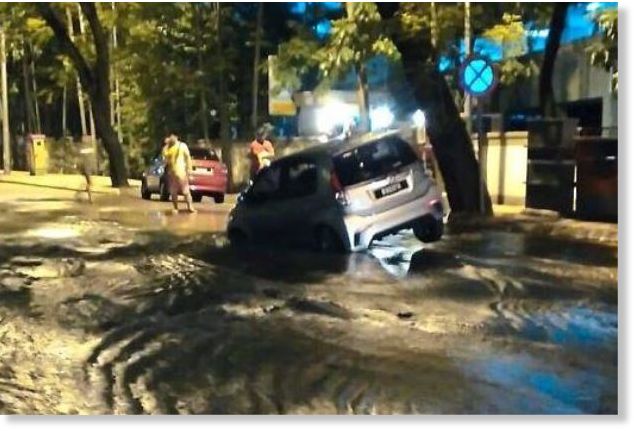
Car falls into sinkhole in Kuala Lumpur, Malaysia

Image
The car fell into the sinkhole which was covered with water.
A motorist drove into a 0.6m deep sinkhole that was filled with water in Jalan Pinang in Kuala Lumpur at 5am yesterday.

Syabas corporate affairs executive director Priscilla Alfred said the car fell into the sinkhole measuring 2m wide and 2m long.

The water, she said, was from an unreported underground pipe that had burst, causing the sinkhole.

"The car was not damaged during the incident. The driver was also reported to be fine and could drive the car out unassisted."

Priscilla said a team was despatched to the scene immediately and water supply was disconnected to facilitate repair works.

Horse

Horse rescued from sinkhole in Washington County, Pennsylvania

Image
Crews in Washington County rescued a horse from a sinkhole on a Scenery Hill farm Friday morning. The retired racehorse, named Chautauqua Worms, was uninjured except for a few cuts, rescuers said.
The Washington County Animal Response Team rescued a horse Friday morning from a 6-foot sinkhole at a Scenery Hill farm.

Responders lifted the 1,000-pound horse, named Chautauqua Worms, from the hole with an A-frame hoist borrowed from the county, said Ed Childers, a firefighter at the North Strabane fire department, which runs the rescue team known as CART.

The response team arrived at the Amos Road property about 6 a.m., pulling the horse from the pit at 9:30 a.m., Childers said.

"All in all, everything went pretty well," Childers said. "No injuries, no damaged equipment."

Neighbors identified the horse as belonging to horse farm owner Lisa Beinhauer. She could not be reached for comment.

Arrow Down

Beach closed after large sinkhole appears in Exmouth, UK

Image
The sinkhole
A 15ft deep hole opened up on a popular Devon beach on Thursday.

A large part of the beach in Exmouth has been closed to the public over fears of further sinkholes appearing in the sane.

One beach-goer reported the discovery to the coastguard near Orcombe Point.

Specialist teams secured the area and on arrival found a hole approximately 15ft wide and the same distance down had appeared and was filled with water.

The surrounding sand was also soft, with fresh holes starting to appear nearby.

East Devon District Council said a 100m squared cordon has now been put in place after concern was raised that the hole may be indicative of a much larger chamber underneath.

Comet

Solar system-wide 'climate change': Rosetta spacecraft sees sinkholes on comet

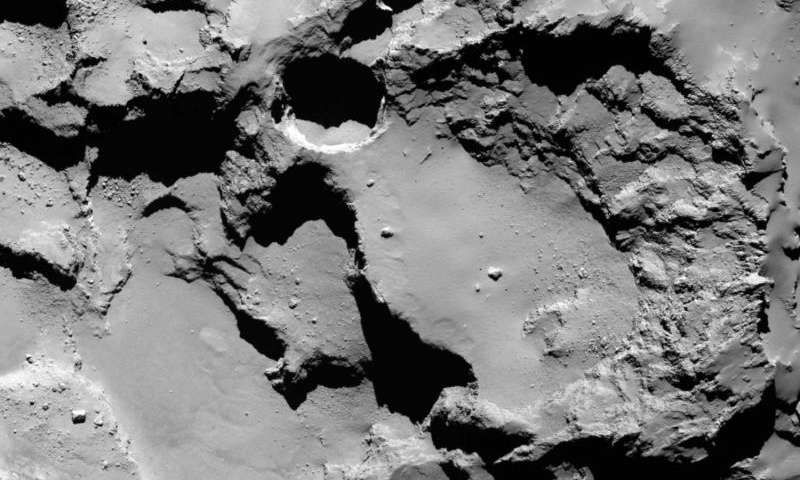
sinkholes on comet
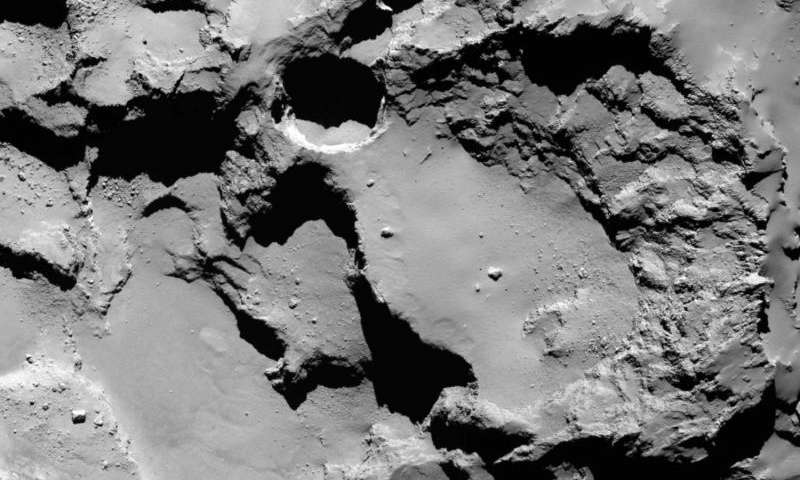
© Vincent et al., Nature Publishing GroupThis close-up image shows the most active pit, known as Seth_01, observed on the surface of comet 67P/Churyumov-Gerasimenko by the Rosetta spacecraft. A new study suggests that this pit and others like it could be sinkholes, formed by a surface collapse process similar to the way these features form on Earth.
The European Space Agency's Rosetta spacecraft first began orbiting comet 67P/Churyumov-Gerasimenko in August 2014. Almost immediately, scientists began to wonder about several surprisingly deep, almost perfectly circular pits on the comet's surface. Now, a new study based on close-up imagery taken by Rosetta suggests that these pits are sinkholes, formed when ices beneath the comet's surface sublimate, or turn directly to gas.

The study, which appears in the July 2, 2015 issue of the journal Nature, reveals that the surface of 67P/Churyumov-Gerasimenko is variable and dynamic, undergoing rapid structural changes as it approaches the sun. Far from simple balls of ice and dust, comets have their own life cycles. The latest findings are among the first to show, in detail, how comets change over time.

"These strange, circular pits are just as deep as they are wide. Rosetta can peer right into them," said Dennis Bodewits, an assistant research scientist in astronomy at the University of Maryland who is a co-author on the study. The pits are large, ranging from tens of meters in diameter up to several hundred meters across.

"We propose that they are sinkholes, formed by a surface collapse process very similar to the way sinkholes form here on Earth," Bodewits added. Sinkholes occur on Earth when subsurface erosion removes a large amount of material beneath the surface, creating a cavern. Eventually the ceiling of the cavern will collapse under its own weight, leaving a sinkhole behind. "So we already have a library of information to help us understand how this process works, which allows us to use these pits to study what lies under the comet's surface," Bodewits said.

Comment: The Rosetta mission scientists have already admitted, based on new information, that what they "have discovered is already starting to transform our understanding of Rosetta's target comet, 67P/Churyumov-Gerasimenko (C-G for short), and cometary science."

Wheres the ice 3 surprising comet facts we've already learned from Rosetta

Perhaps if they considered the electrical nature of comets, as Wallace Thornhill states in this video, these sinkholes and other phenomena, such as the "increasingly stormy" conditions on Uranus, increased volcanic activity on Jupiters moon Io, scientists have been puzzled by the wobble of Saturn's moon Mimas and a major increase in asteroid activity has seen MIT astronomers upgrade the solar system from stable to dynamic would seem to indicate solar system-wide 'climate change'.

For more information read: Earth Changes and the Human Cosmic Connection


Arrow Down

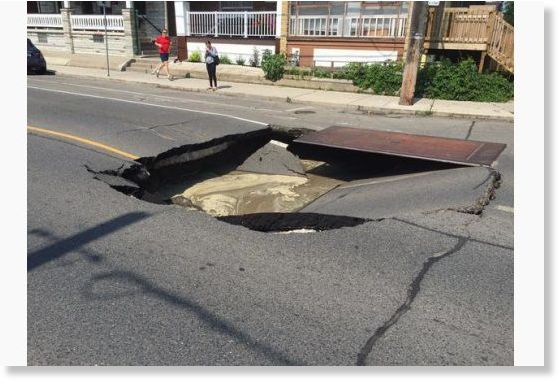
Huge sinkhole closes Runnymede Road in Toronto

Image
© Jos YuleA giant sinkhole opened up on Monday afternoon in the Junction, closing Runnymede Rd.
Toronto Police have closed Runnymede Rd. in the west end from St. John's Rd. to Annette St. indefinitely due to a giant sinkhole.

TTC has rerouted the 71 Runnymede and 79 Scarlett Rd both ways via Annette St., Jane St. and Dundas St.

Sinkholes are caused when leaking pipes or water mains wash away soil or rock deep beneath the road's surface - not to be confused with potholes, which are caused by surface damage.

In Toronto, most sinkholes are caused by man-made failures, like leaky pipes.

In 2006, a 10-metre-wide sinkhole on Sheppard Ave. W. cost the city close to $1 million to repair. It's estimated that Toronto experiences about 20 to 50 sinkholes a year.