Animals
S


Question

Costa Rica Investigates Mysterious Death of Sea Turtles

Image
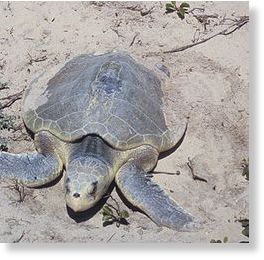
© UnknownLepidochelys kempii
Scientists in Costa Rica are studying the death of at least 10 and 12 more ailing turtles in the southern zone. Universidad Nacional (UN) told the press that the environmental organization MarVia found the 22 turtles floating near Matapalo beach.

Ten of the Kemp's Ridley turtles died within days of bringing them to shore and biologists and veterinarians have no idea of what caused their deaths.

According to Widecast Network, this occurs when creatures have been floating adrift in the water for a prolonged period.

Widecast diretor, Claudio Quesada, told the La Nación that the turtles could have been at sea for more than two months, as they showed dehydration and lack of feeding for weeks.

Bad Guys

Wik-Bee Leaks: EPA Document Shows It Knowingly Allowed Pesticide That Kills Honey Bees

Bee Die Off
© Fastcompany

The world honey bee population has plunged in recent years, worrying beekeepers and farmers who know how critical bee pollination is for many crops. A number of theories have popped up as to why the North American honey bee population has declined--electromagnetic radiation, malnutrition, and climate change have all been pinpointed. Now a leaked EPA document reveals that the agency allowed the widespread use of a bee-toxic pesticide, despite warnings from EPA scientists.

The document, which was leaked to a Colorado beekeeper, shows that the EPA has ignored warnings about the use of clothianidin, a pesticide produced by Bayer that mainly is used to pre-treat corn seeds. The pesticide scooped up $262 million in sales in 2009 by farmers, who also use the substance on canola, soy, sugar beets, sunflowers, and wheat, according to Grist.

The leaked document (PDF) was put out in response to Bayer's request to approve use of the pesticide on cotton and mustard. The document invalidates a prior Bayer study that justified the registration of clothianidin on the basis of its safety to honeybees:

Bizarro Earth

US: Unusually Cold Weather Killing Florida's Manatees

Unusually cold weather last winter killed Florida's endangered manatees at a record rate, a report said on Friday.

During 2010, a record 699 manatees have died in Florida, according to the Florida Fish and Wildlife Conservation Commission's Research Institute.

Of those, 244 were attributed to cold weather and many of the 271 undetermined deaths were also likely caused by weather. In most years, the leading cause of manatee deaths is from collisions with power boats.

The latest surveys estimate there are only about 5,000 of the chubby marine mammals left in Florida waters.

"We are very concerned about the unusually high number of manatee deaths this year," Gil McRae, the director of the institute, said in a statement. "The cold-related deaths this past winter emphasize the importance of warm weather habitat to the Florida manatee."

The previous record of 429 manatee deaths was set in 2009 but only 56 of those were caused by cold weather.

Binoculars

Africa's "Terrible Hairy Fly" Found in Kenya

Image
© Reuters/International Center of Insect Physiology and EcologyMormotomyia hirsuta. Scientists in Kenya have located one of the world's rarest and oddest-looking flies after a long hunt for an insect dubbed the "terrible hairy fly," experts said on Wednesday.
Scientists in Kenya have located one of the world's rarest and oddest-looking flies after a long hunt for an insect dubbed the "terrible hairy fly," experts said on Wednesday.

Scientists first stumbled across the yellow-haired fly in 1933 and then again in 1948. Since then, at least half a dozen expeditions have visited a site between the towns of Thika and Garissa to find it again.

At about one centimeter long and so far found on a single 20-meter high rock, the Mormotomyia hirsuta looks more like a spider with its hairy legs, scientists said.

Unable to fly and partial to breeding in bat feces, the fly is thought to live only in the dank, bat-filled cleft of an isolated rock in the Ukazi Hills. It also has non-functional wings that resemble miniature belt-straps, and tiny eyes.

Dr Robert Copeland of the Nairobi-based International Center of Insect Physiology and Ecology said the fly's physical appearance had left scientists bamboozled about where exactly it belonged in the entire order of Diptera, or "true flies."

Camcorder

Maine diver videos underwater encounter with shark


A scuba diver who came face-to-teeth with a shark used a camera to fend off the animal when it came at him with its teeth bared - and he has the frightening video to prove it.

Scott MacNichol, 30, was shaken up but uninjured after a porbeagle shark apparently mistook his camera equipment for food Saturday while diving near Eastport, off the eastern tip of Maine. He estimated the shark was 8 feet long (2.4 meters) and weighed about 300 pounds (136 kilograms).

MacNichol saw the shark swimming above him while he was filming the ocean floor under empty salmon pens as part of an environmental assessment for Cooke Aquaculture Inc. The animal then came at him, jabbing at the camera with its snout. In the video, its sharp teeth fill the frame before it swims off.

"He took a couple of bites at the camera. When he did that I was pretty much petrified," MacNichol said Wednesday. "If you watch the video, you can hear me screaming underwater."

Butterfly

Majestic Monarch Butterflies Face Population Crisis

Monarch Butterflies_1
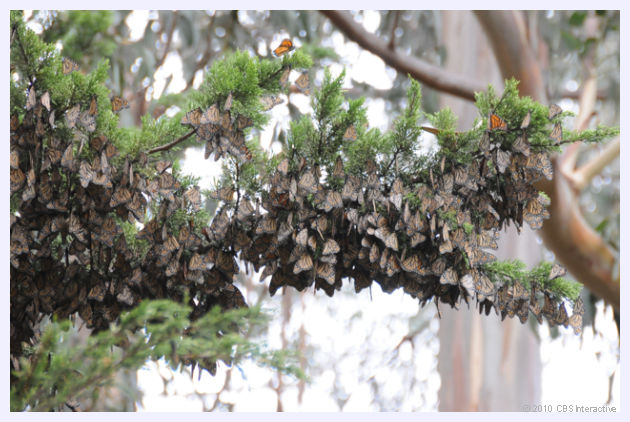
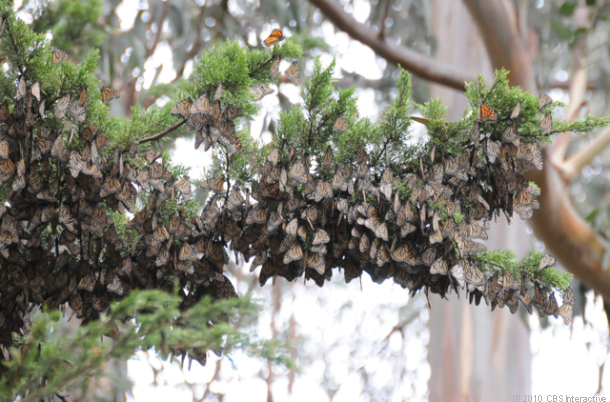
© Daniel Terdiman/CNETClusters of monarch butterflies in coastal California locations like Santa Cruz may become rarer and rarer as loss of habitat and essential plants threaten the majestic species.

Santa Cruz, California.--When I lived in this beach town on the central California coast in the early 1990s, I loved visiting a stunning local state park where each winter you could find more than 120,000 monarch butterflies swarming, clustering, and flying everywhere you looked.

It was an awesome sight.

Today, a visit to the monarch grove at Natural Bridges State Beach reveals a much grimmer situation--just 2,000 monarchs during the peak of their "overwintering" season, the period from late October through early March when the colorful butterflies rest in the trees here, protected from the cold, rain, and wind, waiting for mating season in the early spring.

And the same bleak picture is being painted in nearby Pacific Grove, California., a tiny town adjacent to Monterey that is known as "Butterfly Town, USA," Where once many tens of thousands of monarchs would spend each winter, there are now less than 5,000. And that's up a tick from last year.

"The big picture is that the monarch populations have precipitously dropped since the 1970s, '80s, and '90s," said Mia Monroe, a monarch expert with the international insect conservation group, The Xerces Society. "And needless to say, we're all worried and concerned and are asking why."

What's happened during the last 15 or so years then is nothing short of a crisis for these beautiful creatures. The rapid depletion of the annual coastal monarch population is a direct reflection, experts say, of the impact of humans on nature. Monarchs must lay their eggs on the milkweed plant, which is gradually disappearing in crucial parts of California as housing subdivisions replace the orchards, meadows, and vacant lots where the plant once proliferated, and as more efficient farming methods have allowed people to grow crops at the margins of their properties, places where milkweed used to thrive.

Bizarro Earth

California, US: Sea Lion Found At School, Miles From Water

Brentwood - A wayward sea lion was rescued near Brentwood Saturday after wandering a couple of miles away from any source of water.

Officials don't know how the 170-pound female sea lion ended up at an elementary school in the town of Knightsen, but it was first spotted on Delta road.

The Contra Costa Sheriff's Department corralled her in at the school until volunteers with the Marine Mammal Center arrived.

Also on scene were curious residents who ventured out to get a good look at the sea lion

"It's cool! We're the Knightsen sea lions now!," said some children watching the spectacle.

The marine mammal center says the sea lion is named Na'au and has actually rescued her once before.

Jim Oswald, a spokesman for the center says the 5-year-old female sea lion was about two miles away from the closest source of water when it was rescued.

Oswald says the sea lion was previously rescued in May, then again in June, in Santa Cruz County.

Cloud Lightning

Australia: Wheat crops devastated by rain

wheat
© ABC News: Jo PrendergastGrain Growers Association chairman John Eastburn says damaged crop will only be good for stock feed.

The Grain Growers Association (GGA) says the recent wet weather has devastated wheat crops across Queensland, New South Wales and Victoria.

A report by the Commonwealth Bank reveals the national harvest is expected to be pared back from 25 million to 22 million tonnes.

It says the "disruptions to the harvest this year and the implications for quality are the worst for a lifetime".

The loss of crops is also expected to have implications for some of Australia's staple foods.

GGA chairman John Eastburn says it has been a tough time for farmers.

"The crop here is well and truly shot and sprung and [there is] very little quality left in it," he said.

"I'll probably harvest a little bit for stock feed, but that's about it."

Mr Eastburn says the loss of the crops will hit hard.

Frog

Albino kookaburras found in northern Australia

albino kookaburras
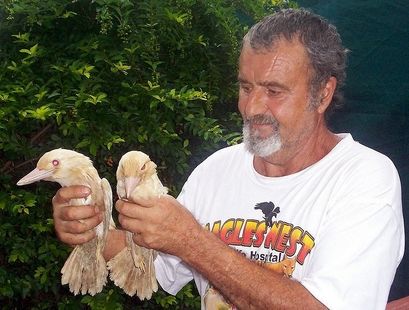
© AFP/ENWH-HO/Leslie BrownAn undated handout photo released by the Eagles Nest Wildlife Hospital shows wildlife expert Harry Kunz holding two extremely rare blue-winged albino kookaburras in Ravenshoe, believed to have been swept from their nests in a wild storm, at the wildlife sanctuary.
Australian wildlife workers on Monday said they had discovered a never-before-seen pair of blue-winged albino kookaburras, believed to have been swept from their nests in a wild storm.

The six-week-old birds, renowned for their laughing cry, were found waterlogged at the base of a tree by a cattle farmer near Ravenshoe, in far northern Queensland, said Harry Kunz from the Eagles Nest Wildlife Sanctuary.

The pink-eyed, pink-beaked and starkly white creatures, thought to be sisters, are the first specimens of their kind ever found in Australia, Kunz said. They are still too young to feed themselves or fly.

"Everybody asks me 'are they rare?' They have never been seen because in nature they would not survive a few days out of the nest because their white colour sticks out and every reptile, owl or predator will get them," Kunz told AFP.

"In the whole of Australia I know there is about three white laughing kookaburras but they are not albino, they have black eyes. For blue wings nobody knows that they exist or can be hatching in this colour."

Heart - Black

Protected seals clubbed to death at sanctuary

Image
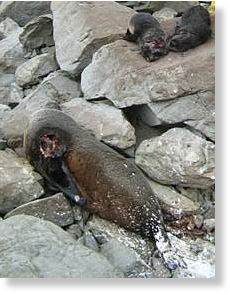
© AP PhotoThree of the seals clubbed to death in New Zealand.
Wellington, New Zealand - Attackers wielding bats or clubs slaughtered two dozen fur seals, including newborn pups, over several days at one of New Zealand's most popular sanctuaries for watching the animals, officials said Monday.

Government officials condemned the attacks on the protected species as brutal and senseless and vowed to fully prosecute anyone involved.

The Department of Conservation said the bludgeoned bodies of 23 fur seals had been found at the Ohau Point colony, a rocky stretch of coastline near a highway that is a breeding ground for the animals.

Officials said eight pups - some just days old - were among those killed, and there were likely more juveniles that had died or would soon because their mothers were among those slaughtered.

The condition of the carcasses and the wounds indicated the attackers had returned several times to the scene, possibly for as long as two weeks. The site is at the bottom of a steep, 100-foot cliff with no easy access, and the bodies were only just discovered.