Animals
S


Blackbox

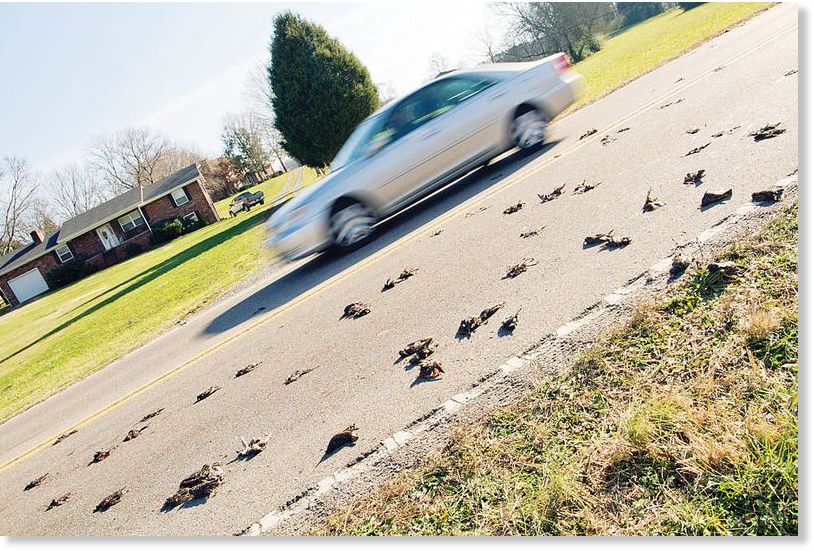
Double deja vu on December 31st? Up to 300 starlings litter roadway and fields in Seymour, Tennessee

Image
Residents and those passing by near Dogwood Hills subdivision on Boyd Creek Highway Sunday afternoon were met with an unusual scene. Dozens of dead birds littered the highway and surrounding fields after falling from the sky.Sgt. Robert Stoffle of the Sevier County Sheriff's Department said a call about the birds came in around 1:15 p.m. He said a witness reported seeing the birds in flight before turning back around to see them on the ground.

"It covered one lane of traffic," Stoffle said of the bodies of the birds. Estimates of the number of birds varied from between 30 and 60 up to 300. They appeared to be starlings.

While the vast majority of the birds were dead by the time The Mountain Press photographer arrived, several were still alive, convulsing and flopping their wings on the ground.

A count of the birds on the scene stopped at around 50, when not even half of the visible birds were tallied. Perhaps dozens more were scattered in a nearby field, which was flooded from the recent rainfall. As far as 60 yards from the main site of the birds, individual starlings were found.

Comment: Radar Dopppler images confirm overhead 'turbulence' cause of 2011 mass bird death case in Beebe, Arkansas
Meteoric Deja-vu: Exactly one year later, dead blackbirds fall again in Beebe, Arkansas
A Sign for the New Year: 1,000 Birds Fall From the Sky in Beebe, Arkansas
Situation Update More than 5000 birds fall dead from Sky in Arkansas 12-31-2010 New Years Eve


X

Mysterious coral disease strikes Hawaiian island

Image
© USGSUSGS scientist Thierry Work takes a sample from diseased coral at Tunnels Reef on the north shore of Kauai, Hawaii.
An unusual epidemic of coral disease has been killing a large number of corals on the north shore of the Hawaiian island, Kunai, according to researchers at the University of Hawaii Institute of Marine Biology.

Examination of the diseased areas, called lesions, suggests a mysterious cyanobacterial infection. Known for causing blooms in freshwater lakes, some species of Cyanobacteria, a type of blue-green algae, produce toxins that can sicken aquatic life, animals and even humans. However, the researchers said the current outbreak appear limited to corals.

The coral disease outbreak is said to be the first such cynobacterial infection documented in Hawaii on such a large scale. The university researchers are collaborating with USGS scientists to identify the cause of infection and what is promoting the outbreak.

Arrow Down

Minnesota's moose population is in mysterious decline

Image
© Times Leader
Fly over northeastern Minnesota with "Sky Dan" and you'd see a moose. One time, he spotted 15 of them during an hour flight. The pilot was so confident, he even offered those on his aerial tours a money-back guarantee.

"If you didn't see a moose, you didn't pay," Dan Anderson, 49, said.

No longer. Anderson stopped providing refunds to customers in 2008. He was handing back too much money.

The state's iconic moose population has been mysteriously declining for years, a drop-off that pushed the Minnesota Department of Natural Resources this month to propose labeling moose a species of "special concern."

"It's a classification that means we need to pay attention to this species," said Richard J. Baker, endangered species coordinator for the department.

Bizarro Earth

Hypothermic sea turtles continue to wash up in record numbers on Cape Cod

Image
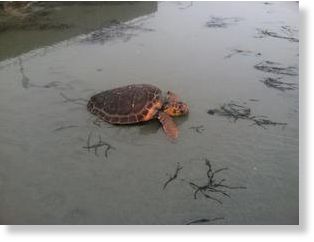
This distressed loggerhead sea turtle was found on Nantasket Beach in Hull. Another turtle was found earlier in the week in Humarock.
Hypothermic sea turtles continue to wash up in record numbers on Cape Cod but in an unusual twist, two large loggerhead sea turtles have stranded on South Shore beaches since Monday. On Tuesday, Hull animal control officer Casey Fredette retrieved a live loggerhead from Nantasket Beach while on Monday another 40-pounder was rescued in the Humarock section of Scituate.

Cold-stunned sea turtles strand annually on Cape Cod but almost always on the southern and eastern beaches of Cape Cod Bay from Sandwich to Truro. Typically, the northwest and northeast winds of late autumn create enough wave activity to drive the floating, nearly immobile marine reptiles ashore on those windward towns. Strandings on the South Shore are very rare events, and normally are confined to the discovery of long dead, smaller turtles early in the winter.

Blackbox

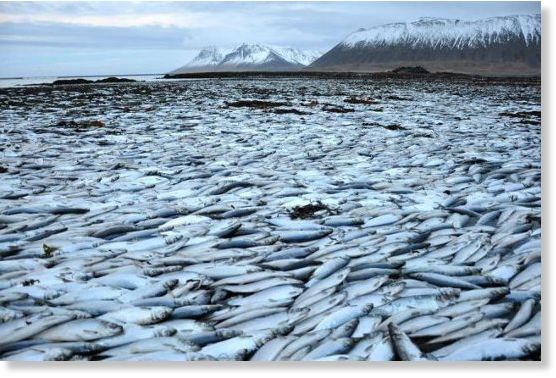
Cause of death of thousands of herring in West Iceland a mystery

The Icelandic Marine Research Institute has ruled out that the herring that swam ashore in large numbers and died in Kolgrafafjörður fjord in West Iceland last week were killed by infection, from which the fish stock has suffered for some time. The infection has reportedly not progressed. Captain Runólfur Guðmundsson from Grundarfjörður has put forth the theory that a cold current below the surface of the fjord is to blame, reasoning that it may have been so cold that ice crystals formed inside the fish and killed them, Fréttablaðið reports.
Image
© Ljósmynd/Róbert Arnar Stefánsson
Þorsteinn Sigurðsson, manager of the Marine Research Institute's exploitable marine stock division did not dismiss Runólfur's theory but stated that the ocean temperature had been around zero, which the herring are supposed to be able to handle.

Bjarni Sigurbjörnsson, a resident at the farm Eiði by Kolgrafafjörður, said whales and birds have taken advantage of the incident and been feasting on the buffet of nature.

Bizarro Earth

'Hypothermic' sea turtles rescued from South Shore Beaches - Massachusetts, US

Image
© Chris GobeilleRescued sea turtle
Dozens of sea turtles, all of them near death, rely on 'round-the-clock care from a team of experts. The animals will call a re-purposed building on the grounds of the Fore River Shipyard in Quincy home until they're ready to go back to the sea. It's an expensive journey, but one advocates say is vital if the species are to survive.

"There's 85 endangered and threatened species swimming around us right now," explains Connie Merigo, the Director of the New England Aquarium's rescue program. "We do think it's going to be a bad season."

Already this year, close to 200 sea turtles have stranded along the Cape. They include loggerheads and Kemp's Ridley turtles. It is the "highest number of sea turtle strandings we've ever experienced in the history of the aquarium" says Merigo. No one knows for sure why the animals get stranded, but all of them are hypothermic when they are found. In some cases, their body temperatures fall into the 40s, and their heart-rate drops to one or two beats per minute. Even so, with proper care, most can be rehabilitated.

Bizarro Earth

Thousands of sea turtles die - India Bay of Bengal


Comment: What is going on below us?
Thousands of bluebottle jellyfish washed up on the sands of Oreti Beach near Invercargill
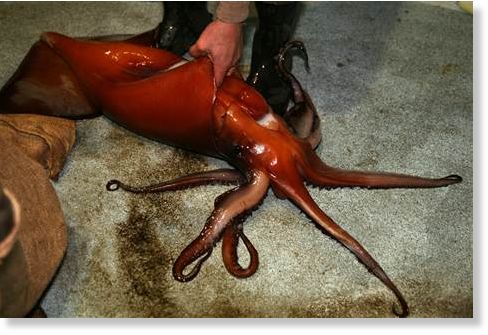
Hundreds of dead Humboldt squid washed up on beaches Sunday along Rio Del Mar in Santa Cruz County, California


Magnify

Mystery of mass squid deaths possibly solved

For decades, beach lovers have reported bizarre mass strandings of squids.
Humboldt Squid
© mikeledray / Shutterstock.com Humboldt Squid
Thousands of jumbo squid have beached themselves on central California shores this week, committing mass "suicide." But despite decades of study into the phenomenon in which the squid essentially fling themselves onto shore, the cause of these mass beachings have been a mystery.

But a few intriguing clues suggest poisonous algae that form so-called red tides may be intoxicating the Humboldt squid and causing the disoriented animals to swim ashore in Monterey Bay, said William Gilly, a marine biologist at Stanford University's Hopkins Marine Station in Pacific Grove, Calif.

Each of the strandings has corresponded to a red tide, in which algae bloom and release an extremely potent brain toxin, Gilly said. This fall, the red tides have occurred every three weeks, around the same time as the squid beachings, he said. (The squid have been stranding in large numbers for years, with no known cause.)

"It's not exactly a smoking gun, but it's pretty circumstantial evidence that there is some link," Gilly told LiveScience.

Bizarro Earth

Thousands of bluebottle jellyfish washed up on the sands of Oreti Beach near Invercargill

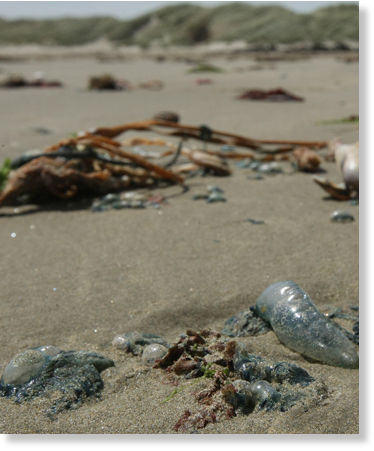
Visitors to Oreti Beach near Invercargill in recent days will have noticed the bodies of thousands of bluebottle jellyfish washed up on the sand. Department of Conservation biodiversity programme manager Jessyca Bernard - who said she was "99.9 per cent certain" they were bluebottle jellyfish - warned they were dangerous even when dead.

People who saw them on the beach should not touch them and should keep their pets away from them, she said. "They may remain potent for hours or even days after the death of the creature or the detachment of the tentacles." If stung an allergic reaction could follow and those affected should seek medical assistance, she said.
Image
© John Hawkins / Fairfax NZJellyfish or" bluebottles" litter Oreti Beach, in Invercargill.

Comment: Just a few days ago, we had this on the California seashore:
Hundreds of dead Humboldt squid washed up on beaches Sunday along Rio Del Mar in Santa Cruz County, California


Blackbox

Hundreds of dead Humboldt squid washed up on beaches Sunday along Rio Del Mar in Santa Cruz County, California

Someone ready a deep-fryer and aioli. Hundreds of dead Humboldt squid washed up on beaches Sunday along Rio Del Mar in Santa Cruz County, according to the Santa Cruz Patch. There is no immediate explanation for why so many of the large invertebrates would die suddenly and in this location. Humboldt squid have not been native to the Monterey Bay area for very long. The squid have been seen further north - which can be confusing for some, since the squid are named for Humboldt Bay, where they can also be found - since the 1997 El Nino event, according to the Patch, and apparently like the Monterey Bay area for its plentiful food.

The squid grow to as big as four feet long thanks in part to the bounty of fish in the Monterey Bay - itself a notable area for the deep Monterey Canyon just offshore. Squid have washed up on California beaches before. In 2009, dead squid were found in the sand after an earthquake.