Animals
S


Info

Number of dead dolphins washed up this year in Virginia hits 100

Image
© Dorothy Edwards | The Virginian-Pilot
From right, Virginia Aquarium Stranding Response Team members Krystle Rodrique of Virginia Beach, Va. and intern Liz Schell of Durango, Co. carry a deceased male dolphin on a metal stretcher from Ocean View Beach in Norfolk, Va. on Thursday, Aug. 1, 2013. This was their third dolphin retrieval of the day.
The number of dead dolphins that have washed ashore this year in Virginia reached 100 over the weekend.

Since Thursday, 13 dolphin corpses have been recovered in the state, bringing the total for 2013 well above the typical 64 found annually by the Virginia Aquarium Stranding Response Team.

Some of the dolphins have been severely decomposed, making it difficult for marine biologists to understand what is causing the die-off.

"We get calls from people who see them floating, but we don't have the equipment to track them down," said Joan Barns, spokeswoman for the Virginia Aquarium & Marine Science Center. "Unfortunately, there are probably more dead dolphins out there, but they just haven't landed yet."

According to marine biologists, dolphin strandings peak in May and June. But this year, 44 dolphins were found dead on Virginia beaches in July, most in the southern part of the Chesapeake Bay. On average, only six or seven dead dolphins are picked up by the team in July.

Bizarro Earth

Eight-foot sturgeon found belly up in Lake Washington

Dead Sturgeon
© Keith MagnusonA dead sturgeon was found floating in Lake Washington over the weekend.
Keith Magnuson who lives in Seattle along the shores of Lake Washington, was waterskiing Saturday when he came across a giant dead fish.

"At first I thought it was a shark, but then we figured out it was a large sturgeon," Magnuson said.

Magnuson found the sturgeon that he and a friend estimated to be about 8 feet long floating belly up north of Matthews Beach.

The dead sturgeon is now tied to a post, and state Fish and Wildlife planned to send out a biologist to take a look at it in the next couple days.

Bug

Spider infestation delays five flights out of Kansas City International

Olathe - The FAA believes it now knows how many flights at KCI were delayed abruptly on Saturday afternoon due to spiders.

There may have been as many as five flights delayed about 15 minutes after air traffic controllers were bombarded with an infestation of spiders.

Three employees were bitten by the spiders last week at the Air Traffic Control Center in Olathe, Kan., which controls the air space around Kansas City.

On Saturday, air traffic controllers had to evacuate and moved to another area of the building.

Exterminators found a spider's nest egg that had likely hatched.

"You're talking in some spider cases up to 400 and in large breeds, you're talking 1000's from one mom," CJ Workman with Schendel Pest Control said.

The FAA has not said what kind of spider it was but said no travelers were ever in danger.

Arrow Down

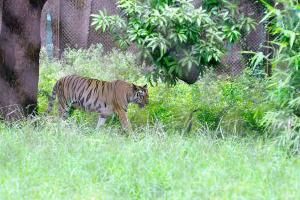
India lost 50 tigers in six months, 5 in Madhya Pradesh

Image
Indore: Even as India is striving hard to save the big cats, the country has lost fifty tigers so far this year against 72 tiger deaths in 2012.

Heading the list is Karnataka with the loss of 13 tigers till now, followed by eight in Maharashtra, seven in Uttarakhand and five in Madhya Pradesh. Out of the five tiger deaths in Madhya Pradesh, two are from Bandhavgarh Tiger Reserve, two from Pench Tiger Reserve and one from Katni forest division.

National Tiger Conservation Authourity (NTCA) DIG, SP Yadav on Wednesday said, every tiger in the country is under threat from poaching. Under the new protocol issued by NTCA on tiger mortality, cause of every tiger death will be considered as due to poaching, till the time state government proves it otherwise with proper evidence.

Earlier there was trend among states to hide exact cause of the death. Now rules have been changed so as to highlight the actual cause of tiger deaths. The NTCA directions will bring in more transparency in the post-mortem process.

Fish

What a fishy tale: Friendly dolphin dives down and catches 10lb cod before giving it to family for their dinner

Lucy Watkins, 14, was admiring the dolphin with her family in Devon

Mammal jumped out of the water and placed fish near to the teenager

At first they didn't know whether to take the cod but dolphin reappeared with its own dinner - a seabass

The family gratefully scooped up the cod and took it home for tea


A family watching a dolphin from their boat were shocked when it dropped them off a cod supper for dinner.

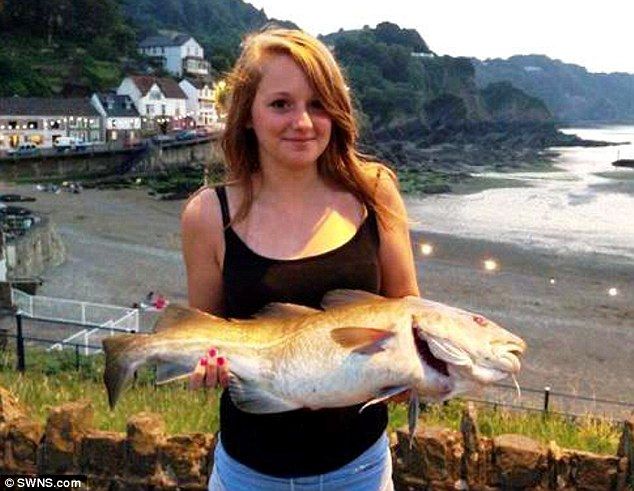
The group were enjoying watching the mammal frolic in the water when it suddenly dived down and caught the cod before placing it near to Lucy Watkins, 14.

The dolphin then then resurfaced and began nudging the fish towards the stunned teenager.

Image
Fish supper: Lucy Watkins proudly holds the 10lb cod given to her by a friendly dolphin off Combe Martin in Devon
Lucy and her grandparents wondered whether they should pick up the fish in case the dolphin wanted it for tea.

But the dolphin then appeared seconds later with his own fish, this time a seabass, and began tucking in.

Attention

UK: Hundreds of birds die in Harrow Lodge Park after 'worst outbreak of botulism'

Hundreds of birds have died at Harrow Lodge Park after the hot weather caused a potent outbreak of botulism in the lake.

Image
Three cygnets were discovered dead as a result of the outbreak of botulism
Lawrence Howes, a volunteer from the Swan Sanctuary, a charity that cares for swans and waterfowl, said that it was the "worst outbreak" he had ever seen in the Hornchurch park.

He added: "It has happened before, but this one is particularly potent.

"I have never known it this bad in Harrow Lodge Park."

The volunteers at the park have been scooping up dead ducks since the beginning of the week.

The swans have also been affected by the bacteria and today the volunteers noticed that the disease had killed three cygnets.

Resident Patricia Dowsett said: "It is heart breaking.

"It is so sad to see those innocent creatures dying helplessly."

Lawrence added: "It is really terrible.

"This normally affects the ducks, but it has taken the lives of three cygnets."

Botulism is a disease in lakes produced by botulinum bacterium.

It is caused when air temperatures rise and water and oxygen levels drop.

X

Lobster cannibalism: Crustaceans starting to eat each other, probably because of climate change

Image
© Getty
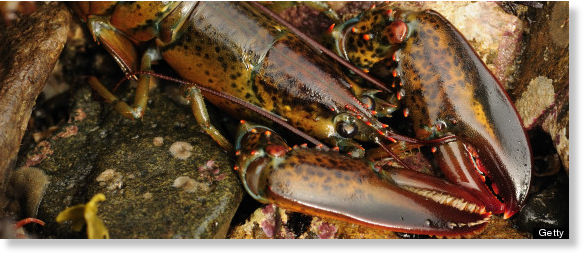
SumPity the young lobster. In addition to keeping a watchful eye out for the regular motley crew of predators, they now need to watch out for mom and dad as well.

Although lobsters have been known to assault and eat each other in captivity - not a surprising reaction given the conditions - marine biologists have recently observed an unprecedented degree of lobster cannibalism taking place in the wild.

Noah Oppenheim, a biologist studying the New England marine ecosystem, was the first to record the new development by setting up a camera trap using a young lobster as bait, reports The Independent.

When the same kind of experiments were conducted 20 years ago, other fish would feed on the bait; now, it's adult lobsters that are swooping in and making mincemeat of their young. After repeated experiments, scientists concluded that juvenile lobsters were 90 percent more likely to be attacked and eaten by adult lobsters than by any other type of fish.mary

Question

Rare mystery bird found in Manchester car park, UK

Image
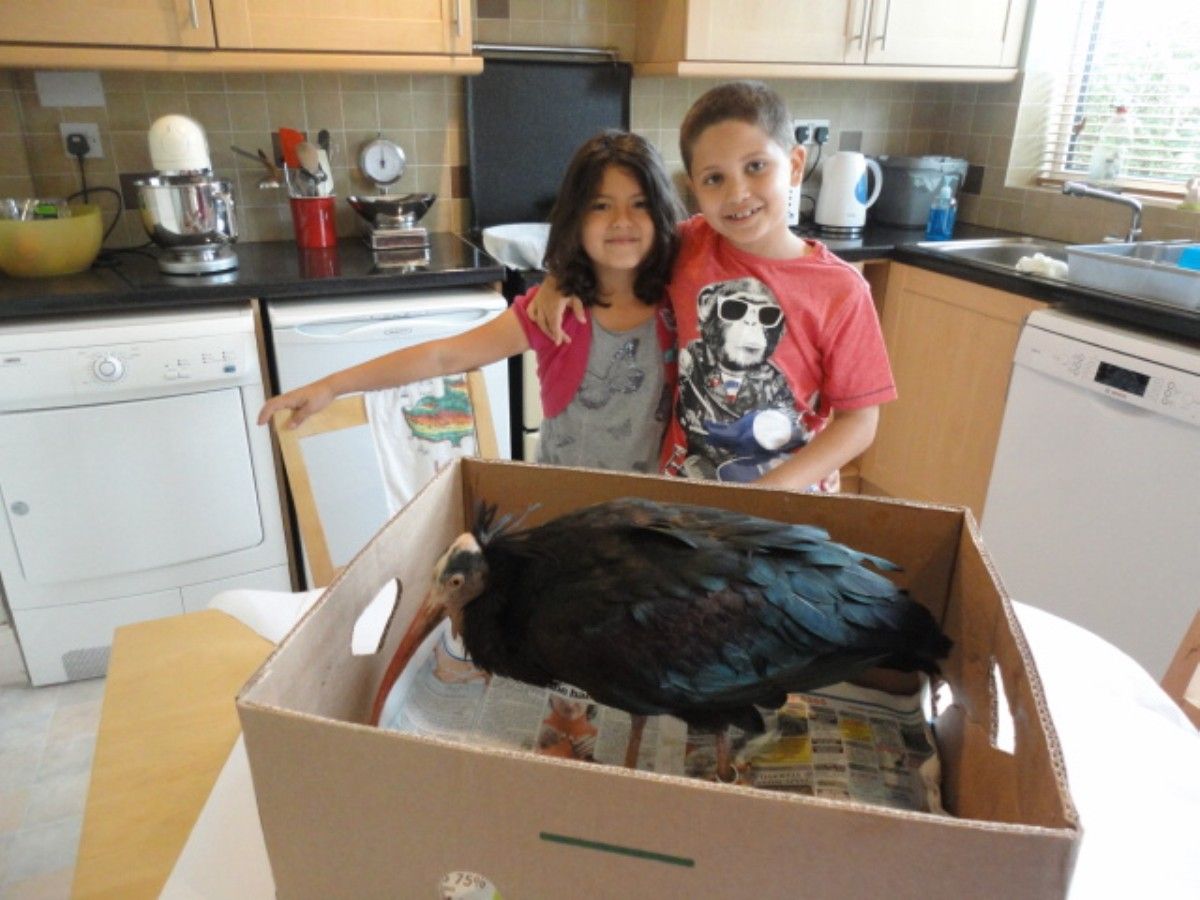
Nihal Sonmez (6) and Bilal Sonmez (9) with the ibis
A rare and critically endangered bird was found in the car park of Stretford Mall by astonished shoppers.

It was initially believed that the northern bald ibis had escaped from a zoo in Stoke some years ago, but experts at Chester Zoo are baffled as to where the bird came from.

Can Sonmez, 39, and his two children saw the ibis as they were walking to the mall on Saturday, July 20.

"It was basically flying up and down and the literally fell down the side of the building. When I actually picked it up it looked quite lethargic as if it hadn't fed for a while.

"I knew it was an ibis as we'd seen them before at Chester Zoo, but I didn't realise it was a critically endangered species of ibis."

Can, of St Andrews Road, Stretford, then took the bird home and called Chester Zoo, the curator of which collected the mystery bird a couple of days later.

Curator of birds, Andrew Owen, said: "We're pleased to report that after some TLC from our bird keepers and vets the northern bald ibis is now getting on really, really well.

Megaphone

Many stranded Bottlenose dolphins may be deaf

Image
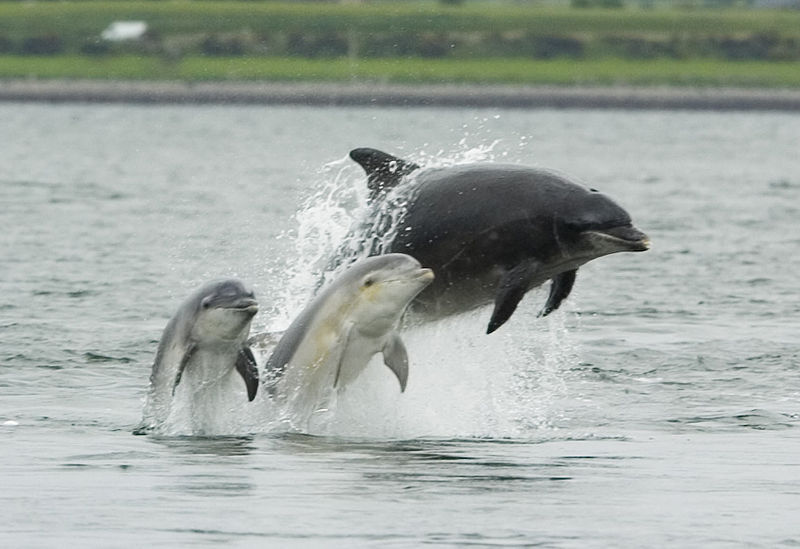
© Wikimedia CommonsAn adult female bottlenose dolphin with her young, Moray Firth, Scotland
Dolphin deafness can be caused by aging, underwater noise or other factors.

In waters from Florida to the Caribbean, dolphins are showing up stranded or entangled in fishing gear with an unusual problem: They can't hear.

More than half of stranded bottlenose dolphins are deaf, one study suggests. The causes of hearing loss in dolphins aren't always clear, but aging, shipping noise and side effects from antibiotics could play roles.

"We're at a stage right now where we're determining the extent of hearing loss [in dolphins], and figuring out all the potential causes," said Judy St. Leger, director of pathology and research at SeaWorld in San Diego. "The better we understand that, the better we have a sense of what we should be doing [about it]."

Whether the hearing loss is causing the dolphin strandings -- for instance, by steering the marine mammals in the wrong direction or preventing them from finding food -- is also still an open question.

Question

Spooked baboons baffle Dutch zoo in Emmen

Image
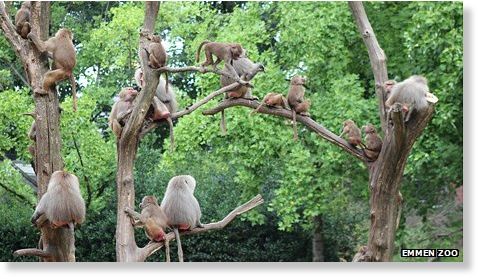
© Emmen zooThe baboons took to the trees in fear... and stayed there
Staff at a zoo in the Netherlands say they are baffled by their baboons, who have spent days sitting still, huddled together in fear and hardly eating.

The behaviour started on Monday evening, and only now are the 112 baboons becoming their normal, active selves again, said a biologist at Emmen Zoo.

The zoo still has no idea what spooked the hamadryas baboons, but it is a good sign that some are now eating apples, biologist Wijbren Landman said.

The zoo last saw such hysteria in 2007.

"What frightened them? We don't know, it's a mystery. There have been many suggestions - an earthquake, escaped snakes, aliens, thunder," Mr Landman told BBC News.