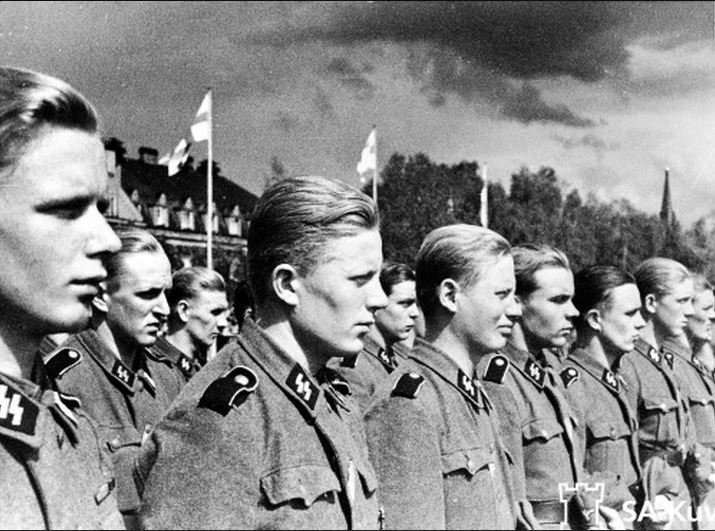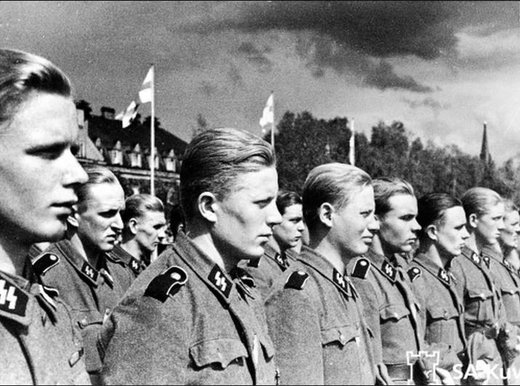
© UnknownFinnish Volunteer Battalion of the Waffen-SS (5. SS-Panzer-Division “Wiking”) in Tampere, Finland, 1943
The pen has been used to fix what the sword has ripped to shreds in our history.
- J.K Paasikivi
Every state that participated in the Second World War has written its history in support of national unity, with its narratives eliminating certain facts and emphasizing silence over controversial and 'unpleasant things'.
This has resulted in the patriotic, religious and quasi-scientific mythologization of war events, and fomented a hysterical attitude towards anyone who disagrees with the official narratives. Today we are in a situation where those unpleasant things are unconsciously avoided because openly confronting them causes fear, anxiety and uncertainty.
A specific interpretation of history, in which absolute evil and blame for the war is projected onto the adversary, even decades later, becomes, for most people, 'how it was always so'. Conversely, 'absolute good' is measured by good deeds on behalf of the constituted authorities of the motherland, and done in the name of liberal-individualist 'freedom and democracy'. Such a black-and-white 'division of values' has no place for self-criticism, compassion/forgiveness, or openness to new ideas.
In Finland, we have been so strongly raised (conditioned) in this "patriotic" (i.e. non-questioning) way
that even the slightest hint that our war-time leaders bear some responsibility for the war invites accusations of heresy and evokes strong emotional resistance in most, along with pronounced
cognitive dissonance.
Selective memory theories and the Separate War ThesisFinnish historian Heikki Ylikangas wrote, in
Mitä on historia - ja millaista sen tutkiminen ('What is history and how is it researched'), about the factors hindering renewal of historical narratives, not least the control of research by policy-makers. Commenting on the 1939-1940 Winter War between the Soviet Union and Finland, he wrote:
Even today, contemporary policy-makers limit the picture of the political background behind the Winter War. The hand of the clock that measures the progress of research on this issue is stuck in place. It is stuck at the point where Tanner, Ryti and Mannerheim penned their words on the matter. From the perspective of historical research by the amateurs of like mind in this field, and from the point of view of strongly biased people in legal research, a historical picture of the political background of the Winter War was constructed, which continues to be almost fully in force.
This is a very common problem in the writing of history. The closer the personal ties historians have with a topic, the more critical we should be about what they say. A classic example is the great effect Cicero and his writings have had in shaping today's
perception of Julius Caesar: Many historians have ignored the fact that they were political rivals, which makes Cicero a very questionable source when building an objective portrait of Caesar. Ask yourself, would future societies get a realistic description of Russian President Vladimir Putin by only using
American politicians and Western media as sources, or the
fifth column of Russian 'opposition' leaders?