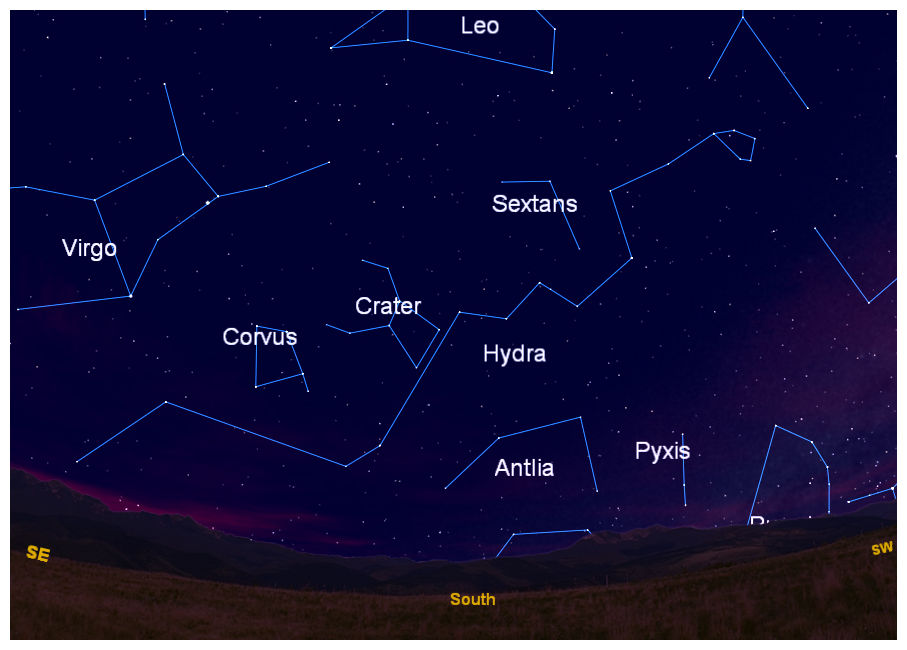
© Starry Night SoftwareThis sky map shows the location of the huge snake constellation Hydra in the southern sky at around 9 pm ET as seen from the mid-latitudes of the Northern Hemisphere.
A giant celestial snake is slithering into view in our current night sky this spring.
We can look to the south to trace it during the early evening hours. In fact, the snake is one of the most extensive of all star patterns: the long and mostly faint constellation of Hydra, the female water snake.
Interestingly, there is also a much shorter, male snake bearing the name Hydrus that is visible only in Southern Hemisphere skies.This sky map of the Hydra constellation shows where to look in the southern sky to spot the cosmic snake.
A long stream of stars
Hydra begins just below Cancer with a boxy shape of five stars representing the snake's head, between Procyon and Regulus, and south of the faint Cancer, the Crab.
Hydra's scraggly stream of dim stars then wriggles southeastward past its lone bright star - ruddy second magnitude Alphard - which appears brighter than it is because it has no competition star (hence it's sometimes called the "Solitary One").