Earth ChangesS


Bizarro Earth

USGS: Earthquake Magnitude 6.5 - 192km SSE of L'Esperance Rock, New Zealand

L'Esperance Rock Quake_020214
© USGS
Event Time
2014-02-02 09:26:37 UTC
2014-02-01 21:26:37 UTC-12:00 at epicenter

Location
32.908°S 177.822°W depth=40.4km (25.1mi)

Nearby Cities
192km (119mi) SSE of L'Esperance Rock, New Zealand
732km (455mi) NE of Whakatane, New Zealand
740km (460mi) NNE of Gisborne, New Zealand
761km (473mi) NE of Tauranga, New Zealand
1138km (707mi) NE of Wellington, New Zealand

Technical Details

Attention

Gray Whale washes up dead near Salmon Creek Beach, California

Image
This is a dorsal view (the upper surface) of the whale. It was ~18 feet long.
On Friday we heard that a young Gray Whale (Eschrichtius robustus) had washed up dead just north of Salmon Creek Beach. I decided to drive up during my lunch break to take a quick look. I learned that this whale had been around for a while (further north), so its condition had been deteriorating for at least 10 or more days. But it still seemed like a record worth documenting.

I learned that the average length of Gray Whale calves is ~4.6-5 meters (15-16.5 feet) and that they weigh ~1/2 ton. [Compare that with adults which reach 12-15 meters (39-49 feet) and 15-35 tons.]

The next picture shows a head-on view where you can see the arched mouth (upper jaw on left, lower jaw on right):

Image

Cloud Precipitation

UK floods: Bus carrying 14 passengers swept onto seafront and left stranded at Newgale

Image
© William Lawrence/@wjrlawrenceThe bus stuck on the seafront the morning after 14 people had to be rescued from it
A bus has been left marooned on a seafront following a giant wave that shrouded the vehicle with water and forced the rescue of 14 people on board.

The bus was hit by a massive wall of water as it travelled along the coast near Newgale in west Wales at roughly 7pm last night.

Milford Haven Coastguard received a call advising them the vehicle was stuck and surrounded by water, following high tides and wind speeds of up to 50mph.

Emergency teams including fire, police and ambulance crews also attended the scene and there have been no reported injuries.

Steve Matthews from Swansea Coastguard said: 'There are tricky conditions on the sea and along the coast, with gale force winds, high tides and heavy rain.

'Our advice is simple, please don't take risks. But if you do get into difficulty, or spot someone who might be in trouble, call 999 and ask for the Coastguard.'

Image
© William LawrenceA picture of the bus taken on the morning of 2/2/14

Snowflake

Severe snowstorms in the province of Vojvodina, Serbia


Severe weather has continued in Vojvodina on Saturday. Roads in the vicinity of Subotica have been snowed in, and members of the Serbian Army and Gendarmerie have been engaged to evacuate citizens cut off by snowdrifts.

Drama that commenced on Friday with evacuation of frostbitten people snowed in in the north of Vojvodina has continued through the night into Saturday.

The rescue operation went on through the night during which the Serbian Army, gendarmerie, Emergency Situation Sector, and the Department of Roads of Serbia struggled to evacuate 200 people from stranded vehicles, while strong wind trapped two international trains on the railway line between Zmajevo and Vrbas.

Meanwhile, some 1,000 people have been blocked in their vehicles forming a line near Feketic. Additional problems have arisen due to freezing rain.

Some 100 passengers from the two international trains have been evacuated in the morning and placed in a shelter in Vrbas, the Serbian Railways communicated to the Tanjug news agency.

The border crossing Horgos has been closed for freight transportation due to the stormy winds and snow drifts over 3.5 meters tall, and authorities appeal to citizens not to travel without a pressing need.

The Serbian government provided telephone lines [(011)2282910, or (011)2289208] for snow emergency calls.

Fish

Gruesome epidemic is ravaging starfish populations in the Pacific

Image
A mysterious illness has claimed the lives of tens of thousands of starfish on North America's west coast, and its symptoms are horrifying. Dubbed "sea star wasting syndrome," the arms of an infected individual will twist into knots, develop lesions, and finally crawl away in opposite directions until they tear away from its body, allowing its insides to spill out.

Researchers still aren't sure how the disease spreads, let alone where it comes from. What they do know is that sea stars occupy a pivotal niche in ocean ecosystems, and large-scale die outs are almost certainly a very bad sign. In a fascinating piece that's as sad as it is disturbing, PBS special correspondent Katie Campbell reports on how researchers and citizen scientists are teaming up to investigate the spread of the mysterious syndrome:

Comment: See also:
Pacific coast starfish dying in record numbers
Pacific salmon may be dying from leukemia-type virus
Dead sea life covers 98% of Pacific Ocean floor after Fukushima
"They're All Gone": Shock as sardines vanish off California - Fishermen didn't find a single one all summer
The ocean is broken


Arrow Up

Kavachi undersea volcano (Solomon Islands) erupts

Image
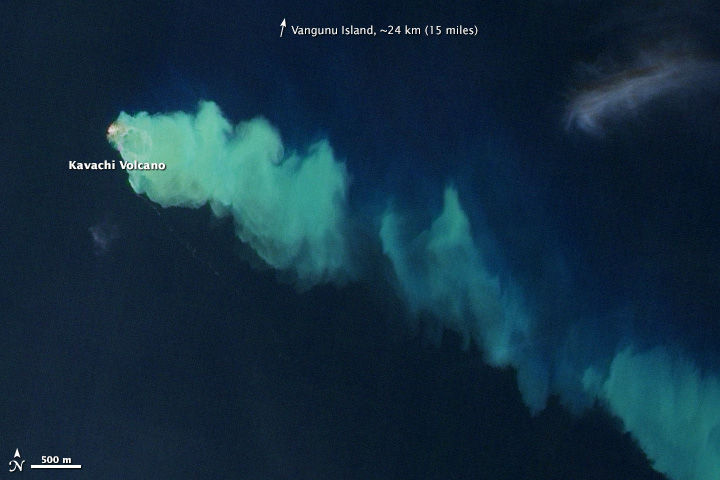
© Jesse Allen and Robert Simmon, NASAThe discolored water plume from Kavachi volcano
A submarine eruption is likely occurring at the submerged volcano. A NASA satellite image from 29 Jan shows a plume of discolored sea water swirling and drifting from the location of the volcano. The discoloration is likely from suspended volcanic sediments (the fragmented lava) and gasses.

Kavachi is an undersea volcano on the southern edge of the Solomon Islands in the western Pacific Ocean. It erupted dozens of times in the 20th century, often breaking the water surface, only to be eroded back below the water line within a few months.

Red Flag

Man swept to death by freak wave

Image

A man swept to his death in Spain saw the wave that killed him for only a split-second before he was washed away, chilling video of his final moments reveals.

An unnamed 43-year-old Senegalese man was walking on the pier in the port of Ondarroa when he was caught out by a freak wave in stormy weather just before 11am local time on Tuesday, El Pais reports.

The man appears to be unaware of his danger as a wall of whitewater explodes over the top of the concrete pier, the video shows.

He then turns to run as tonnes of water come crashing down but it is too late.

Stock Down

U.S. cattle herd at lowest number since 1951

cattle
© Cattle image via Ellmist on Wikimedia, Creative Commons licensed.
The lingering effects of drought across the Great Plains in recent years have led to another decrease in the U.S. cattle herd.

The National Agricultural Statistics Service reports that the U.S. inventory of cattle and calves totaled 87.7 million animals as of Jan. 1. That was down by about 1.6 million cattle, or 2 percent, compared with this time last year.

The agency says this is the lowest January inventory since 1951.

Question

Another case of outgassing? Mysterious smell reported in western Kentucky and northwestern Tennessee

Authorities in multiple counties in western Kentucky and northwestern Tennessee reported a mysterious gas-like odor Thursday morning, but the source of the stench is still unknown. Calloway County dispatcher Dan Galloway said the Sheriff's Office received anywhere between 15 to 20 calls of a natural gas smell.

The first call came from the Almo area at about 6:30 a.m. Galloway said Calloway County Fire-Rescue units responded to a residential area to find nothing. Minutes later, firefighters were called to the Dexter area for the same call. By later in the morning, Galloway said reports were coming in from most of the county as well as Marshall, Graves and Ballard counties in Kentucky and Henry and Stewart counties in Tennessee.

"We've talked to sheriffs' offices south of us and they have all reported the smell."

Calloway County Emergency Management Director Bill Call said officials have tested the air in multiple areas county wide to find no unusually high concentrations of natural gas or propane.

Cloud Precipitation

January was England's wettest winter month in almost 250 years

Image
Last month's seasonal total was higher than any since 1767 and three times the average level

The deluge that has engulfed southern and central England in recent weeks is the worst winter downpour in almost 250 years, according to figures from the world's longest-running weather station.

The rainfall measured at the historic Radcliffe Meteorological Station at Oxford University in January was greater than for any winter month since daily recording began there in 1767, and three times the average amount.

The latest Met Office data shows that the region from Devon to Kent and up into the Midlands suffered its wettest January since its records began in 1910.

But Ian Ashpole, the Radcliffe Meteorological Observer, said: "The Radcliffe measurements more than double the length of the Met Office record and give us a better grip on how things are changing."