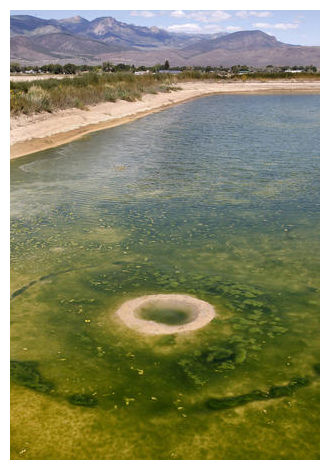
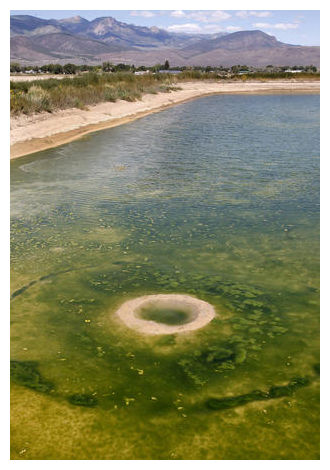
© Stuart Johnson, Deseret NewsBryce Dalton and his two brothers recently discovered a round hole or crater in the bottom of their irrigation pond on their farmland in Circleville, Piute County. So far, they have not found anyone that know what it is or what cause it to be there.
Circleville, Piute County - Farmers in southern Utah are scratching their heads and trying to figure out what caused an unusual phenomenon in an irrigation pond.
Earlier this week, Gary Dalton of Circleville discovered a mysterious crater that suddenly appeared under the water.
"The sun was just right," Dalton said, "so I saw this blasted thing that no one had ever seen."
He noticed it after most of the water was drained from the pond for irrigation. Just beneath the surface he saw concentric circles in the pond bottom with a diameter of about 25 feet. The outer ring is a circular depression filled with algae. An inner circle looks as though something erupted from beneath, forming what looks startlingly like a small volcanic crater.
"My heck, I guess that's Martian art," Dalton said. "I don't know."
Experts from the Utah Geological Survey took a look and were initially baffled.
"Well, yeah, we've got several theories," said veteran geologist Bill Lund as he examined the pond. "Most of them have gone up in smoke."
Most of the theories were disposed of almost immediately. Some had speculated that the feature was caused by a natural spring, pushing up from under the pond after being supercharged by recent rains. But Lund said that theory was quickly disproved by aerial photos that were taken before the pond was excavated 2 ½ years ago.
"This was an alfalfa field and there was no spring here," Lund said. "It's not a spring."
Another theory was that a buried pipeline had been punctured during construction of the pond. But Lund said there is no pipeline.
Another possibility is that there was a burp of methane gas from decaying organic material under the pond. Lund strongly doubts that theory because the local geology isn't the type that sometimes causes such events.
"If we were in coal country," Lund said, "I'd be thinking about that a little harder but, you know, we're not."








Comment: SOTT wonders what will happen when macro-bursts of this type begin happening?