Earth ChangesS


Attention

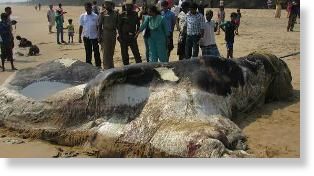
Carcass of whale found near Chennai, India

Image
The carcass that weighed around 15,000 kilograms was hauled with a crane and buried on the shore by forest department officials.
The carcass of a 40-foot-long tropical male whale washed ashore on the Sadras Kuppam Beach near Chennai on Sunday morning.

The whale, also known as the Bryde's whale, might have died after being struck by a large steel-hulled vessel as its spine was broken, a forest official said.

The carcass that weighed around 15,000 kilograms was hauled with a crane and buried on the shore by forest department officials.

"From the measurements of the whale, the small size of its dorsal fin and the absence of teeth, we declared it to be a tropical whale," said Supraja Dharini of Tree Foundation.

Info

314 turtles found dead on Chennai beaches in 20 days, India

Image
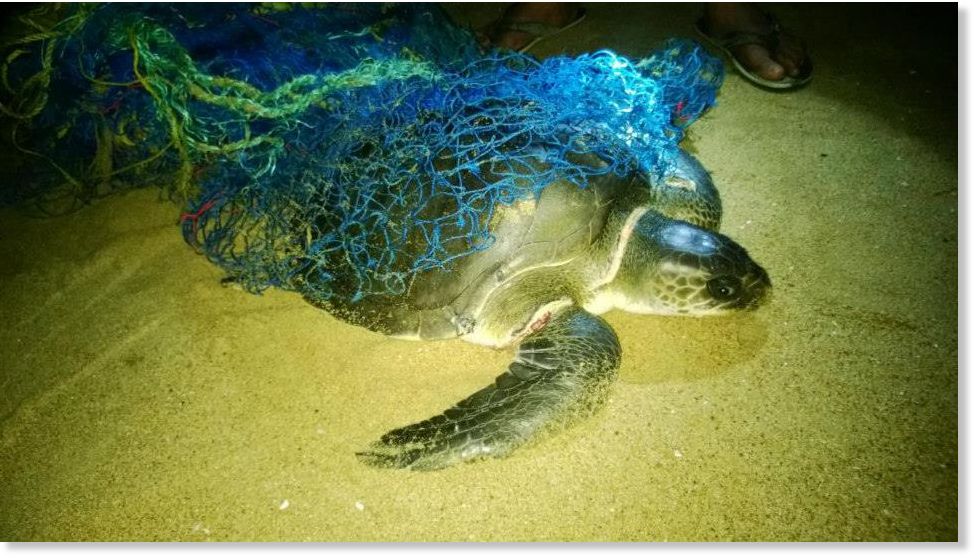
© Tree Foundation India Facebook An olive ridley sea turtle tangled in fishing net; Feb. 22, 2014.
The nesting season for Olive Ridley turtles is barely 20 days old and already 314 turtles have washed ashore dead on the city's beaches. Conservationists say the turtles die after getting stuck in trawlers' fishing nets.

On Saturday morning, 60 turtles were found dead on the stretch between Neelankarai beach and Alamparai village in Kancheepuram district, according to Tree Foundation that patrols the stretch every year during the nesting season. "The numbers are alarmingly high this year and we are just into the second week of the season that will continue till March-end," said Tree Foundation founder-chairperson Supraja Dharini. Tree Foundation volunteers buried the dead turtles near the shore later in the night.

Members and volunteers of the Students' Sea Turtle Conservation Network (SSTCN), a group that patrols the coastline from Neelankarai to Napier's Bridge, including Marina and Elliot's beaches, reported 70 dead turtles were washed ashore. SSTCN coordinator V Arun said, "Considering that only 5-6% of the dead turtles are washed ashore, the real death toll could be many times higher."

According to turtle conservation groups, most of the deaths are caused due to the failure in implementing the Tamil Nadu Marine Fishing Regulation Act, 1983, which prohibits fishing trawlers from operating within 5 km of the shore.

Comment: Other reports of turtle mass deaths over the past 2 years, some due cold weather conditions and some to unknown factors other than fishing nets: 1,122 dead turtles washed ashore in Tamil Nadu, Andhra Pradesh, India in January

30 Kemp's ridley sea turtles suffering from hypothermia taken from Cape Cod to the Florida Keys

Over 1,200 sea turtles have washed up on Cape Cod beaches during December

Gulf World treating some 50 endangered sea turtles stranded by cold weather in Florida

23 Olive Ridleys turtles washed ashore in two days, Napier Bridge, India

800 turtles found dead on Nellore beach, India

Costa Rica investigates deaths of 280 sea turtles

Eighty sea turtles wash up dead on the coast of Guatemala


Snowflake Cold

Oops! NASA only 38% sure 2014 was 'warmest on record'

  • NASA's Goddard Institute for Space Studies claimed its analysis of world temperatures showed '2014 was the warmest year on record'
  • But it emerged that GISS's analysis is subject to a margin of error
  • NASA admits this means it is far from certain that 2014 set a record at all
  • Image
    NASA's Gavin Schmidt - paid disinfo artist?
    The NASA climate scientists who claimed 2014 set a new record for global warmth last night admitted they were only 38 per cent sure this was true.

    In a press release on Friday, NASA's Goddard Institute for Space Studies (GISS) claimed its analysis of world temperatures showed '2014 was the warmest year on record'.

    The claim made headlines around the world, but yesterday it emerged that GISS's analysis - based on readings from more than 3,000 measuring stations worldwide - is subject to a margin of error. NASA admits this means it is far from certain that 2014 set a record at all.

    Bizarro Earth

    Key reservoir for Sao Paulo drying out from extreme drought

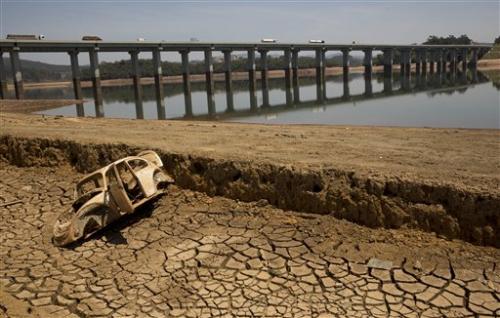
    Atibainha dam, Brazil
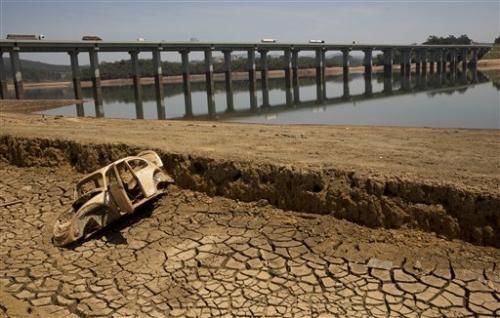
    © AP Photo/Andre PennerIn this Oct. 10, 2014 file photo, the frame of a car sits on the cracked earth at the bottom of the Atibainha dam, part of the Cantareira System responsible for providing water to the Sao Paulo metropolitan area, in Nazare Paulista, Brazil. Halfway through the rainy season, the key reservoir for the hemisphere's largest city, the Cantareira water system, holds just 6 percent of its capacity, and experts warned Friday, Jan. 16, 2015 that authorities must take urgent steps to prevent the worst drought here in more than 80 years from drying it out.
    Halfway through the rainy season, the key reservoir for the hemisphere's largest city holds just 6 percent of its capacity, and experts warned Friday that Sao Paulo authorities must take urgent steps to prevent the worst drought in more than 80 years from drying it out.

    The system of reservoirs and rivers that provide water to millions in this city have received less rainfall than hoped during the first weeks of the wet season, raising fears they won't be replenished as hoped. Rainfall during the first two weeks of January totaled just 2.9 inches (7.1 centimeters), well below the historic average for the month of 10.7 inches (27.1 centimeters).

    The biggest problem is in the Cantareira water system, which is the largest of six reservoirs that provide water to some 6 million of the 20 million people living in the metropolitan area of Sao Paulo city. Cantareira is now down to 6 percent of its capacity of 264 billion gallons (1 trillion liters), the water utility Sabesp said on its website.

    Of the remaining five systems, Alto Tiete is at 11 percent of capacity, Rio Claro 25 percent, Alto Cotia 30 percent, Guarapiranga 40 percent and Rio Grande 70 percent.

    Comment: Sao Paulo experienced violent storms and heavy flooding in December, yet drought conditions persist. For a better understanding of the reasons why weather patterns have become extreme and unpredictable around the world, read Earth Changes and the Human-Cosmic Connection.


    Hardhat

    Man attacked by owl in Salem, Oregon

    Image
    Great Horned Owl
    Ron Jaecks of Salem was on his usual morning run in Bush's Pasture Park on Tuesday when he was attacked, or so he thought.

    Jaecks was jogging near the baseball field about 5:15 a.m. Suddenly in the morning darkness his stocking cap was pulled from his head, and almost simultaneously he felt something puncture his scalp.

    Jaecks thought he was dying.

    "It was like a huge electric shock ran through my body, but also like I got hit in the head with a two-by-four all at the same time," Jaecks said. "Or maybe a strike of lightning."

    Jaecks, 58, immediately began to run faster, trying to escape his assailant.

    Running in circles and screaming, the general surgeon for Kaiser Permanente began to think that he was having a stroke or an aneurysm.

    Comment: See also: Barred owl attacks 6 people, terrorizes others in Jacksonville Beach, Florida

    Canadian rabbit trapper says owl attack left his head bleeding

    Multiple owl attacks reported in Springfield, Missouri


    Attention

    Hundreds of thousands of blue jellyfish invade Surfer's Paradise, Australia

    Image
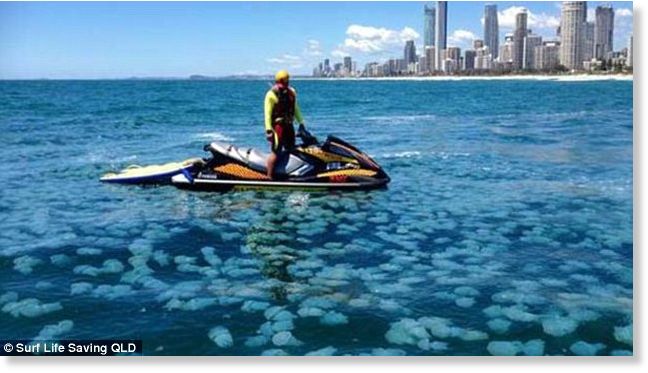
    A giant swarm of blue jellyfish has invaded the pristine waters of the Gold Coast
    A giant swarm of blue jellyfish has invaded the pristine waters of the Gold Coast, forming a spectacular display as the mass of creatures congregated in Queensland's iconic Surfer's Paradise.

    Spotted just off Narrowneck, near the northern end of Surfer's Paradise beach, the school of jellyfish extended for 50 metres in circumference.

    Photographer and lifesaver Grahame Long captured footage of the blue jellyfish as he patrolled the beach, about 400 metres offshore.


    Snowflake

    Record snowfall of two meters in western Norway

    Image
    © Rune Sævig
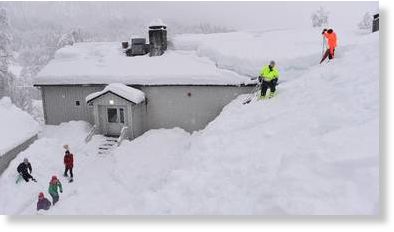
    Some buildings in Voss have collapsed under the weight and several municipal buildings are in danger of collapsing.

    On Tuesday, civil defense authorities asked for assistance in shoveling massive amounts of snow from roofs on municipal buildings.

    As if 1,000 cars on the roof

    According officials, the Vossestrand omsorgstun, which has a roof surface of 2,500 square meters, was covered by a half to two meters deep snow.

    "Our calculations show that it is 400 kilograms per square meter of snow. It is as if we were placed 1,000 cars onto this roof," said operations Eivind Hovden in civil defense.

    There is so much weight that you have trouble opening doors and windows. There is immense power, he adds.

    Binoculars

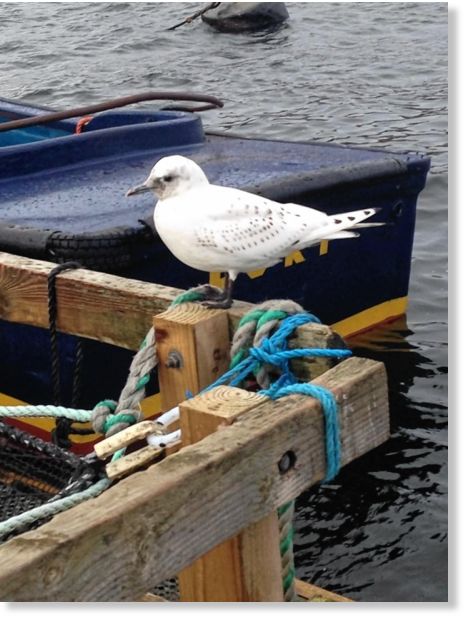
    Rare Arctic Ivory gull found in Ullapool, Scotland

    Image
    © Matthew RossThey're more at home following polar bears around the Arctic but this young ivory gull has taken up residence at a fish farm near Ullapool.
    A rare Arctic visitor is getting folk all a flutter in Wester Ross.

    A young ivory gull, generally found in the high Arctic, has been spotted at a fish farm near Ullapool.

    They have only been reported in the UK as few as 100 times.

    The bird was spotted by Wester Ross Salmon employee Matthew Ross when it landed at the fish farm at Ardmair Bay north of Ullapool. Matthew was unsure of the species of bird and sent pictures to a local wildlife tour operator to identify it.

    The sighting has caused interest with bird watchers due to its rarity and there is speculation that it may be the same individual that was spotted at Uig Harbour in Skye at New Year and has possibly been blown to the mainland in the recent winds.

    Inverness-based Alan Tissiman of RSPB Scotland said: "Ivory gulls are very rare visitors to the British Isles, invariably seen in the winter months after strong north westerly gales. They are usually found far to the north on the Arctic pack ice where they live all year round.

    "They are scavengers, never happier than when they find a dead whale or seal to feed on! They are known to follow polar bears and other predators to feed on the remains of their kills.

    "They are lovely-looking birds and I would imagine that this individual will have attracted a fair amount of interest from birdwatchers - though they may not wish to enquire too closely into its feeding habits!"

    Comment: See also: Rare Arctic Ivory gull spotted in Quincy, Illinois


    Attention

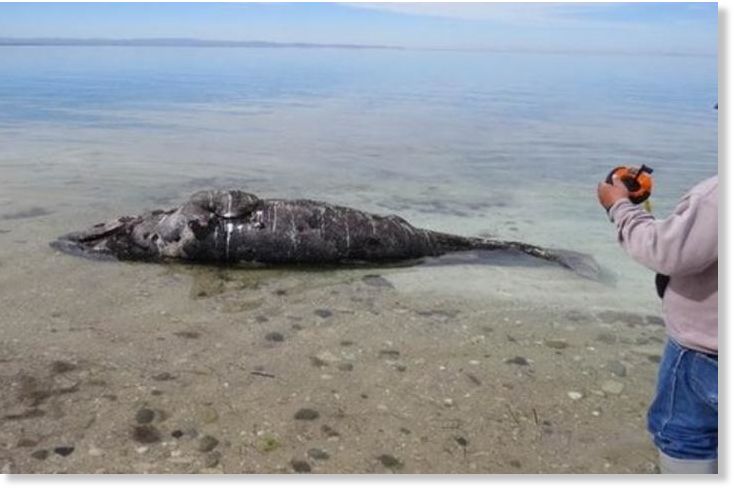
    14 whales and 16 turtles wash up dead on Baja California Sur coast

    Image
    © Profepa The finding of the specimens was detected during a surveillance round carried out by Profepa inspectors .
    Specialists say the death of the specimens might be due to natural causes.

    14 gray whales and 16 sea turtles were found dead in the Baja California Sur coast, according to the Federal Attorney's Office for Environmental Protection (Profepa).

    The finding of the specimens was detected during a surveillance round carried out by Profepa inspectors on the Ojo de Liebre lagoon, in the municipality of Mulegé, Baja California Sur.

    According to specialists, the death of cetaceans could be due to natural causes, as this is a breeding area for the mammals, so it is common the whale calves get lost or are abandoned by the mother, so they do not receive adequate nutrition and die.

    Cetaceans found were in an advanced state of decomposition, however no rips or injury caused by ships or entanglements were found.

    According to Profepa inspectors, another cause of death could be hypothermia, derived from the low temperatures due to cold fronts in recent days.

    Comment: See also: 554 dead seabirds and 4 sea lions found on beaches in Baja California, Mexico


    Igloo

    Ice covering Great Lakes makes giant leap in January

    GIF animation

    Animation of ice cover on the Great Lakes from Jan. 7 to Jan. 14 (NOAA)

    Ice cover on the Great Lakes has made quite a leap after the first, week-long cold snap of the season.

    As of Thursday, ice covered 34.1 percent of the Great Lakes, up from just 5.6 percent on Jan. 1, and 10.8 percent on Jan. 5 - the first day of a polar plunge that gripped most of the eastern U.S. for days to come.

    "Last year, the Great Lakes were 21.2 percent ice-covered on Jan. 14, making this year's ice cover 13 percent higher to date," writes weather.com. "If you recall, below-average temperatures were persistent from mid-January onward in the winter of 2014, leading to the second highest ice coverage on record at 92.2 percent on March 6, 2014."
    Amazing shot from our Life on #LakeErie Photo Contest: Fortress of Solitude by @LakeErieSurfer pic.twitter.com/YrxyzROkUw

    - Lake Erie Commission (@OhioLakeErie) January 15, 2015
    This year's January cold snap set off an upward spiral in ice cover over the lakes, particularly for Erie, the shallowest lake in the network.