Secret HistoryS


Dig

Pompeii: Newest find shows man decapitated by rock during eruption of Vesuvius

Pompeii man crushed rock
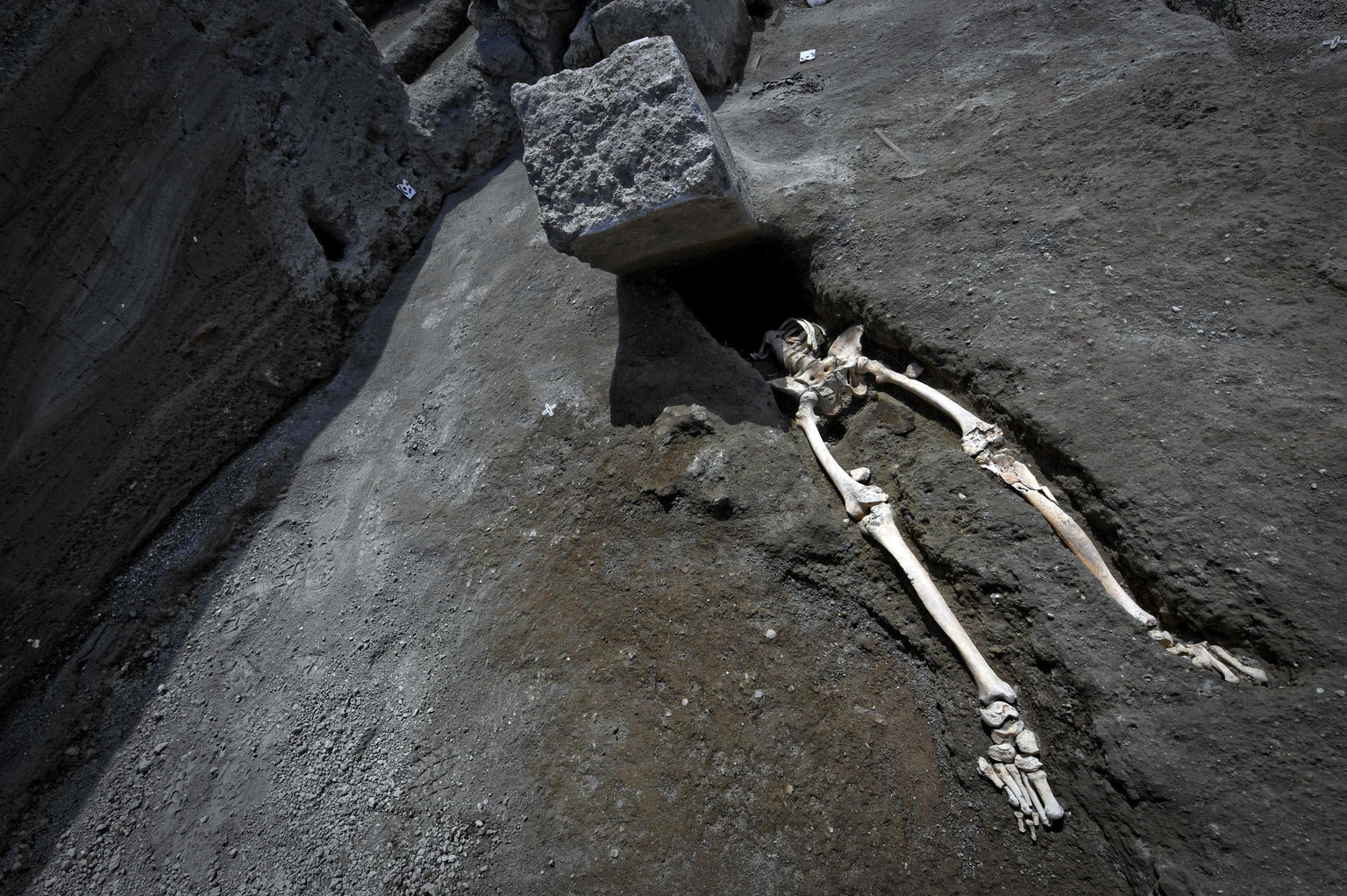
© Ciro Fusco/ANSA via APThe legs of a skeleton emerge from the ground beneath a large rock believed to have crushed the victim's bust during the eruption of Mt. Vesuvius in A.D. 79, which destroyed the ancient town of Pompeii, at Pompeii's archeological site, near Naples, on Tuesday, May 29, 2018. The skeleton was found during recent excavations and is believed to be of a 35-year-old man with a limp who was hit by a pyroclastic cloud during the eruption.
Officials at the Pompeii archaeological site have announced a dramatic new discovery, the skeleton of a man crushed by an enormous stone while trying to flee the explosion of Mt. Vesuvius in 79 A.D.

Pompeii officials on Tuesday released a photograph showing the skeleton protruding from beneath a large block of stone that may have been a door jamb that had been "violently thrown by the volcanic cloud."

The victim, who was over 30, had his thorax crushed. Archaeologists have not found the victim's head. Officials said the man suffered an infection of the tibia, which may have caused walking difficulties, impeding his escape.

Comment: See also:


Archaeology

Siberia: 50,000 year old bones may be the oldest Homo sapiens outside Africa and Middle East

Tuyana bones
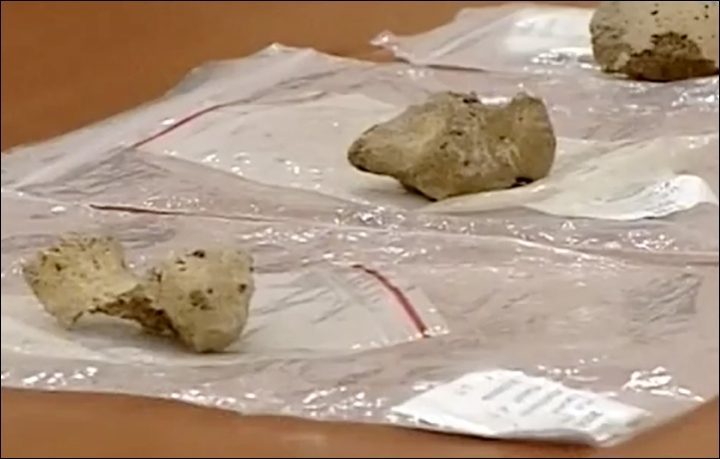
© Vesti.IrkutskThe older set of bones found on Tuyana site dated to 50,000 years ago.
Finds of 'lion-hunting ancient man' excavated from site of new road new Lake Baikal now undergoing tests at Germany's Max Planck Institute.

If the discovery in Buryatia is verified as being Homo sapiens, it will alter scientific thinking about the arrival of man in Siberia.

The discovery was made in the Tunkinskaya Valley by Irkutsk scientists in 2016.

Comment: There are a great many questions regarding the 'out of Africa' theory:


Bad Guys

Why it matters: The blatant conspiracy behind Senator Robert F. Kennedy's assassination

Robert F Kennedy
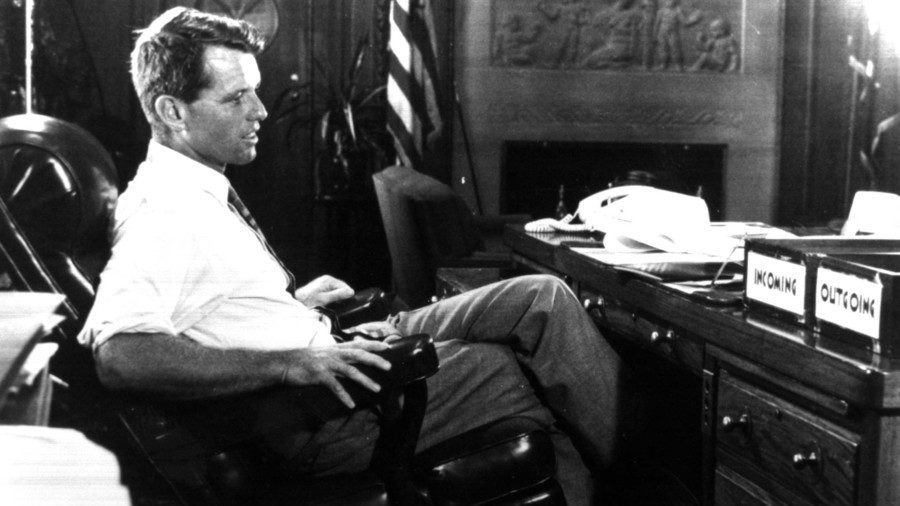
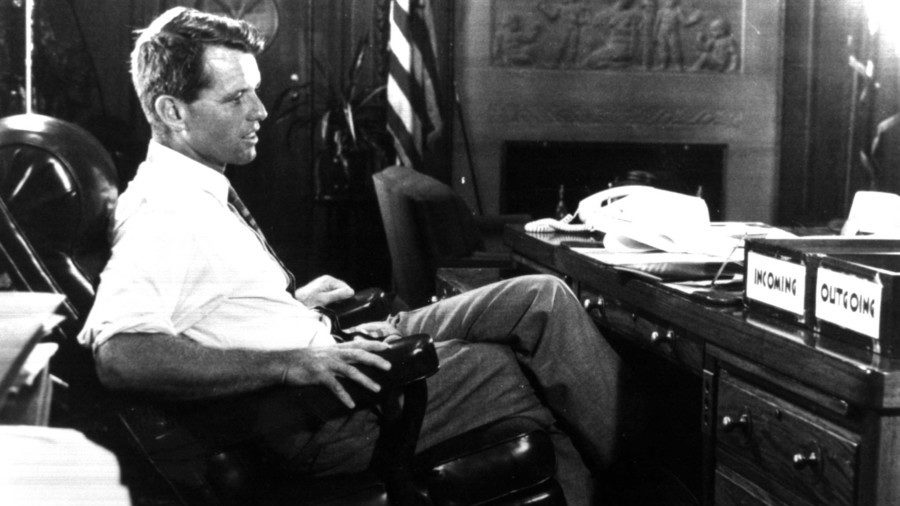
© ReutersRobert F. Kennedy sits at his desk at the Justice Department in this 1968 file photograph. Kennedy was shot in Los Angeles 30 years ago on June 5, 1968, and died the following day.
Early in 1968, Clyde Tolson, F.B.I. Director J. Edgar Hoover's deputy and bosom buddy, a key player in the assassination of Rev. Martin Luther King, Jr., expressed both the hope and intent of those making sure that there would never be another president by the name Kennedy, when he said about RFK that "I hope someone shoots and kills the son of a bitch." Earlier, as reported by Robert F. Kennedy, Jr. in his new book, American Values: Lessons I Learned from My Family, the influential conservative Westbrook Pegler expressed this hope even more depravingly when he wished "that some white patriot of the Southern tier will spatter [Robert Kennedy's] spoonful of brains in public premises before the snow flies."

These sick men were not alone. Senator Robert Kennedy was a marked man. And he knew it. That he was nevertheless willing to stand up to the forces of hate and violence that were killing innocents at home and abroad is a testimony to his incredible courage and love of country. To honor such a man requires that we discover and speak the truth about those who killed him. The propaganda that he was killed by a crazed young Arab needs exposure.

When he was assassinated by a bullet to the back of his head on June 5, 1968, not by the accused patsy Sirhan Sirhan, who was standing in front of RFK, but by a conspiracy that clearly implicates U.S. law enforcement and intelligence agencies, not only did a precious and good man die, but so too did any chance for significant political change through the official political system, short of a miracle. We are still waiting for such a miracle.

Comment:
Evidence of Revision
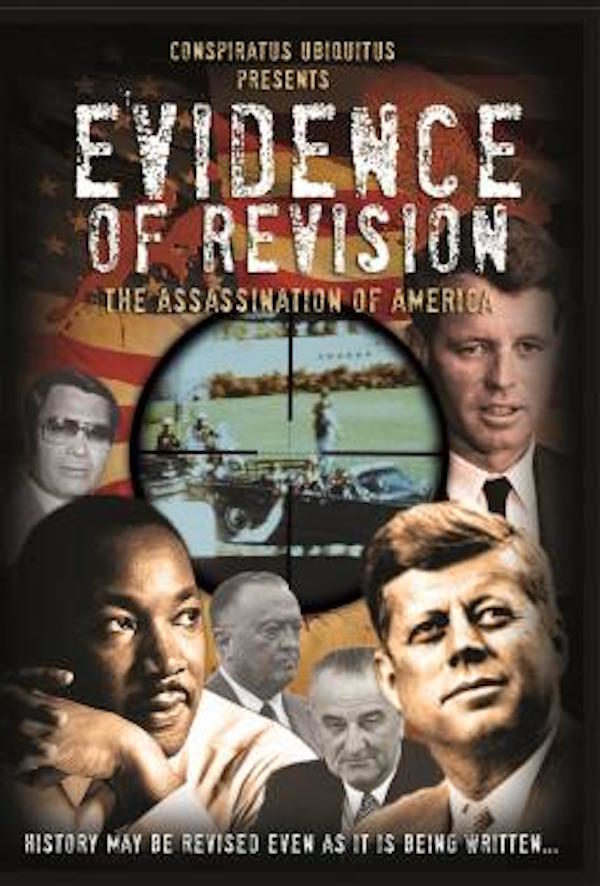
There are few documentaries in existence today that have followed the murders of all three of these beacons of hope, JFK, MLK and RFK, like the following, a SOTT Focus from 2012. The vignette footage used in this documentary film reveals the terror and manipulation that underpinned society at that time. Much has been forgotten and yet it still haunts the very fabric of Western civilization today.

The Murders of JFK, MLK, and RFK - Evidence of Revision
Evidence of Revision is a six-part documentary containing historical, original news footage revealing that the most seminal events in recent American history have been deeply and purposefully misrepresented to the public. Footage and interviews provide an in-depth exploration of events ranging from the Kennedy assassinations to the Jonestown massacre, and all that lies between.

The footprints left in this archival footage reveal the coordinated, clandestine sculpting of the America we know today. Evidence of Revision proves once and for all that history has been revised, even as it was written!
Also read So who killed Bobby Kennedy? RFK, Jr. does not believe it was Sirhan Sirhan.
Kennedy called Sirhan's trial "really a penalty hearing. It wasn't a real trial. At a full trial, they would have litigated his guilt or innocence. I think it's unfortunate that the case never went to a full trial because that would have compelled the press and prosecutors to focus on the glaring discrepancies in the narrative that Sirhan fired the shots that killed my father."


Pistol

So who killed Bobby Kennedy? RFK, Jr. does not believe it was Sirhan Sirhan

Robert Kennedy Jr.
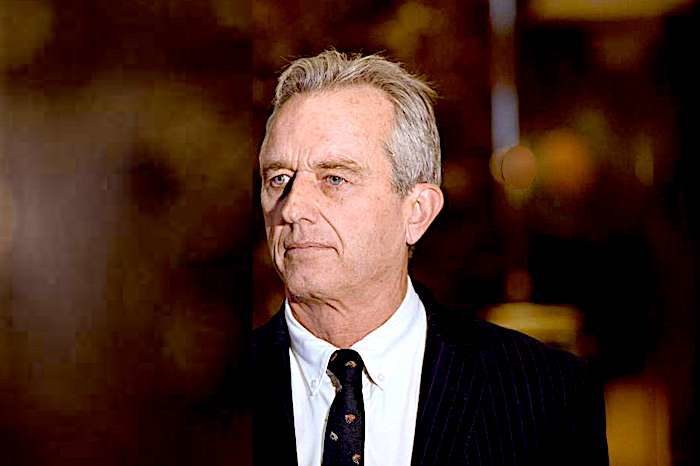
© Bloomberg Photo/Anthony BeharRobert Kennedy Jr.
Just before Christmas, Robert F. Kennedy Jr. pulled up to the massive Richard J. Donovan Correctional Center, a California state prison complex in the desert outside San Diego that holds nearly 4,000 inmates. Kennedy was there to visit Sirhan B. Sirhan, the man convicted of killing his father, Sen. Robert F. Kennedy, nearly 50 years ago.

While his wife, actress Cheryl Hines, waited in the car, Robert Kennedy Jr. met with Sirhan for three hours, he revealed to The Washington Post last week. It was the culmination of months of research by Kennedy into the assassination, including speaking with witnesses and reading the autopsy and police reports.

"I got to a place where I had to see Sirhan," Kennedy said. He would not discuss the specifics of their conversation. But when it was over, Kennedy had joined those who believe there was a second gunman, and that it was not Sirhan who killed his father.
"I went there because I was curious and disturbed by what I had seen in the evidence," said Kennedy, an environmental lawyer and the third oldest of his father's 11 children. "I was disturbed that the wrong person might have been convicted of killing my father. My father was the chief law enforcement officer in this country. I think it would have disturbed him if somebody was put in jail for a crime they didn't commit."
Kennedy, 64, said he doesn't know if his involvement in the case will change anything. But he now supports the call for a re-investigation of the assassination led by Paul Schrade, who also was shot in the head as he walked behind Kennedy in the pantry of the Ambassador Hotel in Los Angeles but survived.
Bobby Kennedy
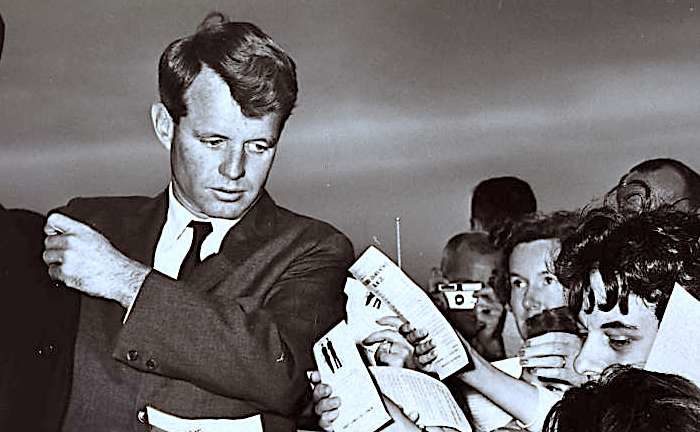
© Times Union archiveSen. Robert F. Kennedy during his visit to Schenectady, N.Y. on Sept.19, 1964

Network

When the internet went live in 1969

early internet
© UC Daily Bruin
On Oct 29, 1969, UCLA and the Stanford Research Institute made the first host-to-host connection on the ARPANET, which grew into the internet that we all know and love today! UCLA and UC Santa Barbara were two of the original nodes when the internet (then ARPANET) went live in 1969.

The Advanced Research Projects Agency Network (ARPANET) was an early packet switching network and the first network to implement the protocol suite TCP/IP. Both technologies became the technical foundation of the Internet. The ARPANET was initially funded by the Advanced Research Projects Agency (ARPA) of the United States Department of Defense.

Bad Guys

Footage of LSD trialled on UK marines, and other human experiments courtesy of Porton Down

royal marines lsd
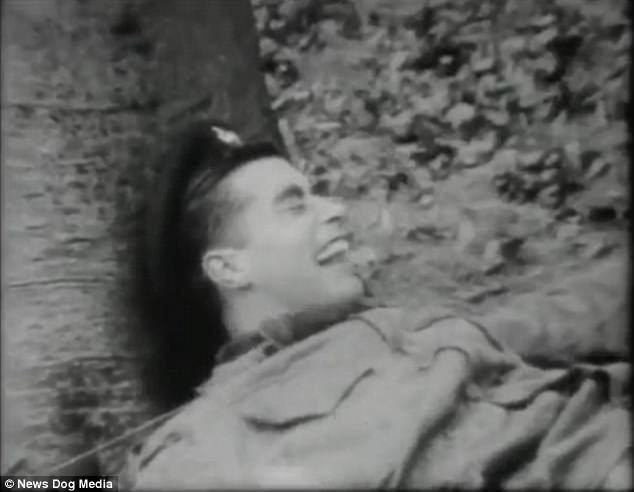
In the kind of clipped BBC English that more frivolous generations associate with comic Harry Enfield's Mr Cholmondley Warner, the narrator explained how the LSD was given to the Royal Marine Commandos "in a cup of wartah."

"Twenty-five minutes latah, the first effects of the drug became apparent. The men became relaxed and began to giggle."

They certainly did. The black and white footage from 1964 shows the hitherto ferociously well-drilled servicemen lying flat on their backs, helpless with laughter, or staggering against trees, intoxicated by the hilarity of it all, and by the acid.

"One ahr and ten minutes after taking the drug," intones the narrator, "With one man climbing a tree to feed the birds, the troop commander gave up, admitting he could no longer control himself or his men.

"He himself then relapsed into laughter."

Comment: The murky world of government human experimentation and drugs is much more extensive and depraved: Also check out SOTT radio's:


Gold Bar

In the 1930s when the US Government defaulted

American Default book
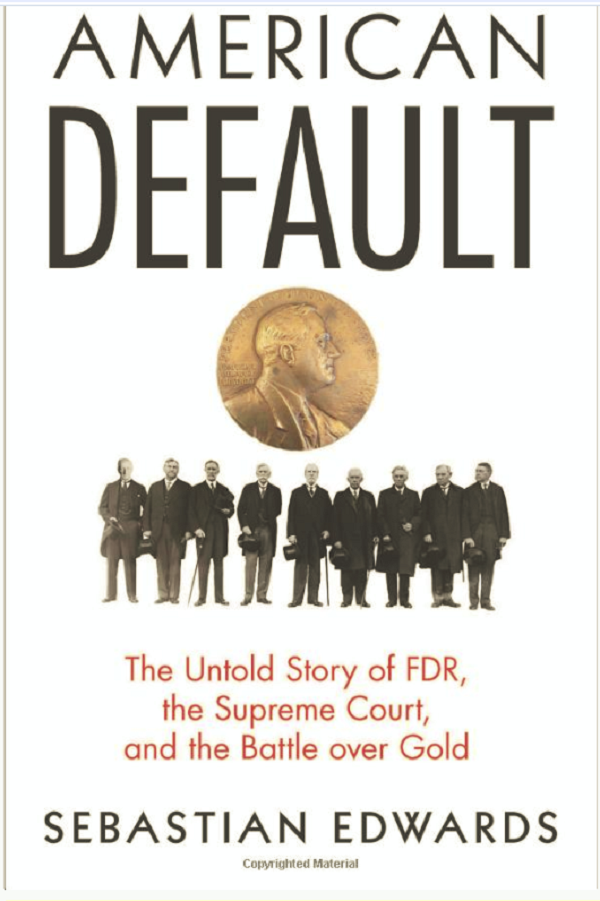
One of the most pervasive myths about the United States is that the federal government has never defaulted on its debts. There's just one problem: it's not true, and while few people remember the "gold clause cases" of the 1930s, that episode holds valuable lessons for leaders today. - Sebastian Edwards, Project Syndicate, May 21, 2018
My friend, UCLA professor, Sebastian Edwards, is out with a must-read summer book, American Default: The Untold Story of FDR, the Supreme Court, and the Battle over Gold.

Sebastian has also published an excellent synopsis of the the book, Learning from America's Forgotten Default, on the Project Syndicate (PS) website. It is an excellent introduction to the subject material but only scratches the surface and should not be a substitute or excuse for not purchasing the book.

Archaeology

Denmark: Archaeologists discovered mangled remains of slaughtered barbarian tribe

Bog bones Denmark
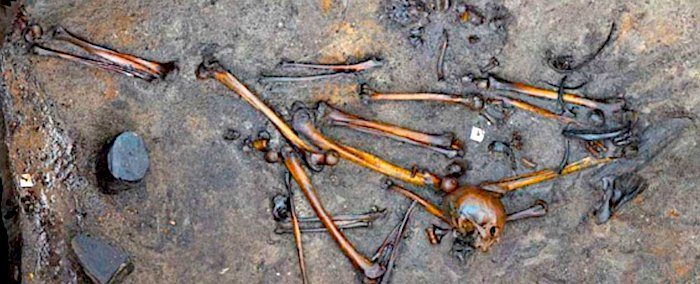
© Holst et al./PNAS/CC by 4.0One of the nearly 400 slaughtered barbarians buried at Alken Enge in Denmark.
Some 2,000 years ago, a ragtag troop of about 400 Germanic tribesmen marched into battle against a mysterious adversary in Denmark, and they were slaughtered to the last man.

Or at least that's the story their bones tell. Exhumed from Alken Enge - a peat bog in Denmark's Illerup River Valley - between 2009 and 2014, nearly 2,100 bones belonging to the dead fighters have given archaeologists a rare window into the post-battle rituals of Europe's so-called "barbarian" tribes during the height of the Roman Empire. In a new study published online May 21 in the journal Proceedings of the National Academy of Sciences, a team of researchers from Aarhus University in Denmark dug into the bloody details.

"The ferocity of the Germanic tribes and peoples and their extremely violent and ritualized behavior in the aftermath of warfare became a trope in the Roman accounts of their barbaric northern neighbors," the authors wrote in the new study. Despite these historical accounts, little evidence of these practices has ever been discovered in archaeological finds - until now.

Dominoes

How Gerald Ford's pardon of Nixon tore his administration apart

Gerold Ford Donald Rumsfeld watergate
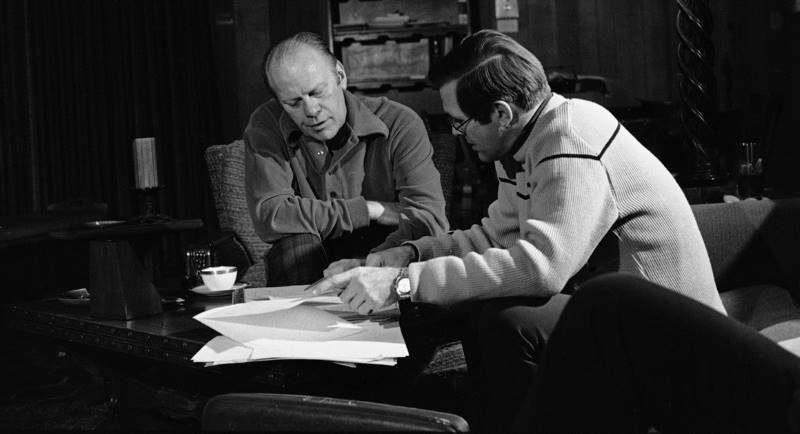
© Associated PressGerald Ford and Donald Rumsfeld
Gerald Ford and the decision that overshadowed his legacy.

When Gerald Ford became president minutes after Richard Nixon's resignation, Ford surprised many of us with how dramatically different he was in the role than his predecessor, starting with his very first Cabinet meeting.

During Nixon's administration, I had been a member of the Cabinet as counselor to the president, among other roles, and one of the Nixon-led Cabinet meetings still remains vivid in my mind. Fresh from his historic triumph in 1972, in which he'd won 49 out of 50 states, Nixon entered the Cabinet Room to rousing cheers and an extended standing ovation. But rather than enjoying the moment and expressing warm appreciation to his team, Nixon began a meandering yet colorful lecture with seemingly no clear point. He spoke of various British prime ministers and other men he admired, tossing in unusual comments, like, "Richard Nixon doesn't shoot blanks" and noting that Winston Churchill's father was a "brilliant man whose career was ruined by syphilis." Then he mentioned "exhausted volcanoes," a phrase he said British politician Benjamin Disraeli had used to describe public servants drained of their energy and inspiration.

Boat

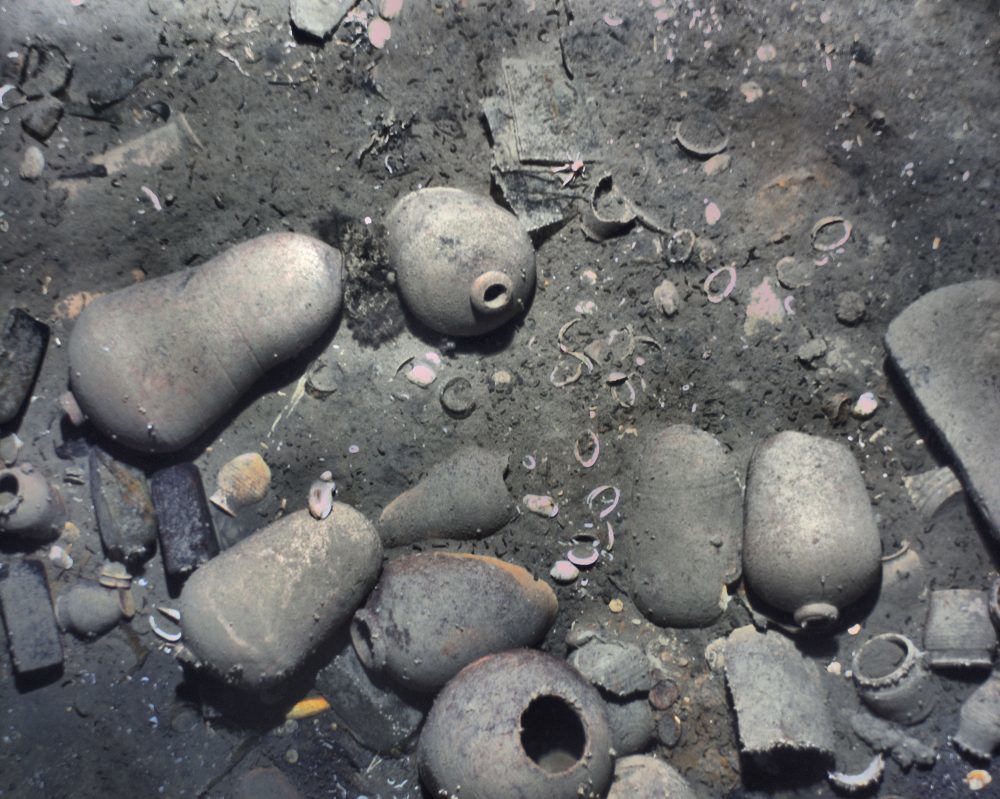
Holy Grail of shipwrecks: Details released on discovery of treasure laden Spanish galleon found near Colombian coast

Shipwreck San Jose Spanish galleon Colombia
The 62-gun, three-masted galleon, went down on June 8, 1708, with 600 people on board as well as a treasure of gold, silver and emeralds during a battle with British ships in the War of Spanish Succession. The treasure is worth as much as $17 billion by modern standards.
A Spanish galleon laden with gold that sank to the bottom of the Caribbean off the coast of Colombia more than 300 years ago was found three years ago with the help of an underwater autonomous vehicle operated by the Woods Hole Oceanographic Institution, the agency disclosed for the first time.

New details about the discovery of the San Jose were released on Monday with permission from the agencies involved in the search, including the Colombian government.

"We've been holding this under wraps out of respect for the Colombian government," said Rob Munier, WHOI's vice president for marine facilities and operations.

The exact location of the wreck of the San Jose, often called the "holy grail of shipwrecks," was long considered one of history's enduring maritime mysteries.

Comment: See also: Columbia discovers 'holy grail' of shipwrecks with treasure valued between $4 and $17 billion