Fire in the SkyS


Meteor

Mystery fireball lights up sky in Tasmania

A fiery meteor has lit up the sky over Victoria and Tasmania.

The object, described as a glowing red fireball moving horizontally across the sky about 10.45pm (AEDT) on Sunday, was an unusual sight for this time of year, according to astronomer David Reneke.

Observers say the meteor was visible for about 20 seconds.

Professor Reneke says he and his colleagues are at a loss to explain the timing and exact nature of the meteor.

It may have been a slow-moving piece of rock that ignited or a piece of space junk, he said.

"It's unprecedented, we don't seem to be in a meteor shower period at the moment," Professor Reneke said.

Meteor

Sungrazing Comet Swan Does Not Survive

Sungrazing Comet SWAN, which dove into the sun's atmosphere during the late hours of March 14th, apparently did not survive. In the following 10 hour movie, Comet SWAN enters the solar corona but does not exit again:


Comet SWAN was a Kreutz sungrazer, a fragment of the same ancient comet that produced sungrazing Comet Lovejoy in Dec. 2011. Comet Lovejoy famously survived its brush with the sun and put on a flamboyant show after it emerged from the solar fire. While Comet SWAN was cut from the same cloth, it was a smaller fragment that has completely evaporated.

The CME emerging from the sun's northwestern limb near the end of the movie was not caused by this tiny comet's impact. It is just another eruption of active sunspot 1429.

Stay tuned to comet expert Karl Battam's blog for updates.

Meteor

Another meteorite found in Oslo

Image
Liv Kibsgaard with her 700 gram meteorite
A woman out walking her dog on the large grassy hilltop plateau known as Ekebergsletta in Oslo found the second meteorite in as many days in Norway's capital on Tuesday. She said it was better that winning the local lottery.

"I laid awake several hours last night and thought about how lucky I was," Liv Kibsgaard told Norwegian Broadcasting (NRK) on Wednesday. Her brother, who is a geologist, advised her to be careful with the meteorite, wrap it up "and don't tell anyone right away."

Kibsgaard's discovery of a 700-gram meteorite lying on the grass at Ekeberg followed the discovery of a 585-gram meteorite on Sunday that had crashed through the roof of a cabin in Oslo's Rodeløkka district. Astrophysicist Knut Jørgen Røed Ødegaard had predicted on Monday that more meteorites could likely be found as well, and he's been proven correct.

"There are still probably more pieces lying around waiting to be found, because we can see on these stones that pieces have fallen off as they traveled through the atmosphere," Ødegaard said. "It's just to keep your eyes open. Now there are stones from outer space in Oslo and Akershus."

Meteor

Meteorite chunk falls on Oslo

Image
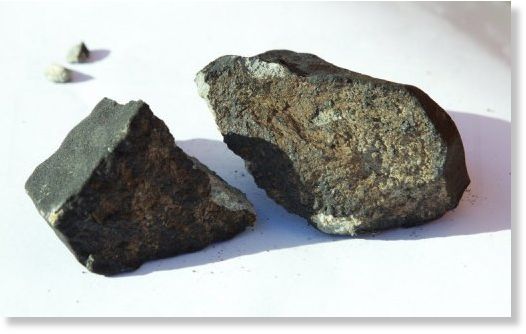
© Agence France-PresseAn apparent meteorite that split in two after hitting the roof of a cottage in central Oslo
A Norwegian family was flabbergasted to find that what appeared to be a piece of a meteorite had crashed through the roof of their allotment garden hut in the middle of Oslo, media reported Monday.

The rock weighing 585 grammes (one pound, four ounces), which split in two, probably detached from a meteorite observed over Norway on March 1, experts said, and had landed on the empty hut in the Thomassen family's allotment in a working-class neighbourhood of the Norwegian capital.

Astrophysicist Knut Joergen Roed Oedegaard and his wife Anne Mette Sannes, a meteorite enthusiast, identified the object as a breccia, or a rock composed of broken fragments of minerals or rock.

Sun

Huge Sphere in Sun's Corona? Or Electrical Phenomena?

Incredible!! March 11th, 2012.

SDO-AIA 171

SOHO EIT 171


Comment: It looks like a dramatic Birkeland current. Read The Electric Sky by Donald E. Scott, Ph.D. and The Electric Universe by Wallace Thornhill and David Talbott. Two good, basic books on the topic.


Sun

A Perfect Solar Superstorm: The 1859 Carrington Event

Image
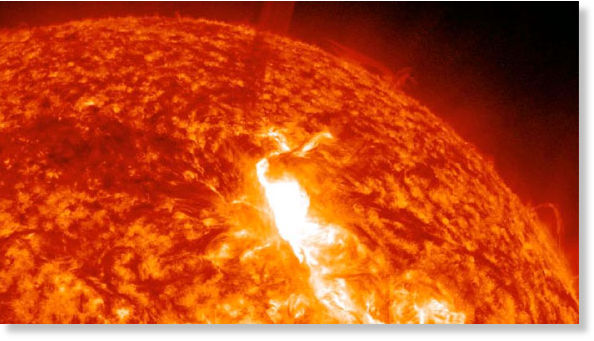
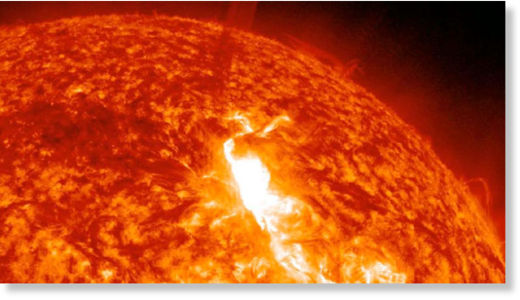
© NASAA solar flare erupts on January 22, 2012
Last Thursday, the world braced itself as the strongest solar storm in five years raced toward the planet. Fortunately, it delivered only a glancing blow, and global communications continued to operate without disruption. In 1859 Earth wasn't so lucky.

The Carrington Event

On the morning of September 1, 1859, amateur astrologer Richard Carrington ascended into the private observatory attached to his country estate outside of London. After cranking open the dome's shutter to reveal the clear blue sky, he pointed his brass telescope toward the sun and began to sketch a cluster of enormous dark spots that freckled its surface. Suddenly, Carrington spotted what he described as "two patches of intensely bright and white light" erupting from the sunspots. Five minutes later the fireballs vanished, but within hours their impact would be felt across the globe.

That night, telegraph communications around the world began to fail; there were reports of sparks showering from telegraph machines, shocking operators and setting papers ablaze. All over the planet, colorful auroras illuminated the nighttime skies, glowing so brightly that birds began to chirp and laborers started their daily chores, believing the sun had begun rising. Some thought the end of the world was at hand, but Carrington's naked eyes had spotted the true cause for the bizarre happenings: a massive solar flare with the energy of 10 billion atomic bombs. The flare spewed electrified gas and subatomic particles toward Earth, and the resulting geomagnetic storm - dubbed the "Carrington Event" - was the largest on record to have struck the planet.


Meteor

Kansans witness early morning meteor


A flash of light in the early morning sky over the Great Plains on Tuesday lit up social media and cyberspace as witnesses tried to figure out what they had seen.

"It was like the whole sky lit up for just a second," Joe Kleinsasser said in an e-mail about what he saw as he drove from Hillsboro to work at Wichita State University at about 6:45 a.m.

More than 50 people in five states - Oklahoma, Kansas, Arkansas, Nebraska and Missouri - reported the flash to the Lunar Meteorite Hunters website on Tuesday:

Bob Henry, program director at the Wichita State University Lake Afton Observatory, said the light appears to have been a meteor about the size of a baseball.

"Something that size is going to be very, very bright and very, very noticeable," Henry said.

Comment: Bob Henry doesn't know what he's talking about. Hundreds of thousands if not millions of people have seen meteors in recent years.

Fire in the Sky


Meteor

Bright Comet Dives Into Radiation Storm

A bright comet is diving into the sun. It was discovered just last week by SOHO's SWAN instrument, so it has been named "Comet SWAN." The comet's death plunge ( or "swan dive") comes just as the sun has unleashed a strong flare and radiation storm around Earth. SOHO images of the comet are confused to some degree by energetic protons striking the camera. Nevertheless, you can see Comet SWAN moving through the electronic "snow" in this 3 hour movie:


Couldn't find it? Here's a finder chart.

This is a Kreutz sungrazer, a fragment of the same ancient comet that produced sungrazing Comet Lovejoy in Dec. 2011. According to comet expert Karl Battams of the Naval Research Lab in Washington DC, "Comet SWAN is one of the brightest Kreutz-group comets ever observed by SOHO, although not quite as bright as Comet Lovejoy." Battams forecasts a peak magnitude of -1 for Comet SWAN, while Lovejoy was three magnitudes brighter at -4.

Will Comet SWAN survive its plunge through the sun's atmosphere as Comet Lovejoy did? Probably not, but experts also said Comet Lovejoy would not survive, and they were happily wrong. Stay tuned to Karl Battam's blog for updates.

Sun

Huge Coronal Hole Is Sending Solar Wind Our Way

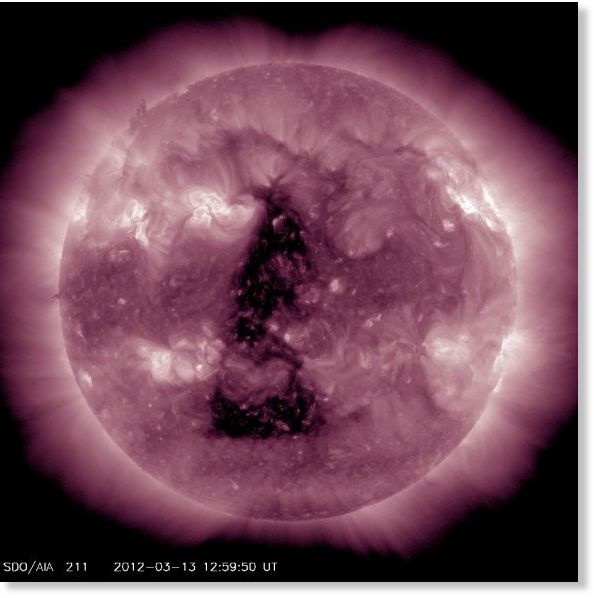
An enormous triangular hole in the Sun's corona was captured earlier today by NASA's Solar Dynamics Observatory, seen above from the AIA 211 imaging assembly. This gap in the Sun's atmosphere is allowing more charged solar particles to stream out into the Solar System... and toward Earth as well.
Image
© SDOSDO AIA 211 image showing a large triangular hole in the Sun's corona on March 13
Normally, loops of magnetic energy keep much of the Sun's outward flow of gas contained. Coronal holes are regions - sometimes very large regions, such as the one witnessed today - where the magnetic fields don't loop back onto the Sun but instead stream outwards, creating channels for solar material to escape.

The material constantly flowing outward is called the solar wind, which typically "blows" at around 250 miles (400 km) per second. When a coronal hole is present, though, the wind speed can double to nearly 500 miles (800 km) per second.

Meteor

Villain in disguise: Jupiter's role in impacts on Earth

Image
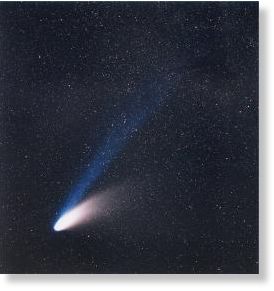
© ESOComet C/1995 O1 Hale-Bopp, which shone in the night sky in 1997.
Jupiter is often credited for shielding Earth from catastrophic asteroid and comet impacts. But new simulations of the influence of gas giant planets in solar systems casts doubt on Jupiter's reputation as Earth's protector.

Whilst most famous for his catalog of 110 galaxies, nebulae, clusters and double stars, Charles Messier was a comet-hunter at heart. His catalog was simply a list of nuisances, faint fuzzies that looked like comets but were not. The Frenchman found 13 comets in all between 1760 and 1785, but perhaps the most important of them was the streaking comet that he spotted in June 1770. Fast moving on the sky, it was bright enough at magnitude +2 that it could be clearly seen from well-lit towns and cities. A brief spectacle of wonder for eighteenth century astronomers to enjoy, its ramifications could have been much greater.

The comet has since become known as Lexell's Comet, after the Russian (yet Swedish born) astronomer Anders Johan Lexell who first calculated its orbit. He showed that the comet had made a close approach of just 2.2 million kilometers (0.015 AU), which is about six times the distance to the Moon. It was the closest a comet has ever been witnessed to approach the Earth and, in astronomical terms, a very near (and fortunate) miss.