Fire in the SkyS


Fireball 2

Global dust veil: Dust belt from the overhead cometary explosion in Russia raced around the world in just four days

  • The meteor created a 50-foot hole in a frozen lake near town of Chelyabinsk
  • Around 3.5 hours after the explosion, its dust belt moved east at 190 mph
  • In four days, the belt had snaked its way around the entire planet
  • It released 30 times more energy than the atomic bomb in Hiroshima
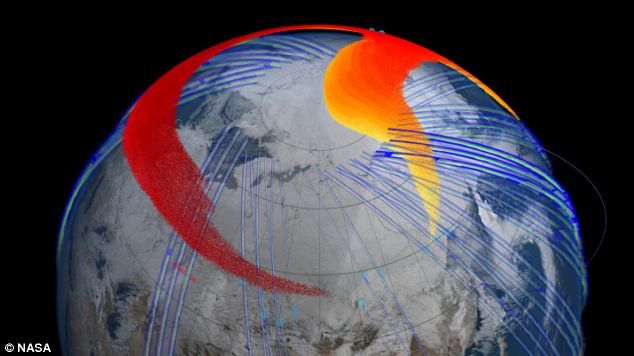
  • The meteor that exploded over Russia in February caused a thin stratospheric dust belt that travelled around the world in just four days.

    NASA satellites made the unprecedented measurements of the meteor which is thought to have released 30 times more energy than the atomic bomb that destroyed Hiroshima.

    The meteor fireball measuring 18 meters across and weighing 11,000 metric tons, screamed into Earth's atmosphere at 41,600 mph.

    Image
    Satellite data from Nasa has revealed that that four days after the bolide explosion, the faster, higher portion of the plume (red) had snaked its way entirely around the northern hemisphere and back to Chelyabinsk in Russia

    Comment: Are SOTT.net readers beginning to understand why we've been warning for years about comet dust veils covering the planet? Just one bolide can circle the northern hemisphere in 4 days! THOUSANDS of bolides have exploded in recent years...


    Fireball

    Best of the Web: Meteor that crashed in Russia was part of a 656-foot wide asteroid that broke off during its orbit around Earth

    Image
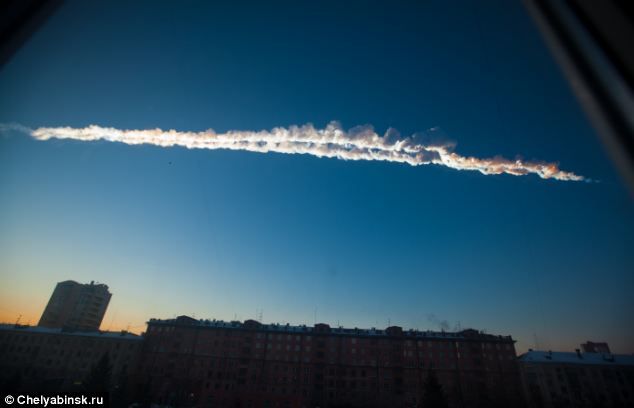
    The meteor fireball, pictured, that crashed into Russia in February was part of a 656-feet wide asteroid called 2011 EO40. Spanish astrophysicists analysed fragments of the meteor and claim it came from the Apollo asteroid that regularly crosses passed Earth as it orbits the sun
    Experts say the meteor weighed 10,000 tonnes and was 55 feet wide

    The rock created a 50-foot hole in a frozen lake near Chelyabinsk

    Scientists have analysed more than 53 tiny fragments of the meteor

    It is thought to have been part of a large Apollo asteroid called 2011 EO40


    The meteor fireball that crashed into Russia in February was part of a 656-foot wide asteroid called 2011 EO40.

    Spanish astrophysicists analysed fragments of the meteor that were scattered across the Russian town of Chelyabinsk, where the meteor landed, and claim it came from the large Apollo asteroid that regularly crosses passed Earth as it orbits the sun.

    They added that the piece may have broken off because of the stress caused by the gravitaional pull of the planets and the sun, or could have been caused by the asteroid hitting into something else during its orbit.


    Meteor

    Best of the Web: RT presenter: 'They can spy on all of us all of the time, but they can't tell us when one of these asteroids are gonna hit us?'

    The panic and havoc seen in the Russian Urals last winter when a meteor the size of a house exploded in the skies, may be set for a repeat. Scientists say the huge rock might not have been flying solo as first thought, but rather as part of a group of asteroids which still pose a threat to Earth.

    Comment: Yes, it does boggle the mind, doesn't it? All these years they have poured money into ways of controlling people rather than looking after their well-being and future... and now we are left completely exposed to civilization-destroying cometary catastrophe.


    Fireball 2

    THREE fireballs filmed from night-cam at Sakurajima Volcano in Japan, 20 July 2013

    The following footage appears to show three meteor/fireball/comet fragments falling through the sky over the very southern tip of Japan on July 20, 2013. In the foreground we see Sakurajima Volcano, in Kagoshima, Kagoshima Prefecture. The volcano has been very active lately, erupting several times in recent years.


    Fireball 5

    Probable comet fragment or meteor burns bright across Australian sky

    Fireball
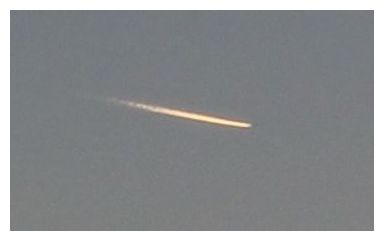
    © Willem Bruinsma Willem Bruinsma snapped this burning light in the sky at Noosa National Park.
    Experts believe a mysterious bright light in the sky north of Noosa was probably caused by the sun's light on a jet's contrail.

    The phenomenon appeared to be soaring across the sky for at least 20 minutes, just after sunset on Sunday.

    Owen Bennedick, of Wappa Falls Observatory, said it was likely to be an atmospheric event, as a meteor usually lasted a maximum five seconds.

    He added that the presence of any comets at the time would have been well documented.

    Comment:
    Owen Bennedick, of Wappa Falls Observatory, said it was likely to be an atmospheric event, as a meteor usually lasted a maximum five seconds.
    Presumably they meant to write 'unlikely'. Mr Bennedick ought to study the behaviour of fireballs and meteors - they can remain visible in the sky for hours.
    He added that the presence of any comets at the time would have been well documented.
    Comets, fireballs, and meteors, far from being 'well-documented', are largely ignored.


    Fireball 3

    Reports of bright 'fireball' in sky over Tennessee, Alabama

    There were reports of a bright fireball late on Sunday night and Monday in Tennessee, Alabama, and Mississippi. A number of unconfirmed reports were posted on the American Meteor Society website.

    "This was so very exciting for me. The colors were beautiful," wrote one user, Liz W., from Nashville, Tenn.

    Another person from Oakland, Tenn., wrote that the fireball was "low moving, passed behind cloud bank and glow could be seen through clouds."

    "The fire trail was a slender taper going from origin to point within the spacing of nine of the original diameter ... the [colors] were sharp:white core, moss green outside it, traces of blue.," wrote another.

    "It almost looked like this fireball was going to make impact," another wrote.

    The fireball sighting coincide with the Perseid meteor shower, which starts in mid-July to late August each year. It is unclear if the "fireballs" that people saw in the southeastern U.S. had to do with the Perseids.

    "It was larger than any meteor I have ever seen," wrote one person.

    On Twitter, at least one person said they heard a "loud boom."

    "Widespread reports tonight of bright fireball in the sky over TN, AL some hearing loud boom," wrote NewsBreaker.

    Fireball 2

    Meteor streaks across the sky over Northeastern Pennsylvania

    La Plume - A fireball seen streaking over Northeastern Pennsylvania early Friday was a meteor, according John Sabia, an assistant at Keystone College's Thomas G. Cupillari Observatory.

    The meteor, which was seen Friday about 12:52 a.m., was photographed by an observatory sky camera traveling across the night sky for 17 seconds.

    He described the meteor as slow moving and one of the brightest the camera has photographed.

    Fireball 5

    Spectacular fireball blazes over Eastern Australia, 30 July 2013

    Image
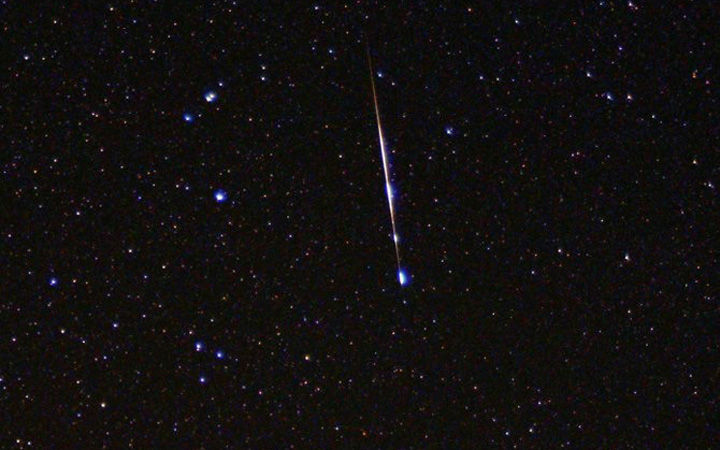
    © Jimmy WestlakeA Delta Aquarid meteor.
    Stargazers were treated to a rare sighting of a meteor fireball in the skies over the Hastings on Tuesday night.

    Port Macquarie resident Jeff Clare phoned the Port News to report what he described as a 'ball of flames' in the night sky sometime between 7pm and 8pm which moved slowly north before arching in shape and disappearing.

    Jeff's story prompted some lively discussion on Facebook, with several residents also reporting having seen the bright, firey light.

    However, according to Mid North Coast Astronomy Group founder and space expert David Reneke, anyone who managed to catch a glimpse of the fireball was extremely lucky.

    "We have just gone through an intense period of meteor shower activity," Mr Reneke explained.

    "We have about eight to 10 of these meteor showers every year, but the one that has just passed, and another coming up this month, are two of the best."

    The Delta Aquarids meteor shower passed over the southern hemisphere on July 28 and 29 and Mr Reneke believes the fireball over Port Macquarie is a remnant of that activity. The next meteor shower, the Perseids, has the space community excited with an estimated 50 to 80 meteor sightings expected every hour during the early hours of the morning between August 10 and 12.

    Fireball 5

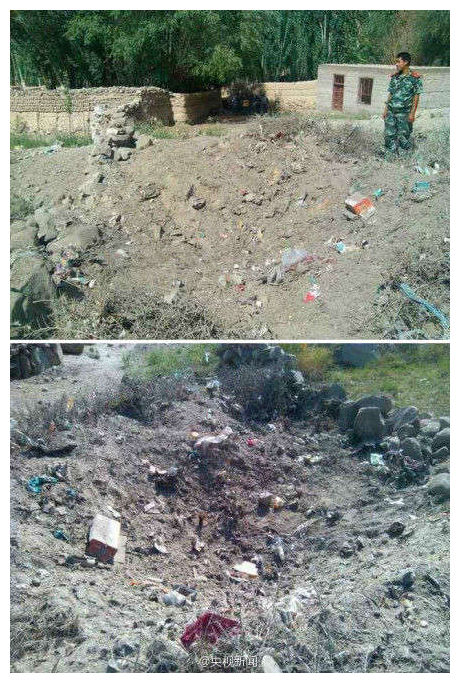
    Meteorite hits village in NW China

    Meteorite Impact
    © WeiboThis photo taken on August 1, 2013, shows the dump site which was hit by a meteorite in a village of Akto County of northwest China's Xinjiang Uygur Autonomous Region.
    A meteorite hit a village in northwest China's Xinjiang Uygur Autonomous Region on Thursday, CCTV.com reports.

    The meteorite crashed at a dump site in a village of Xinjing's Akto County around 2:00 a.m. Thursday and punched a 3-meter wide, 2-meter deep hole in the ground.

    Local authorities say no casualties have been reported and investigation and research work on the meteorite fragments is ongoing.

    Fireball 2

    Massive fireball ignites night sky over Puerto Rico, 21 July 2013