Science & TechnologyS


Gear

Why Advertisers Want to Know Your Deep, Dark Secrets

Psychologist Couch
© Shutterstock
Advertisers want to know all your quirky neuroses. That's because new research reveals that consumers are more likely to be persuaded by an advertisement that targets their personality type than one that caters to their demographic.

So, instead of creating ads that appeal to women between the ages of 25 and 40, for example, marketers should be focusing on targeting ads to nervous people or assertive people or impatient people, according to a study in the current issue of Psychological Science. The research suggests advertisements can be more effective when they are tailored to the unique personality profiles of potential consumers.

"Persuasive messages are often targeted toward specific demographic groups," said study author Jacob Hirsh, from the University of Toronto's Rotman School of Management. "We wanted to see whether their effectiveness could be improved by targeting personality characteristics that cut across demographic categories."

The research examined the reactions of more than 300 consumer to five different cellphone advertisements, each designed to target one of the five major trait domains of human personality: extraversion, agreeableness, conscientiousness, emotional stability and openness to experience.

2 + 2 = 4

Brain Shrinkage Results From Trauma

Image
© Matthew JordaanEmotional stress caused by last year's tsunami caused a part of some survivors' brains to shrink, according to scientists.
Emotional stress caused by last year's tsunami caused a part of some survivors' brains to shrink, according to scientists in Japan who grasped a unique chance to study the neurological effects of trauma.

On a quest to better understand post-traumatic stress disorder (PTSD), the researchers compared brain scans they had taken of 42 healthy adolescents in other studies in the two years before the killer wave, with new images taken three to four months thereafter.

Among those with PTSD symptoms, they found a shrinking in the orbitofrontal cortex, a part of the brain involved in decision-making and the regulation of emotion, said a study published Tuesday in the Nature journal Molecular Psychiatry.

Info

Bigfoot & Yeti DNA Study Gets Serious

Bigfoot
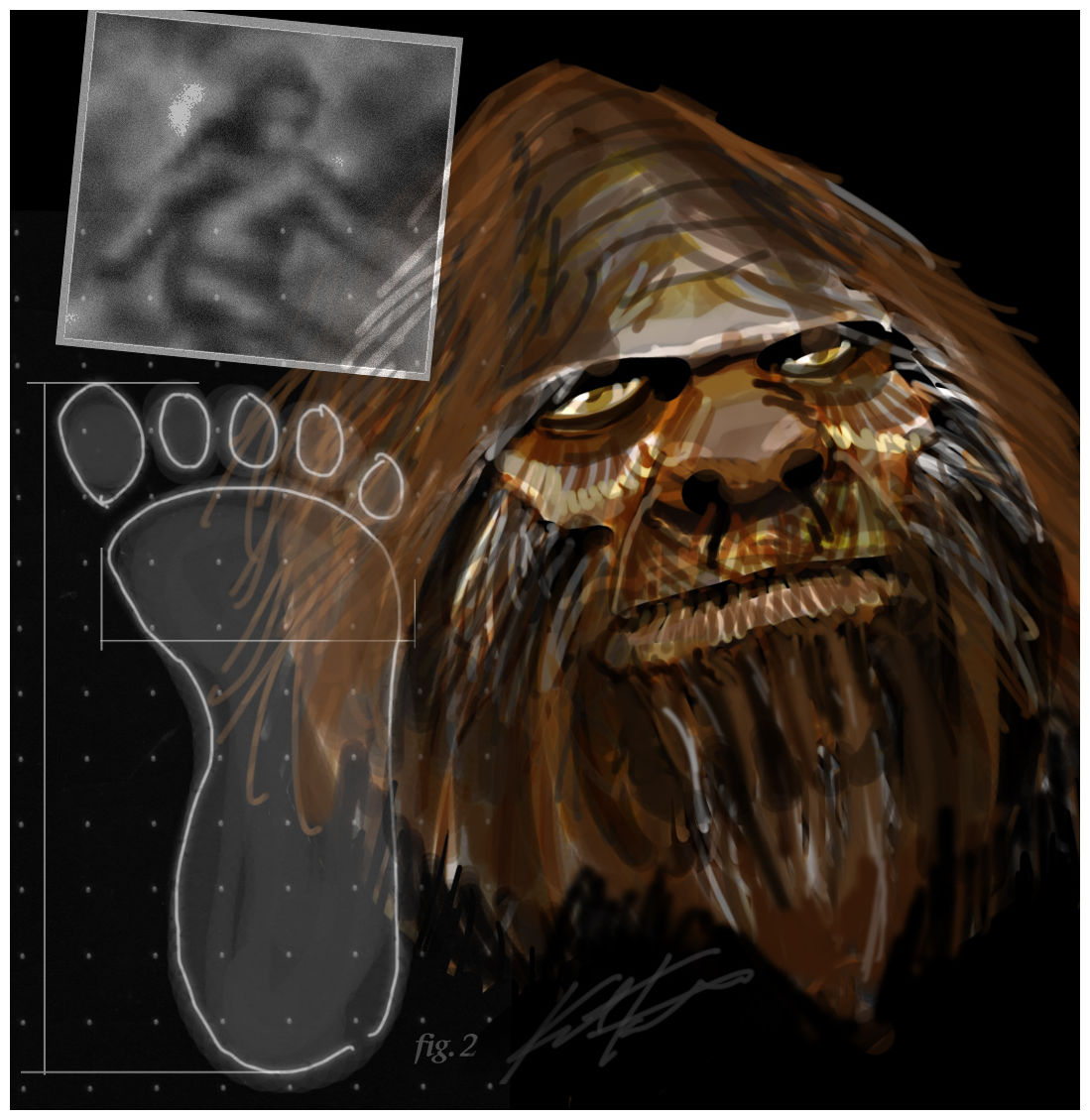
© Karl Tate, LiveScience Infographic ArtistAn artist's interpretation of Bigfoot.
A new university-backed project aims to investigate cryptic species such as the yeti whose existence is unproven, through genetic testing.

Researchers from Oxford University and the Lausanne Museum of Zoology are asking anyone with a collection of cryptozoological material to submit descriptions of it. The researchers will then ask for hair and other samples for genetic identification.

"I'm challenging and inviting the cryptozoologists to come up with the evidence instead of complaining that science is rejecting what they have to say," said geneticist Bryan Sykes of the University of Oxford.

While Sykes doesn't expect to find solid evidence of a yeti or Bigfoot monster, he says he is keeping an open mind and hopes to identify perhaps 20 of the suspect samples. Along the way, he'd be happy if he found some unknown species.

"It would be wonderful if one or more turned out to be species we don't know about, maybe primates, maybe even collateral hominids," Sykes told LiveScience.

Such hominids would include Neanderthals or Denosivans, a mysterious hominin species that lived in Siberia 40,000 years ago.

"That would be the optimal outcome," Sykes said.

The project is called the Oxford-Lausanne Collateral Hominid Project. It is being led by Sykes and Michel Sartori of the zoology museum.

Telescope

Mercury, Jupiter and the Pleiades are converging for a beautiful three-way conjunction

Mercury, Jupiter and the Pleiades are converging for a beautiful three-way conjunction. Unfortunately, it's happening in broad daylight. The two planets and the star cluster are only a few degrees from the sun. The Solar and Heliospheric Observatory (SOHO) photographed the encounter on May 22nd:
Image
© SOHO
SOHO uses a coronagraph to block the glare of the sun, revealing what the human eye cannot see. Later today, Mercury and Jupiter will pass in the noon sky less than 1/3rd a degree apart. Join SOHO for a ringside seat.

Rocket

SpaceX Successfully Launches Falcon 9 Rocket

Image
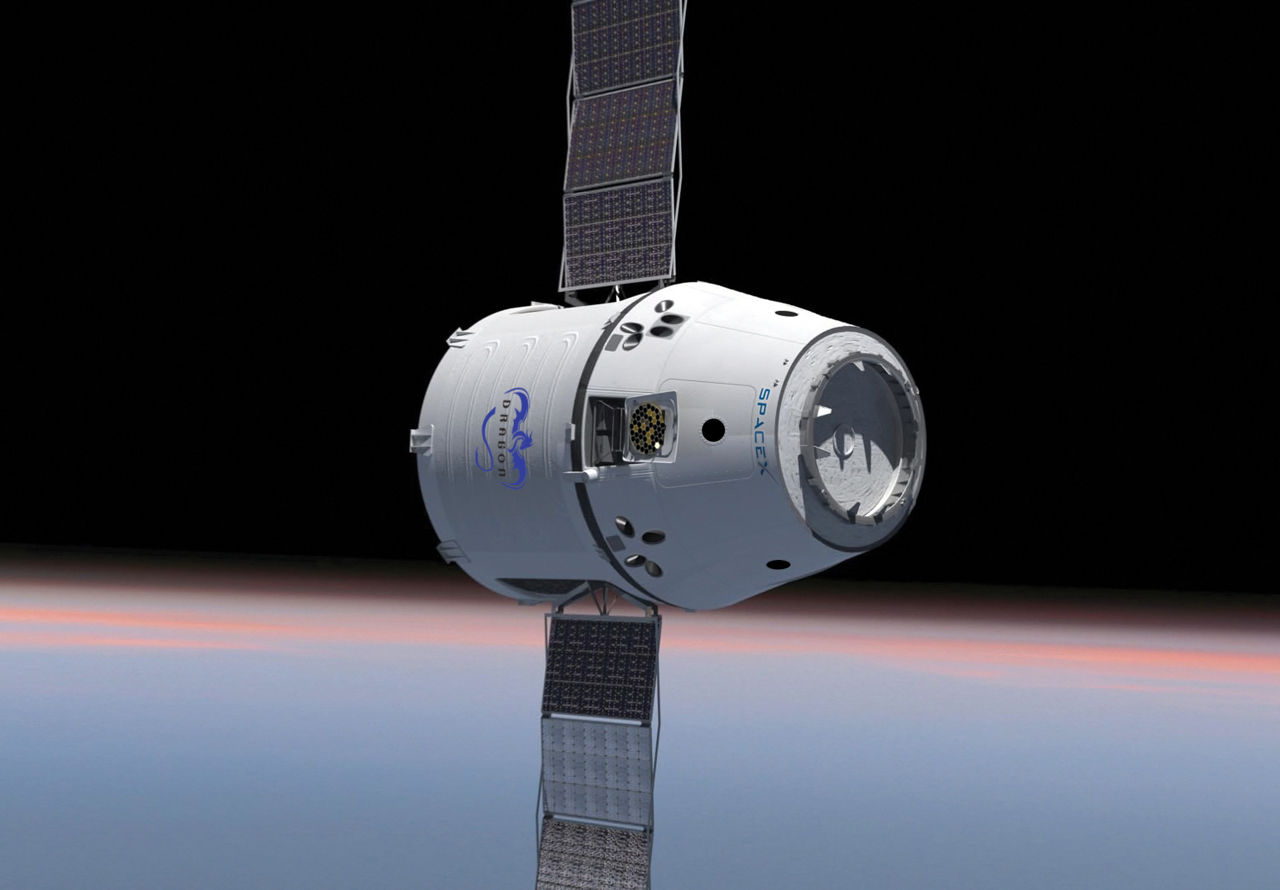
© SpaceXArtist's rendition of the Dragon space capsule in orbit with its solar arrays deployed.
Dragon capsule is on its way to the ISS

After scrubbing its planned launch on May 19 due to a faulty check valve, SpaceX proved its critics wrong this morning by successfully launching the Falcon 9 rocket with the Dragon capsule perched atop. The momentous launch took place at 3:44am EST this morning from Cape Canaveral, Florida.

SpaceX CEO Elon Musk -- also known for his ventures with Tesla Motors -- was understandably ecstatic about the success, and expressed his joy on Twitter, stating, "Falcon flew perfectly!! Dragon in orbit, comm locked and solar arrays active!! Feels like a giant weight just came off my back."

With its solar arrays deployed, the Dragon capsule is on its way to the International Space Station (ISS) and should dock with the station on Friday.

Meteor

NASA's Kepler Space Telescope Detects Possible 'Evaporating' Planet

Image
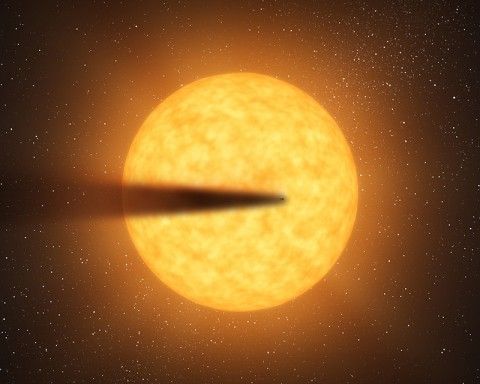
© NASA/JPL-CaltechThe artist's concept depicts a comet-like tail of a Mercury-size planet, perhaps forming from a comet whose orbit around the star stabilized?
Astronomers may have detected evidence of a possible planet disintegrating under the searing heat of its host star located 1,500 light-years from Earth. Similar to a debris-trailing comet, the super Mercury-size planet candidate is theorized to fashion a dusty tail. But the tail won't last for long.

Scientists calculate that, at the current rate of evaporation, the dusty world could be completely vaporized within 200 million years.

A research team led by Saul Rappaport, professor emeritus of physics at MIT, Boston, MA, has identified an unusual light pattern emanating from a star named KIC 12557548 in the Kepler space telescope's field-of-view.

NASA's Kepler space telescope detects planets and planet candidates by measuring dips in the brightness of more than 150,000 stars to search for planets crossing in front, or transiting, their stars.

Comment: Talk about missing the obvious! Clearly what they are witnessing is a planet IN FORMATION, not disintegration. But they can't acknowledge that because "comets are icy snowballs not proto-planets"...

Planet-X, Comets and Earth Changes by J.M. McCanney


Sun

Eerie Eclipse Photo: Blacked-Out Sun Caught Over Desert Lake

Eclipse 2012
© Phil McGrewCalifornia photographer Phil McGrew captured this image of the moon covering the sun's face from Pyramid Lake, Nevada. The solar eclipse occurred May 20, 2012, and was visible over much of the western U.S.
A California photographer captured this perfect "Ring of Fire" image of the May 20 solar eclipse from the Nevada desert.

The eclipse was visible Sunday in the western United States, but only skywatchers on the sun's central path got a view of the solar annulus, or the symmetrical ring of sun peeking out around the body of the moon. San Francisco currency trader and amateur photographer Phil McGrew was one of the lucky few.

"Myself and a few friends have been obsessing over this eclipse since January," McGrew told LiveScience.

McGrew and his friends weren't interested in settling for the "crescent sun" look that the eclipse would take on in San Francisco. To reach the eclipse's central path, they travelled five hours east to Pyramid Lake in Nevada. There, they figured, they'd have the best chance for good weather.

The sky didn't disappoint. [Gallery: Solar Eclipse Photos]

"There were a few low clouds but they offered very little interference," McGrew said. "The hardest part was simply keeping the sun nearly centered in the camera."

Camera

May 2012 Annular Solar Eclipse in Photos

Image
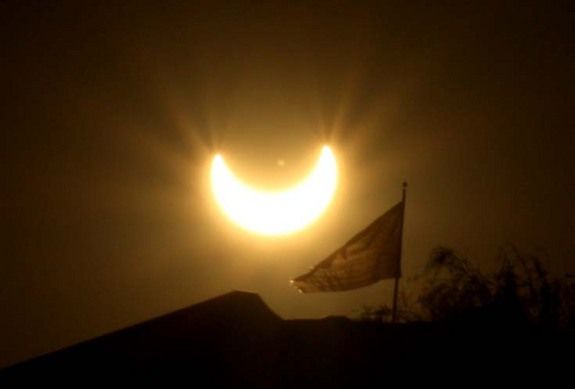
© Diana WardThis image of the annular solar eclipse and the american flag was taken by Diana Ward from Tucson, Arizona on May 20, 2012.

Meteor

Asteroid 2011 KP36 Now Appears to be a Comet

2011 KP36 was originally discovered as an asteroid by T. H. Bressi of Spacewatch survey on 2011, May 21. Its orbit was unusual (actually a=38.6 AU, e=0.87, i=19°), belonging to the outer Solar System. Its T3 parameter (respect to Jupiter) is 2.64, so it entered our T3 internal list of targets.

During observations of NEO 1998 OK1 with the 0.81-m f/4 of ARI Observatory (Westfield, code H21) on Apr. 19 Tomas Vorobjov serendipitously detected also 2011 KP36 in the same FOV. Stacking all the images together (totalling 30 minutes) with its proper motion vector, Tomas Vorobjov firstly noted its cometary appearance, with a coma 6″ wide and a possible tail 9″ long in PA around 10°. Its FWHM was 4.4″ while stars nearby were 3.5″.

Here is an animation from two cropped stacks (30×30 seconds each).

After his alert, Sergio Foglia and myself observed it the following day with the 2.0-m f/10 Faulkes Telescope North at Haleakala. Conditions were nearly the best possible and stacking 4×180 seconds images its cometary activity was quite clear. FWHM was 1.3″ while stars 1.1″, but the real confirmation was the presence (visually) of a round faint coma at least 7″ wide. Here is the image:

Comet 2011 KP36
© G.V.Schiaparelli Astronomical Observatory

Star

Another Possible Nova in Ophiuchus

Following the posting on the Central Bureau's Transient Object Confirmation Page about a possible Nova in Oph (TOCP Designation: J17395600-2447420) we performed some follow-up of this object remotely through the 0.43-m f/6.8 astrograph + CCD of ITelescope network (MPC Code - H06).

On our images taken on May 20.3, 2012 we can confirm the presence of an optical counterpart with unfiltered CCD magnitude 9.5 at coordinates:

R.A. = 17 39 57.00, Decl.= -24 47 07.3

(equinox 2000.0; CMC-14 catalogue reference stars).

Here you can see an animation showing a comparison between our confirmation image and the archive POSS2/UKSTU plate (R Filter - 1996).

Our confirmation image.

Nova in Oph
© Remanzacco Observatory