
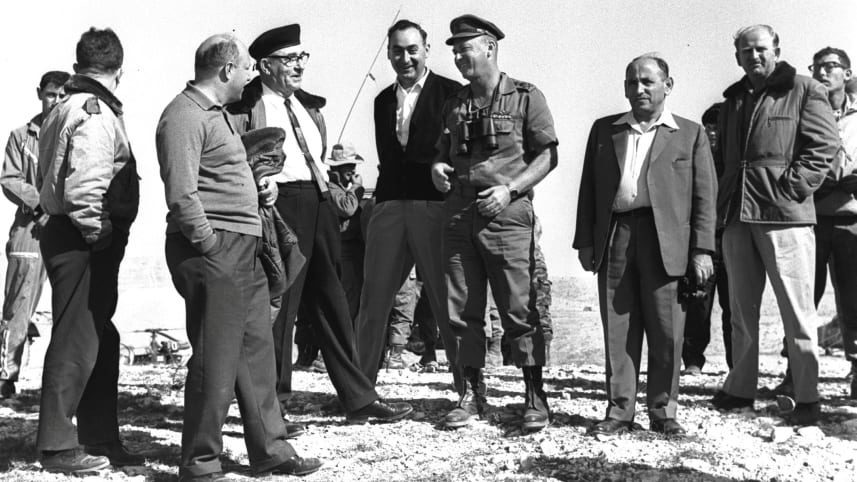
© Moshe Milner / GPOWar criminals: Prime Minister Levi Eshkol, Chief of Staff Yitzhak Rabin and Eshkol aide Isser Harel visiting the Negev, 1965.
Israel lifted its military rule over the state's Arab community in 1966 only after ascertaining that its members could not return to the villages they had fled or been expelled from, according to newly declassified archival documents.
The documents both reveal the considerations behind the creation of the military government 18 years earlier, and the reasons for dismantling it and revoking the severe restrictions it imposed on Arab citizens in the north, the Negev and the so-called Triangle of Locales in central Israel.
These records were made public as a result of a campaign launched against the state archives by the Akevot Institute, which researches the Israeli-Palestinian conflict.
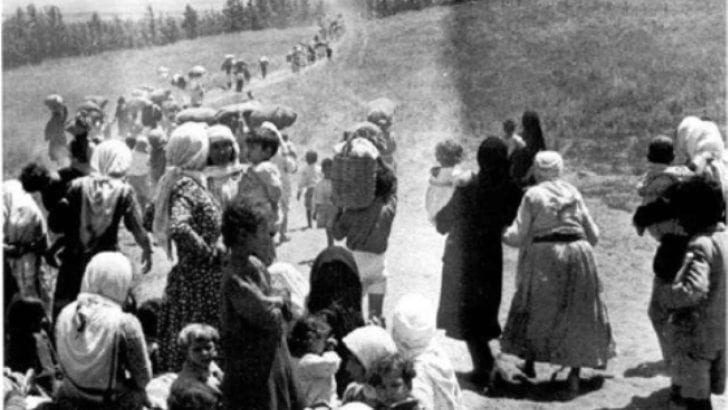
Palestinians fleeing their homes during the Nakba – the Catastrophe – of 1948 when they were forced from their land by the new state of Israel
The newly revealed documents describe the ways Israel prevented Arabs from returning to villages they had left in 1948, even after the restrictions on them had been lifted. The main method: dense planting of trees within and surrounding these towns.
At a meeting held in November 1965 at the office of Shmuel Toledano, the prime minister's adviser on Arab affairs, there was a discussion about villages that had been left behind and that Israel did not want to be repopulated, according to one document. To ensure that, the state had the Jewish National Fund plant trees around and in them.
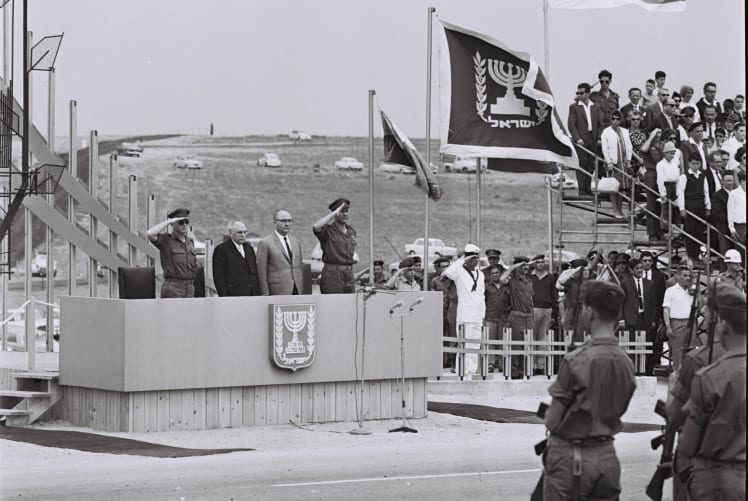
© Fritz Cohen / GPOChief of Staff Yitzhak Rabin, President Zalman Shazar and Prime Minister Levi Eshkol during Independence Day parade, 1965.
In the meeting in Toledano's office, it was explained that these lands had been declared closed military zones, and that once the structures on them had been razed, and the land had been parceled out, forested and subject to proper supervision - their definition as closed military zones could be lifted.
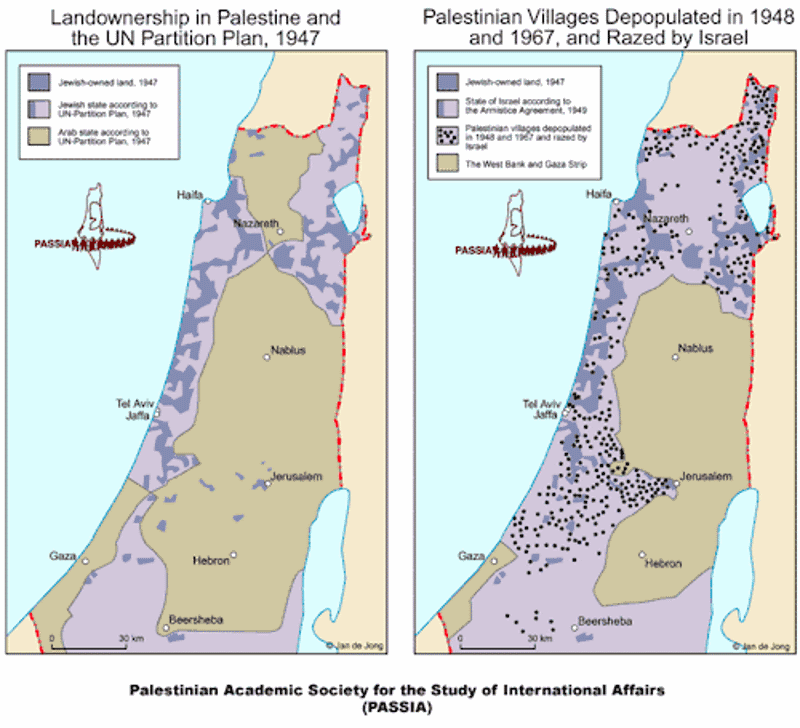
© PASSIAMap of Palestinian Land owned & stolen 1947-67
Landownership in Palestine and the UN Partition Plan 1947
Palestinian Villages depopulated & razed by Israel in 1948-1967
Landownership in Palestine and the UN Partition Plan 1947
Palestinian Villages depopulated & razed by Israel in 1948-1967
The newly publicized record of that meeting shows that the Shin Bet was already prepared at that point to lift the military rule over the Arabs and that the police and army could do so within a short time.
Regarding northern Israel, it was agreed that "all the areas declared at the time to be closed [military] zones... other than Sha'ab [east of Acre] would be opened after the usual conditions were fulfilled - razing of the buildings in the abandoned villages, forestation, establishment of nature reserves, fencing and guarding." The dates of the reopening these areas would be determined by Israel Defense Forces Maj. Gen. Shamir, the minutes said. Regarding Sha'ab, Harel and Toledano were to discuss that subject with Shamir.
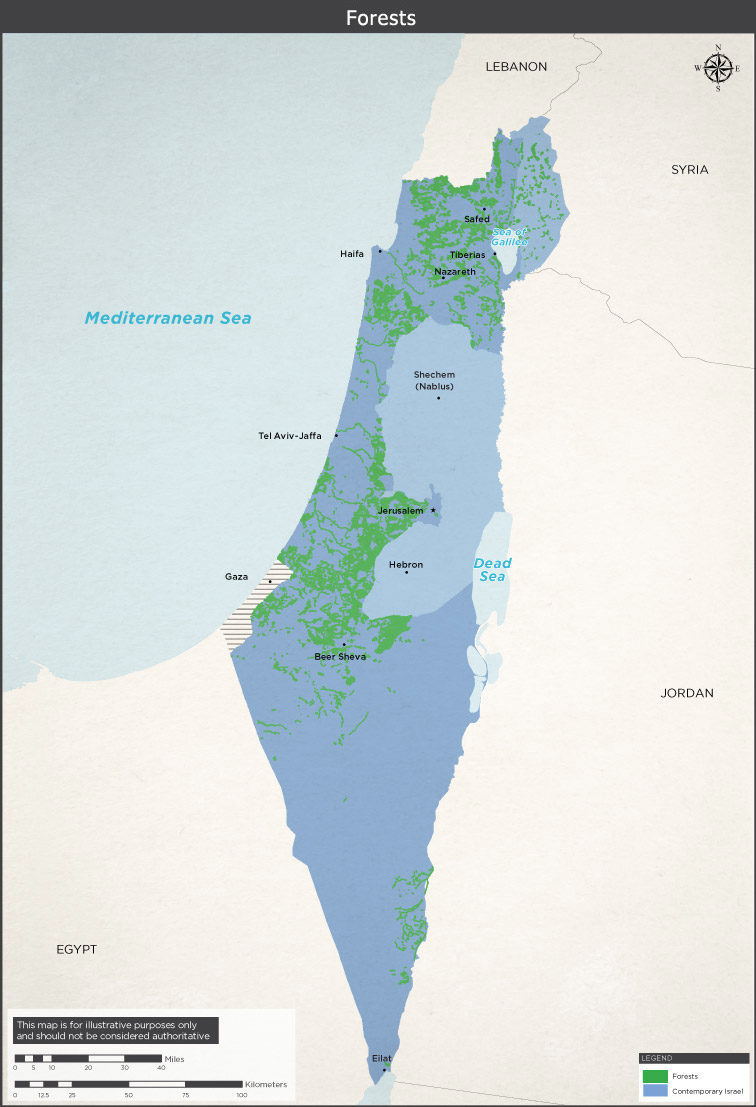
© IDF Mapping UnitForests were planted on razed Palestinian villages
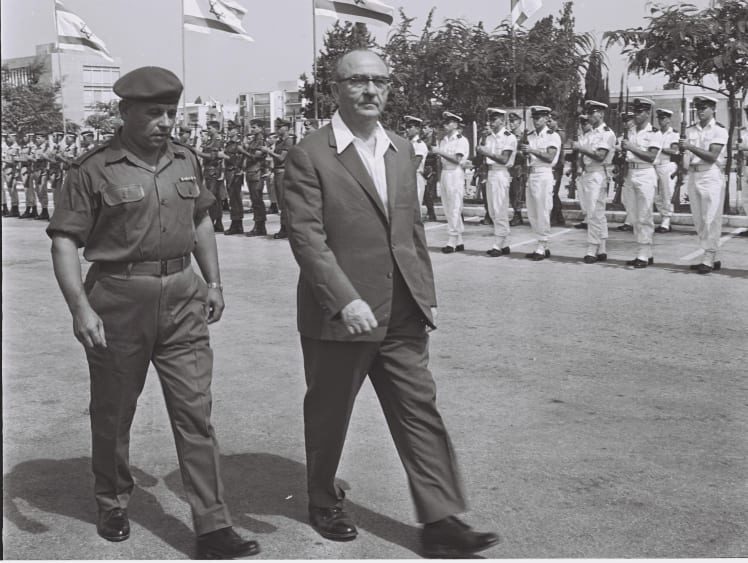
© Fritz Cohen / GPOPrime Minister and Defense Minister Levi Eshkol at the entrance to the Defense Minister in Tel Aviv, 1963.
Among other things, Shamgar wrote in the pamphlet that Regulation 125, allowing certain areas to be closed off, is intended "to prevent the entry and settlement of minorities in border areas," and that "border areas populated by minorities serve as a natural, convenient point of departure for hostile elements beyond the border." The fact that citizens must have permits in order to travel about helps to thwart infiltration into the rest of Israel, he wrote.
Regulation 124, he noted, states that "it is essential to enable nighttime ambushes in populated areas when necessary, against infiltrators." Blockage of roads to traffic is explained as being crucial for the purposes of "training, tests or maneuvers." Moreover, censorship is a "crucial means for counter-intelligence."
Two-year campaign
Despite Shamgar's opinion, later that year, Prime Minister Levi Eshkol canceled the requirement for personal travel permits as a general obligation. Two weeks after that decision, in November 1963, Chief of Staff Tzur wrote a top-secret letter about implementation of the new policy to the officers heading the various IDF commands and other top brass, including the head of Military Intelligence. Tzur ordered them to carry it out in nearly all Arab villages, with a few exceptions - among them Barta'a and Muqeible, in northern Israel.
In December 1965, Haim Israeli, an adviser to Defense Minister Eshkol, reported to Eshkol's other aides, Isser Harel and Aviad Yaffeh, and to the head of the Shin Bet, that then-Chief of Staff Yitzhak Rabin opposed legislation that would cancel military rule over the Arab villages. Rabin explained his position in a discussion with Eshkol, at which an effort to "soften" the bill was discussed. Rabin was advised that Harel would be making his own recommendations on this matter.
At a meeting held on February 27, 1966, Harel issued orders to the IDF, the Shin Bet and the police concerning the prime minister's decision to cancel military rule. The minutes of the discussion were top secret, and began with: "The mechanism of the military regime will be canceled. The IDF will ensure the necessary conditions for establishment of military rule during times of national emergency and war." However, it was decided that the regulations governing Israel's defense in general would remain in force, and at the behest of the prime minister and with his input, the justice minister would look into amending the relevant statutes in Israeli law, or replacing them.
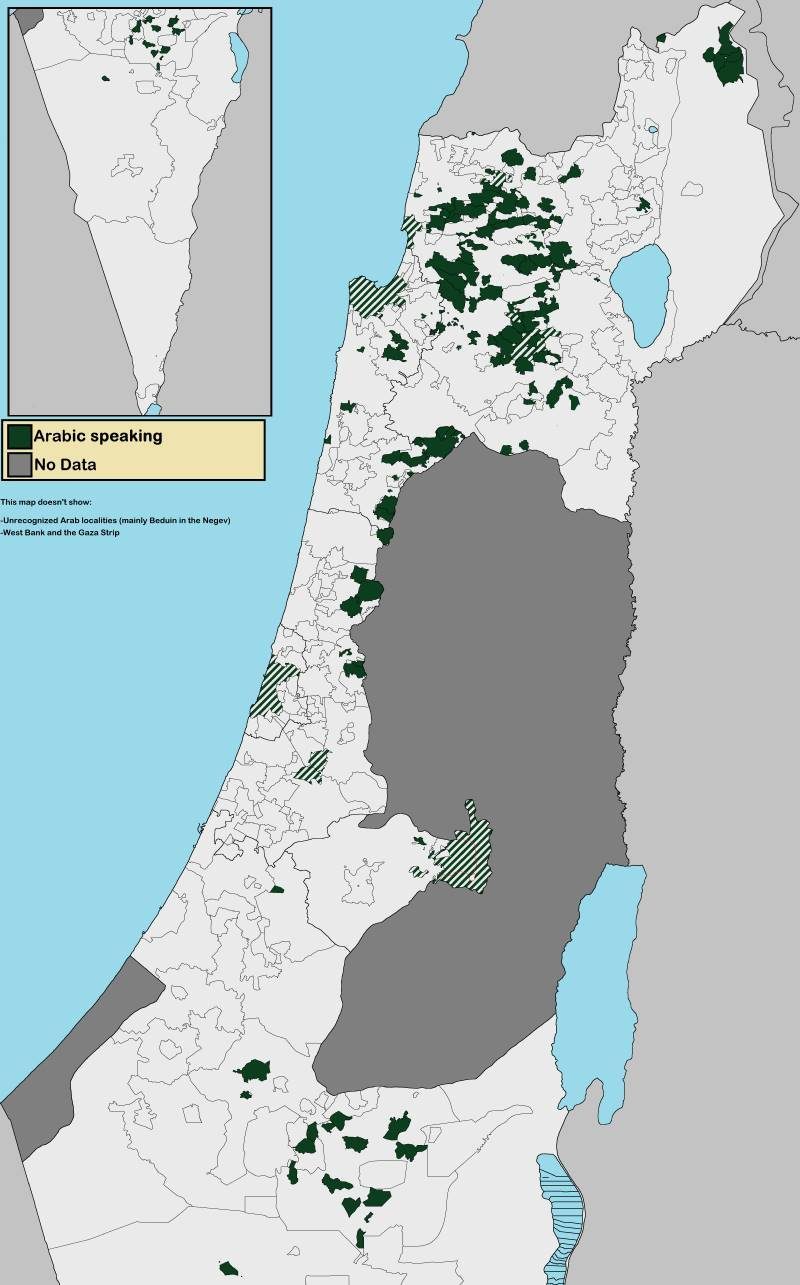
© Bolter21/WikipediaAll the Arabic speaking localities in the State of Israel (including East Jerusalem and the Golan Heights) as of 2015. Striped represent officially mixed cities (by law, at least 2% Arabs in a Jewish majority city). Note: Jerusalem is officially a mixed city but the map shows the boundries of Arab and Jewish neighborhoods.
"Hundreds of thousands of files which are crucial to understanding the recent history of the state and society in Israel remain closed in the government archive," he said. "Akevot continues to fight to expand public access to archival documents - documents that are property of the public."






Comment: For a comprehensive history of the Nakba, see Ilan Pappe's The Ethnic Cleansing of Palestine, which was based on the IDF's own records of the war for Palestine and the systematic expulsion of the native Arab population.