RTSun, 20 Jan 2019 23:34 UTC
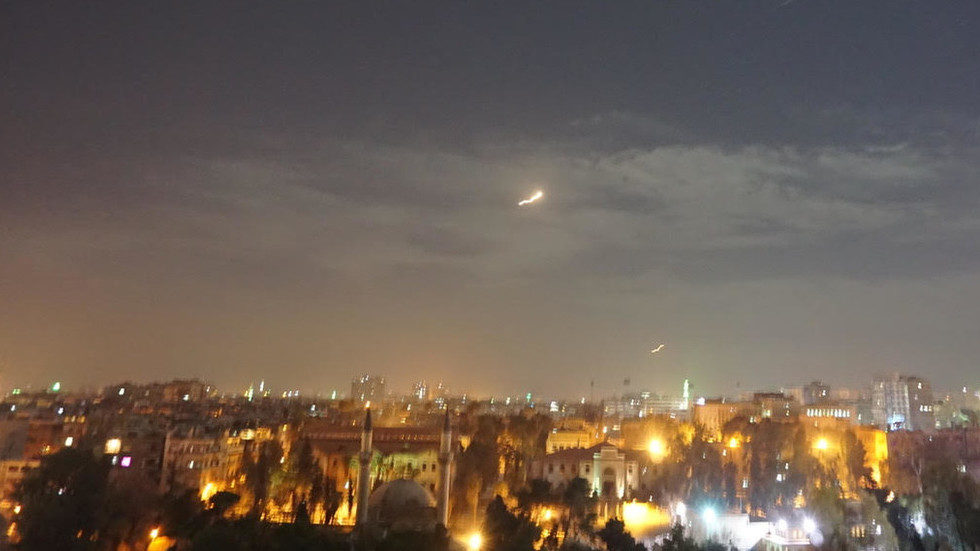
© Global Look Press/ ZUMA PressSyria's air defenses repel an Israeli missile attack over Damascus on Jan.21, 2019.
Syrian air-defense systems have repelled an attack in the skies over Damascus, state news agency SANA has reported. The Israeli Army said it was attacking "Iranian Quds" forces and warned the Syrian military not to retaliate.
A military source cited by SANA said that Syrian air-defenses intercepted most of the Israeli missiles before they hit targets. The source added that
Israel launched guided missiles from ground and air in several rounds.In a brief
statement on Twitter, the Israel Defense Forces (IDF) warned the Syrian Army "against attempting to harm Israeli forces or territory."
Witnesses on the ground reported hearing explosions above Damascus throughout the city. Images posted on social media show bright flashes in the sky as missiles were apparently destroyed mid-flight.
Reports on social media indicated that Israel conducted several rounds of strikes
over more than half an hour.The attacks reportedly proceeded deep into the night and stopped at around 2am local time.SANA, citing its own correspondent,
reported that the missiles were flying over Lebanese territory and the Galilee Panhandle, the northernmost part of Israel, which borders Lebanon.
Earlier on Sunday, Syrian air-defenses repelled another Israeli air raid. According to the Russian Defense Ministry, four Israeli F-16s launched guided missiles into Syrian territory.
Seven missiles were intercepted, with no damage reported on the ground.Israel has been routinely attacking targets inside Syria that it claims belong to Iran, with the stated goal of preventing Iranian forces from gaining a foothold in the country.
The airstrikes often go unacknowledged by the IDF, but in a recent interview outgoing IDF Chief of Staff Gadi Eisenkot revealed its true scale: "thousands of targets" hit in "near-daily" strikes, with 2,000 bombs dropped in 2018 alone.
Comment: Sputnik
reports:
[...]
"The Israeli enemy struck a massive air and ground attack with several 'waves' of guided missiles. Our air defense systems immediately began to repel the attack of enemy missiles. A significant part of the missiles destroyed before they reached the targets", the source said.
State broadcaster Ikhbariya reported that air defense forces had shot down "tens" of Israeli targets. The broadcaster noted that various types of weapons had been used in the attack and that the missiles had been launched from the airspace of Lebanon, as well as from the northern part of the Israeli region of Galilee and from the area of Lake Tiberias.
[...]
Later in the day, the Israeli Air Forces struck, in response to an a attempt of an alleged missile attack on Golan Heights, several air defense targets in Syria, including alleged Iran's Syria-based arms depots, reconnaissance facility and a training camp, the IDF claimed in a twitter statement on Monday.
Israeli Prime Minister Benjamin Netanyahu's press office said on Sunday that "our permanent policy is to oppose Iran's attempts to gain a foothold in Syria and to hurt those who is trying to hurt us".
Earlier in January, Netanyahu vowed to continue confronting military activities in Syria allegedly conducted by Iran.
"Our position is clear. We will continue to act against the Iranian military entrenchment in Syria, including at present, and we will act against any element that undermines, or attempts to undermine, the security of Israel", Netanyahu said.
The Israeli military estimated the number of air strikes over the past two years at 200. Tel Aviv, Tehran's long-time regional opponent, has repeatedly expressed security concerns over an alleged Iranian military presence next to its borders in Syria.
Israel has officially taken a neutral stance on the seven-year Syrian civil war, however, and Tel Aviv claims the IDF has been conducting air raids in Syria allegedly against the Lebanese paramilitary group Hezbollah and also to counter what it claims is alleged Iran's military presence in the neighboring country.
Hezbollah has been reportedly supporting the Syrian government in the civil war since 2012. Hezbollah has repeatedly claimed that its troops came to Syria after receiving an invitation from Damascus and were ready to leave the country as soon as the government asks.
Tel Aviv has a bellicose relationship with Damascus' Lebanese ally Hezbollah and Iran, and repeatedly strikes its alleged targets in the conflict-torn country. According to Tel Aviv, Iran allegedly seeks to turn Syria into a military foothold and Israeli activities in Syria are aimed to curb Tehran's aspirations. Tehran has repeatedly stressed that only its military advisers operate in Syria.
And RFE/RL
reports on a blast that struck a Damascus security facility curiously around the same time, although in this instance the claims are that it was a terrorist on the ground and their affiliation is not yet clear:
A bomb blast has hit Damascus on January 20, in a rare attack in the Syrian capital.
A war monitor reported a "huge explosion" near a military intelligence office in the south of the city that left a number of people dead and wounded.
The blast was followed by shooting, said the Britain-based Syrian Observatory for Human Rights
The state news agency SANA reported that the "bomb blast" hit southern Damascus "without leaving any victims," and said a "terrorist" was arrested.
The explosion came as a bomb in the northern Syrian city of Afrin killed three people and wounded nine others, according to the Observatory, on the first anniversary of the start of a military operation by Turkey and allied rebels in the Kurdish-majority region.
There was no immediate claim of responsibility for the blasts in Damascus and Afrin.
Meanwhile, Israel said it intercepted a rocket fired from Syria's Israeli-occupied Golan Heights after Damascus accused the Jewish state of carrying out air raids on the south of the country.
Syrian air defenses destroyed seven projectiles after four Israeli F-16 military planes "fired rockets into Syrian territory," according to the Russian military.
Israel's military declined comment on the air strike.
Russia and Iran have given Syrian President Bashar al-Assad crucial military and diplomatic support throughout the nearly eight-year war that has killed hundreds of thousands of people and displaced millions.
Israel has pledged to stop Iran from entrenching itself militarily in Syria, carrying out hundreds of air strikes there against Iranian targets and those of Lebanon's Shi'ite militant group Hizballah.
Update (Jan 21): The Israeli military
released their footage of the strikes:
The Russian Ministry of Defense
announced that the attacks killed four Syrian soldiers and partially damaged the infrastructure of the Damascus international airport". They also
revealed that Syrian Air Defenses destroyed over 30 Israeli cruise missiles and guided bombs. The Syrian Foreign Ministry
made the clear point regarding the attacks: that Israel operates under a double standard because of its relationship with the US:
Such attacks are possible only thanks to the unlimited support provided by the US administration, the immunity from investigations extended to Israel by a number of countries in the UN Security Council, as well as the complete silence regime that these countries have imposed in the UN Security Council to prevent this body from fulfilling its role in repelling these criminal attacks






Shalom