
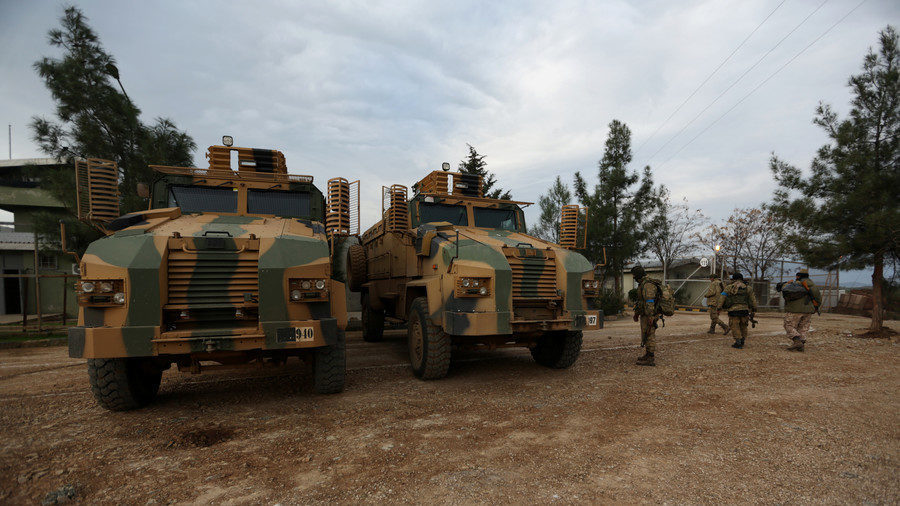
© Khalil Ashawi / ReutersTurkish-backed Free Syrian Army fighters are seen next to military trucks in Northern Afrin countryside, Syria, February 16, 2018
Several conflicting reports have been coming from Syria, suggesting either success or failure of alleged negotiations between Damascus and the Kurdish People Protection Units (YPG) fighters. The negotiations were reportedly aimed at getting help from the Syrian government to repel the ongoing Turkish offensive on the Kurdish-held enclave of Afrin.
On Sunday Reuters citied Badran Jia Kurd, an adviser to the Kurdish self-government, as saying that the military assistance agreement had been reached. Jia Kurd noted that the deal, which could see Syrian forces enter Afrin within two days, will be limited exclusively to immediate military support.
When it comes to the political and administrative matters in the region, it will be agreed upon with Damascus in the later stages through direct negotiations and discussions," he said. Officially, Damascus has not spoken out on the possible agreement, and the YPG's spokesman confirmed only that a request had been made for Syrian forces to protect Afrin.
Even if a deal came into force it would still rest on shaky foundations, Jia Kurd admitted. He said it was hard to predict how long the deal would hold, since it does not sit well with either side.
"We don't know to what extent these understandings will last because there are sides that are not satisfied and want to make (them) fail," he said without elaborating.
It comes just a few days after media reports indicated there were negotiations between Kurdish militias and the Syrian government, which had stalled. The Syrian government reportedly withdrew from the talks after Kurds refused to lay down their weapons in return for military assistance, an RT Arabic correspondent reported on Thursday, citing a military source. Several other networks, including Arab TV network Al Mayadeen and Sputnik, ran reports based on their own sources saying that the deal had been secured, without providing any details of the conditions.
Speculation about a more active role for Damascus in the Afrin confrontation arose back in January, when the Kurdish self-administration urged Damascus to protect Syrian sovereignty by sending troops to Afrin. Last Monday, YPG commander Sipan Hamo said that he would have "no problem" with the Syrian Army intervening in the conflict to drive away the Turkish forces.
Turkey, which has been carrying out Operation Olive Branch in Afrin since January 20, insists that the offensive is solely aimed at wiping out terrorists, denying allegations that it has targeted civilians.
Turkish President Recep Tayyip Erdogan also vowed to return the enclave to its "original owner" after it is "liberated" from YPG.
The offensive will allow some 500,000 displaced Syrians to return to their homes in Afrin, Turkey's first lady Emine Erdogan said on Friday, claiming that "the aim of this operation is to ensure safety in the region."
President Erdogan has repeatedly indicated he would like to expand the operation further and move into Manbij, where US forces supporting the Kurdish-dominated Syrian Democratic Forces (SDF) are stationed; this has raised fears of a potential clash between the two NATO allies. At a recent meeting in Ankara, US Secretary Rex Tillerson and Turkish Foreign Minister Mevlut Cavusoglu agreed that the bilateral relations were at "a crisis point," calling the situation around Manbij a "priority" that needed to be addressed urgently. Turkey also touted the idea of a joint US and Turkey deployment in the area, on condition that the US guarantees a prompt withdrawal of the Kurdish YPG forces.






Comment: See also:
- Turkish FM Mevlut Cavusoglu says Ankara-Washington ties at very critical point - Turkey will close Incirlik airbase if needed, Turkish official says
- Tillerson pledges limited weapon supplies to SDF, Manbij now priority in Syria
- 'Productive and open talk': Tillerson, Erdogan meet amid heightened strain over Operation Olive Branch
- Turkey supports Syria's territorial integrity, says Foreign Minister
- Afrin Kurds turn to Syrian Army to protect borders from Turkish offensive
- Damascus may be about to deploy Syrian Army in Afrin - To repel 'Turkish invasion', or 'Kurdish uprising'?
Update: On the back of reports that Syrian pro-government forces are to enter Afrin, Ankara said "no one can stop" its soldiers if "the regime" comes to help Kurdish militias, but added that Syrians fighting them will be "no problem." The Turkish foreign minister has commented on recent reports made by Syrian state TV that pro-Syrian government forces would enter Syria's Afrin "within hours." Turkish Deputy Prime Minister Bekir Bozdag has commented on reports about the possible deployment of Syrian government forces to Afrin during a news conference following a cabinet meeting. The Presidents of Russia and Turkey have discussed the situation in Syria via phone call, including the Turkish military operation in Afrin, as stated by the press service of the Kremlin.