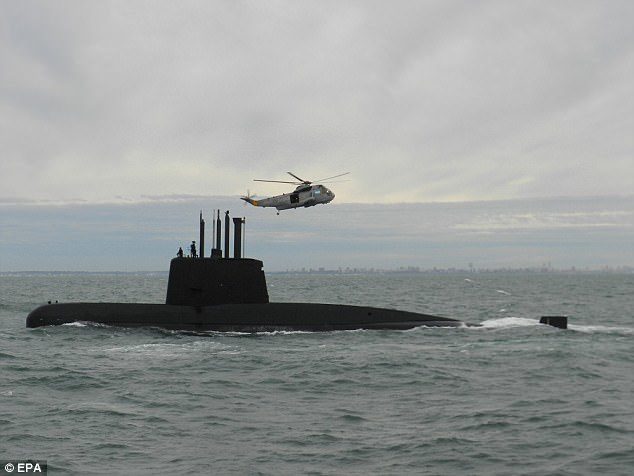
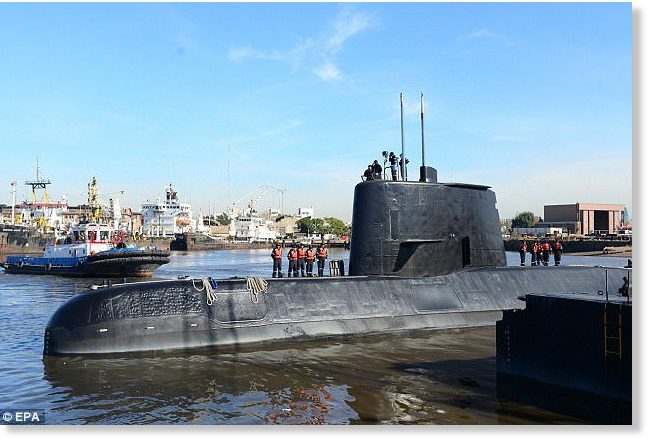
The ARA San Juan (pictured in a file photo) last contacted the Argentine navy on Wednesday while 250 miles off the coast of Patagonia and has not been heard from since
The US Navy has deployed one of its high-tech surveillance aircraft to help find a missing Argentine attack submarine which went missing three days ago.
NASA has also sent a surveillance aircraft to the scene, diverting it from a mission studying Antarctic ice.
The
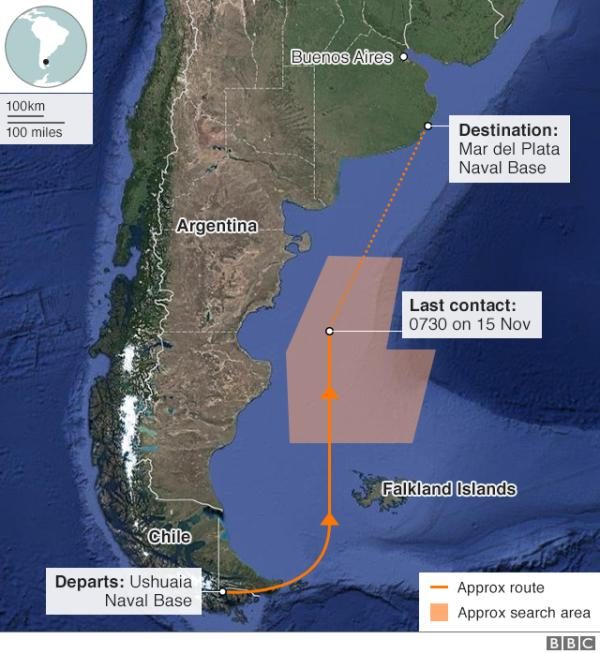
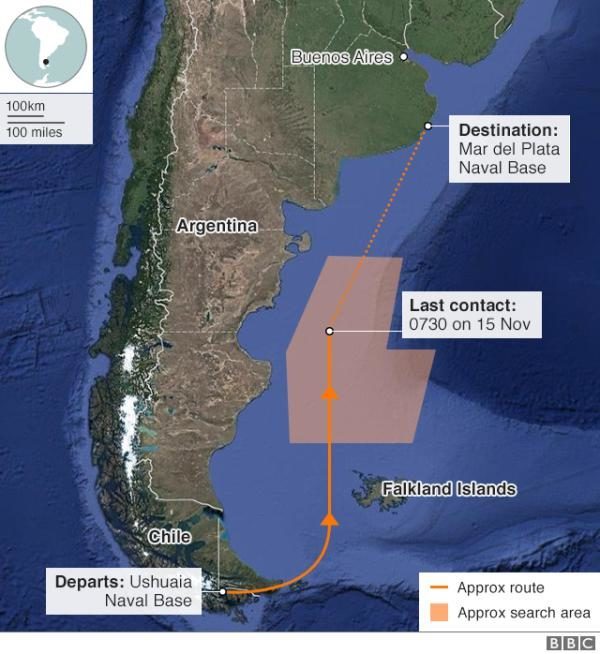
ARA San Juan was last in contact with its base on Wednesday when it was almost 270 miles from the coast of Patagonia.
The US Navy diverted one of its P-8A Poseidon maritime surveillance aircraft to Bahia Blanca, Argentina to help with the search for the missing submarine.
According to the US Southern Command: 'The aircraft and its 21-person crew will depart El Salvador's Comalapa Air Base, where it was supporting counter-illicit trafficking maritime patrol operations.
'Once in Bahia Blanca, they will join the ongoing international search for the Argentinean Navy vessel and its crew, as requested by the government of Argentina.'
The US Navy said the P-8A Poseidon is its newest patrol and reconnaissance aircraft with 'state-of-the-art sensors and communications equipment'.
It can spend four hours patrolling a search area and has a range of 1,200 miles.
Argentine naval spokesman Enrique Balbi said the emergency operation was formally upgraded to a search-and-rescue procedure on Friday evening
after no visual or radar contact was made with the submarine. 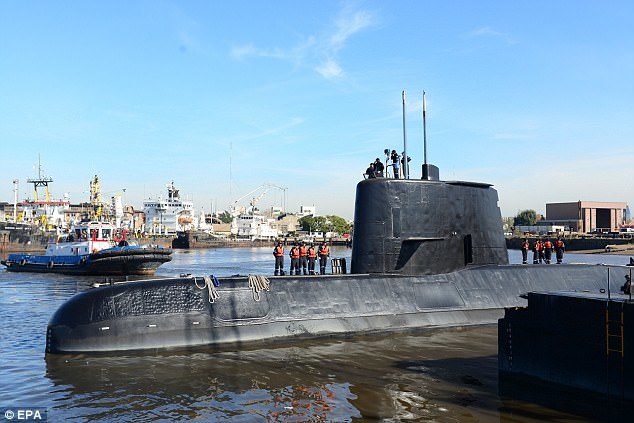
Argentine naval officials hope the submarine may have suffered a communication problem and is currently on the surface although there have been no radar or visual sightings
He said: ' Detection has been difficult despite the quantity of boats and aircraft.'
High winds and heavy seas have hampered the search.
The navy believes the submarine, which left Ushuaia en route to the coastal city of Mar del Plata in Buenos Aires province,
had communication difficulties that may have been caused by an electrical outage, Balbi said. Navy protocol would call for the submarine to come to the surface once communication was lost.
He said: 'We expect that it is on the surface.'
The German-built submarine, which uses diesel-electric propulsion, was inaugurated in 1983, making it the newest of the three submarines in the navy's fleet, according to the navy.
President Mauricio Macri said the government was in contact with the crew's families.
Comment: Update (Nov. 19): Attempts sent on Saturday from San Juan submarine lasted between four and 36 seconds,
says defence ministry.
Seven failed satellite calls were detected on Saturday that Argentina's defence ministry believes could be from submarine that went missing in the south Atlantic three days ago with 44 crew on board.
The attempts - which lasted between four and 36 seconds - "indicate that the crew is trying to re-establish contact" after communications were lost on Wednesday said the navy. The defence ministry said it was working on tracing the location of the calls with an unnamed US company that specialised in satellite communications.
It was not immediately clear what type of calls the ARA San Juan submarine might have tried to make but submarines that are stricken underwater can float a location beacon known as an emergency position indicator radio beacon (EPIRB) to the surface that can then emit emergency signals via satellite.
...
Offers for aid have been received also from South Africa and Brazil, as well as other South American nations.
Argentina's foreign minister, Jorge Faurie, tweeted. "I am deeply grateful to all the friendly nations who are collaborating in the humanitarian search we Argentinians are undertaking."
Argentina's president, Mauricio Macri, has moved to the coastal city of Chapadmalal, near Mar del Plata, because of the situation.
Update (Nov. 20): The international search for the missing Argentinian submarine with 44 crew on board is continuing after a naval commander confirmed the vessel did surface to report an
electrical malfunction.
The military sub surfaced Wednesday to report an electrical issue and was ordered to go back to its base, according to naval commander Gabriel Galeazzi. "The submarine surfaced and reported a malfunction, which is why its ground command ordered it to return to its naval base at Mar del Plata," Galeazzi told reporters on Monday.
The alarm was raised by the Argentinian navy on Friday after the vessel failed to make contact for 48 hours. The crew was returning from a routine mission to Ushuaia, near the most southern tip of South America, when the German-built diesel-electric submarine lost contact.
Rescuers hoped that satellite calls detected over the weekend were from the missing crew, however a navy spokesman confirmed on Monday that the calls did not come from the vessel.
International air and sea search missions by Brazil, Britain, Chile and the US were hindered by bad weather conditions. Waves were up to six meters when the sub went missing, but rescuers are honing in on a 300km radius surrounding the last point of contact with the vessel.
While it's still unclear exactly what happened, a navy spokesperson said an electrical problem may have suddenly cut off the vessel's communications. One possible scenario is that the submarine's communications malfunctioned, but its navigation remains intact. However, such a theory has lost steam after the crew failed to dock as planned Sunday.
Update (Nov. 23): A
"hydro-acoustic anomaly" was detected near where the Argentinian submarine ARA San Juan went missing, three hours after it sent its last communications a week ago, the navy
revealed yesterday.
The anomaly occurred at 30 nautical miles north of the last position from where the submarine had communicated with the navy, spokesman Enrique Balbi said.
A US institute detected the anomaly, but only informed Argentina about it now.
Balbi had earlier said it was unlikely the submarine exploded, because an explosion of that magnitude in the sea would not have gone undetected.
The spokesman said three navy vessels were on their way to the area to check whether the submarine was there.
Hopes of rescuing the vessel's 44 crew before its week's supply of oxygen runs out have been repeatedly raised and dashed by false alarms triggered by undersea noises, a lifeboat and flare rockets, all initially thought to have come from the submarine.
"It's a noise. We don't want to speculate" about what caused it, Balbi said of the anomaly.
Family members of the crew meanwhile criticised the rescue effort. "We are really amazed that they are not finding it, it is impossible at this stage that they don't know where it is," Claudio Rodriguez, brother of one of the crew members, said.
"How can you lose a 60-metres long navy vessel, even if it is under water?" Rodriguez told radio Cielo
.
Argentina has accepted help from Russia in the search. President Mauricio Macri
said the Russian leader, Vladimir Putin, had phoned him to offer to deploy a survey vessel and crew with experience of similar operations.
More than a dozen countries, including the US, are taking part in the search. Brazil, Chile, Colombia, France, Germany, Peru, South Africa, Uruguay and the UK are among the countries that have sent either ships or planes to help with the search.
The last contact was made at 07:30 local time (10:30 GMT) on Wednesday 15 November. It is not known what happened to the sub after that contact.
© BBC
As baffling as the sub's disappearance is, its apparent failure to use any of a number of distress signals or mechanisms at its disposal is troubling. For starters, the boat's commanders could have released an emergency buoy that would have positioned the sub for searchers with radio SOS signals.
The San Juan also is equipped with an ejectable cylinder that releases green fluid a half mile in diameter once it reaches the surface. Moreover, the vessel has large life rafts that can be released if an abandonment is expected.
Officials have theorized that either searchers have yet to come across any of these distress signals or that the submarine was quickly and devastatingly incapacitated by a cataclysmic event onboard.







R.C.