Animals
S


Attention

A Last (Chemical) Gasp for Bees?

Image
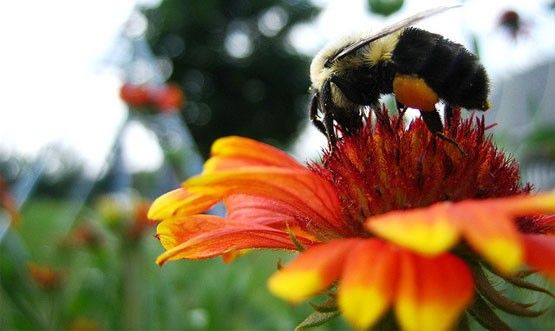
© Brian Wolfe
Colony collapse disorder threatens food crops valued at $15 billion a year. New research says farm chemicals put our food system at risk.

Newly published scientific evidence is bolstering calls for greater regulation of some of the world's most widely used pesticides and genetically modified crops.

Earlier this year, three independent studies linked agricultural insecticides to colony collapse disorder, a phenomenon that leads honeybees to abandon their hives.

Beekeepers have reported alarming losses in their hives over the last six years. The USDA reports the loss in the United States was about 30 percent in the winter of 2010-2011.

Bees are crucial pollinators in the ecosystem. Their loss also impacts the estimated $15 billion worth of fruit and vegetable crops that are pollinated by bees in the United States.

The studies, conducted in the United States, France, and the United Kingdom, all pointed to neonicotinoids, a class of chemicals used widely in U.S. corn production, as likely contributors to colony collapse disorder. The findings challenged the EPA's position - based on studies by Bayer CropScience, a major producer of the neonicotinoid clothianidin - that bees are only exposed to small, benign amounts of these insecticides.
Attention

Thousands of Shellfish Found Dead in Peru

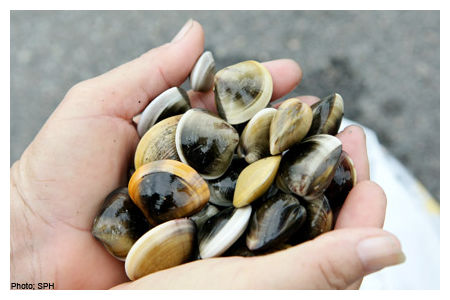
Dead Shellfish
© SPH

Thousands of crustaceans were found dead off the coast of Lima following the mystery mass death of dolphins and pelicans, the Peruvian Navy said Friday.

The cause of death is under investigation, said Industry and Fishing Minister Gladys Triveno, warning that "it would be premature to give a reason for this phenomenon."

The Navy said it presented a report on the find to the Agency of Environmental Evaluation and Control to determine the cause.

Biologist Yuri Hooker of Cayetano Heredia University said the species found on Pucusana Beach, 60 kilometers (37 miles) south of Lima, was a type of red krill about three centimeters (1.2 inches) long.

"They live mostly along the coast of Chile up to the coast of northern Peru. What is happening is that these crustaceans are being affected by the warming of Pacific waters in the north of the country," he said, adding that the phenomenon occurs "with some frequency."

Bizarro Earth

Hundreds of Endangered Antelopes Dying in Kazakhstan

Antelopes
© Zee News
Astana: A massive wave of deaths has been reported among the endangered saiga antelopes in Kazakhstan. Around 540 carcasses of the animal has been found in the country, RIA Novosti reported Thursday.

According to the Kazakh agriculture ministry, the carcasses were found in the Kostanai region.

"Aviation monitoring today (Thursday) discovered a new concentration of saiga deaths with the approximate number of dead animals reaching beyond 400," the ministry said.

Last year, at least 12,000 saiga antelopes died in Kazakhstan, presumably from pasteurellosis infection and from overeating. In November 2010, Kazakhstan introduced a ban on saiga hunting.

The latest statistics put the number of saiga antelopes in Kazakhstan at 85,500. The country spends $800,000 annually to prevent the deaths.

Saiga were virtually exterminated in the 1920s but then their numbers increased in the 1950s. The animals mostly became endangered because of hunting and the high demand for their horns in traditional Chinese medicine.

Saiga are also found in Russia's Kalmykia region and in Mongolia.

Bizarro Earth

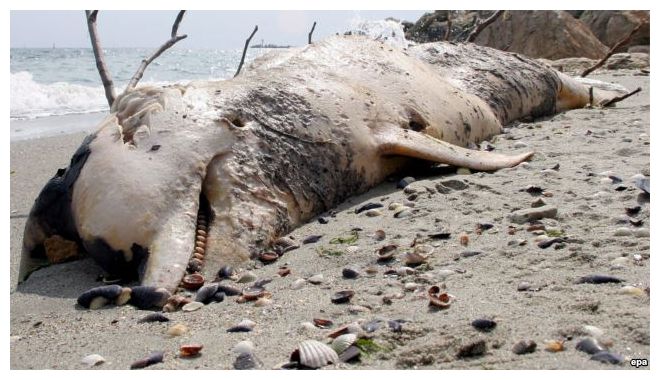
Black Sea Ecologists Alarmed By Dolphin Deaths

Dead Dolphin
© EPAAn increasingly common sight on Russia's and Ukraine's Black Sea coast.

Hardly a day goes by in Sochi, Russia's picturesque Black Sea resort, without a dead dolphin washing up on the beach.

With the tourist season just kicking off, the unexplained deaths have yet to draw much scrutiny.

But environmentalists are increasingly alarmed. The dolphin carcasses are also turning into a real holiday spoiler for vacationers drawn to the region's scenic beaches and pristine vistas.

Russian tourist Aida Kobzh was shocked to discover a group of dead dolphins last week at her local beach in Sochi.

"Everyone stood there and stared at the dead little dolphins lying belly up. Poor creatures!" Kobzh says. "There were some on the beach but also in the water, they were floating there, dead.

Bizarro Earth

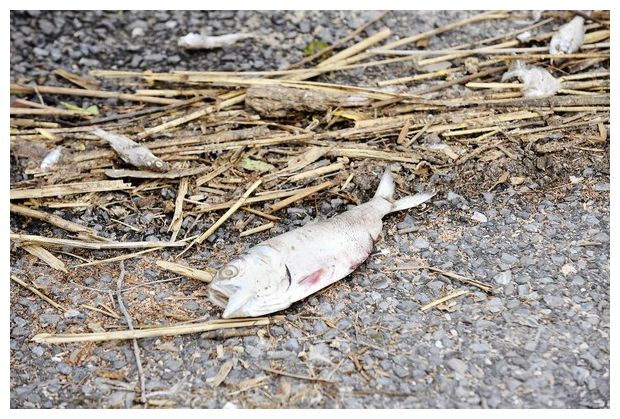
60,000 to 100,000 dead fish wash up eastern shores of U.S. near Chesapeake Bay

Mass-Die Off
© Gene Sweeney Jr., Baltimore SunThe state Department of Environment investigated a fish kill by the boat ramp in Merritt Point Park.
Something's rotten on the Baltimore area waterfront. Fish are washing ashore by the thousands in a mass die-off that officials say appears to be caused by a weather-driven worsening of the pollution that chronically plagues the Chesapeake Bay.

State investigators expanded their probe Wednesday into what they believe are algae-related fish kills in Marley, Furnace and Curtis creeks in Glen Burnie, raising the estimated death toll there tenfold, while finding a new batch of finny carcasses in a Dundalk creek.

Jay Apperson, spokesman for the Maryland Department of the Environment, said the agency's fish-kill investigators estimated anywhere from 60,000 to 100,000 fish of several species dead in the three creeks in northern Anne Arundel County. Only a day before, Apperson had said investigators figured there were about 6,000 dead.

"You could smell it through the neighborhood," said Rob Rogers, 45, who took a break from work at the Point Pleasant Beach Tavern to describe what he called "unbelievable" conditions on the creeks. Rogers said boaters reported dead fish floating in the water so thick they couldn't avoid hitting them.

The state investigators also found about 300 dead fish in Bullneck Creek in eastern Baltimore County, Apperson said, where residents on Tuesday had reported seeing fish and crabs thrashing on the water's surface in apparent distress. The investigators measured little oxygen in the creek's deepest water for fish to breathe.

Bizarro Earth

Dolphin Deaths in Peru: The Mystery Deepens

The mystery surrounding the deaths of at least 877 dolphins in Peru deepened on Wednesday as the government said human activity was not to blame but failed to pinpoint a natural cause for the massive die-off.

A final report from the Peruvian government's Ocean Institute, which manages one of the world's richest marine ecosystems, said the dolphins did not die from a lack of food, hunting by fishermen, poison from pesticides, heavy metal contamination, an infection or a virus.

It also said there was no conclusive evidence that linked seismic offshore exploration by oil companies to the deaths of the long-beaked common dolphins along the Andean country's northern coast.

But it did leave open the possibility that abnormally warm surface water temperatures and high levels of algae may have played a role, saying further analysis would be needed to determine if any red and brown plankton species in the sea were toxic.

"The dolphins were killed by natural causes and not due to any human activity - that is what you might say is the major conclusion," said Minister of Production Gladys Triveno, who oversees the government's Ocean Institute.

However, ORCA, a local NGO, says the deaths occurred after seismic events - which locals attribute to exploration by oil companies - damaged the ears of the sound-sensitive mammals and caused them to surface too rapidly.

Bizarro Earth

Dead Fish Pile up on Mula-Mutha Banks

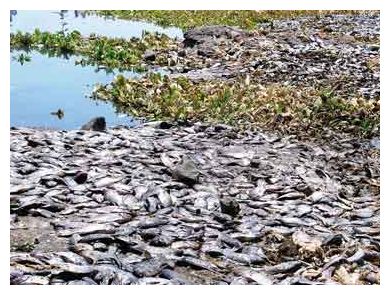
The problem of fish dying in large numbers has come to the fore of the banks of the Mula-Mutha (Bheema) rivers again. Fish have been found dead along the banks of the Mula-Mutha because of rising pollution and the latest in the series was recorded at Hatvalan near the Pune-Daund border last week.
Dead Fishes
© Pune MirrorDead fish at Hatvalan near Pune-Daund border.

Since last week, thousands of Mozambique Tilapia fishes were found dead on the river banks at Hatvalan in Daund division, about 76 km from Pune.

The fish apparently died because of thick blackish water flowing in the river bed. Ironically, Mozambique Tilapia is considered as one of the most resilient species of fish, known to withstand unfriendly environmental conditions.

To make matters worse, the same dead fish were taken to market to be sold by local fishermen. Pune and Mumbai are the primary markets for these fish. According to experts, in May freshwater springs that open into the river dry up, and hence the dissolving factor of oxygen in the water changes accordingly.

This increases the pollution level, causing the fish to die. A study conducted by Jal Biradari and Maharashtra Vikas Kendra last year had shown that the nitrate level in the Bheema river was 10-50 mg per litre, whereas the permissible limit specified by the Bureau of Indian Standards (BIS) is 45 mg/litre. The natural nitrate level should be less than 1 mg/litre, but due to pollutants, the level has shot up.

Red Flag

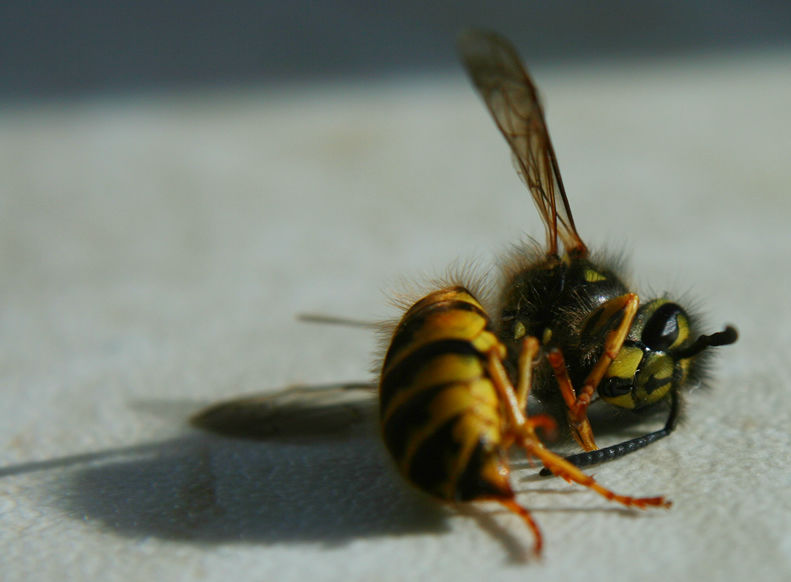
Bee Kills and Genetic Engineering in the Corn Belt

dead bee
© n/a
In the last few weeks beekeepers have reported staggering losses in Minnesota, Nebraska and Ohio after their hives foraged on pesticide-treated corn fields. Indiana too, two years ago. What's going on in the Corn Belt?

No farmer in their right mind wants to poison pollinators. When I spoke with one Iowa corn farmer in January and told him about the upcoming release of a Purdue study confirming corn as a major pesticide exposure route for bees, his face dropped with worn exasperation. He looked down for a moment, sighed and said, "You know, I held out for years on buying them GE seeds, but now I can't get conventional seeds anymore. They just don't carry 'em."

This leaves us with two questions: 1) What do GE seeds have to do with neonicotinoids and bees? and 2) How can an Iowa corn farmer find himself feeling unable to farm without poisoning pollinators? In other words, where did U.S. corn cultivation go wrong?

The short answer to both questions starts with a slow motion train wreck that began in the mid-1990s: Corn integrated pest management (IPM) fell apart at the seams. Rather, it was intentionally unraveled by Bayer and Monsanto.

Attention

Pacific Mystery: What's Killing the Dolphins and the Pelicans?

Image
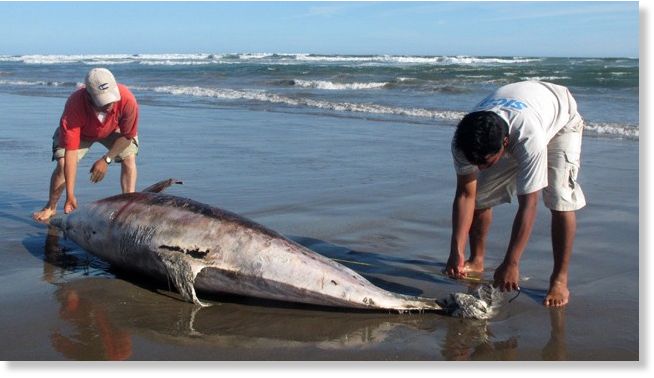
© Wilfredo Sandoval/AFP/Getty ImagesTwo men measure the carcass of a dead dolphin on a beach near Chiclayo, Peru.
Just what is killing all the dolphins? And the pelicans? And what has chased all the fish away?

It's been a mystery for months on the Pacific coast of Peru, where the local government says it has found 900 dolphin carcasses and something like 4,500 pelicans. It's been bad enough that the country's health ministry ordered 1,500 miles of beaches closed.

And while it may all seem very far away from the United States, scientists from around the world have been watching. People in the area say the government has been slow to take up the bodies, and slower to solve the puzzle.

Stop

Mass Bird Deaths: Mystery Linked To El Nino

Image
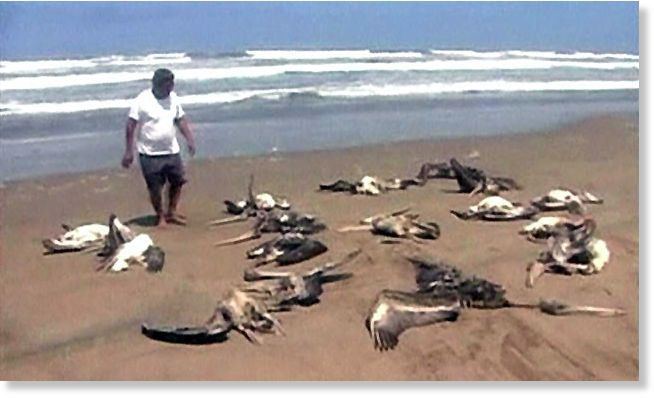
© UnknownPelicans were among the dead birds found on the Peruvian coast
The deaths of thousands of birds found off the coasts of Chile and its northern neighbour Peru recently could be connected to El Nino, the warming of the Pacific Ocean's surface temperature.

More than 2,000 dead fowl were discovered washed up this week on beaches between Cartagena and Playa de Santo Domingo in Chile after apparently being caught up in fishermen's nets.

This time of year, as Chilean weather usually gets colder, migrating birds would normally travel north for warmth.

But instead they are said to have stayed to feast on an influx of anchovies and sardines that fled the coast of Peru in search of cooler waters further south.

There are usually 15-20 bird deaths from fishing nets each year and the rise in bird numbers may explain the marked increase in fatalities.