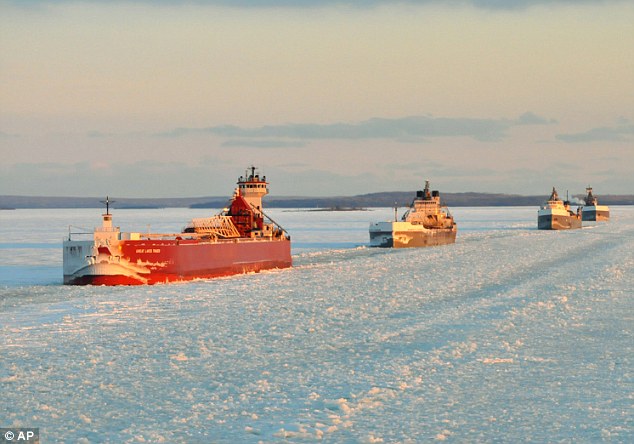
© APFrozen: U.S. Coast Guard a convoy of Great Lakes cargo ships line up to follow an icebreaker on the St. Marys River, which links Lakes Superior and Huron. U.S. Steel said Monday, April 7, 2014 that its largest mill in Gary, Indiana, is on limited production because of a lack of raw materials
U.S. and Canadian Coast Guard crews kept up their battle on Monday to clear pathways for vessels hauling vital raw materials on the ice-clogged Great Lakes, where a shipping logjam forced a weeklong shutdown of the nation's largest steel factory.
Traffic remained largely at a crawl after a winter that produced some of the heaviest ice on record across the five inland seas, where more than half the surface area remained solid this week.
Icebreaking ships slogging across Lake Superior were still encountering ice layers 2 feet to 3 feet thick. In some areas, wind and wave action created walls of ice up to 14 feet high.
United States Steel Corp.'s plant in Gary, Indiana, had resumed limited operations after receiving a shipment over the weekend of iron ore from a company mill near Detroit, which was sending one additional load, spokeswoman Courtney Boone said.
Two ships were scheduled to arrive Tuesday with ore from mines in northern Minnesota following a two-week voyage across Lake Superior, which ordinarily would take three days.
Other companies were hoping their supplies would be adequate to avoid significant disruptions.
'Nobody's stockpile situation is very good,' said Glen Nekvasil, a spokesman for the Lake Carriers' Association, which represents companies that operate 57 U.S.-flagged freighters on the Great Lakes. 'It's still very slow sledding.'










Comment: Not mentioned above is blast from overhead exploding space rocks as an explanation for both the bird deaths and the associated loud booms. See also: Radar Dopppler images confirm overhead 'turbulence' cause of 2011 mass bird death case in Beebe, Arkansas
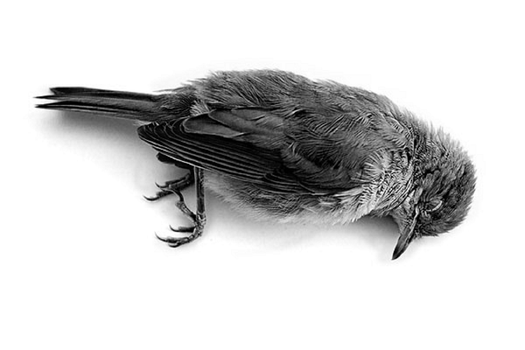
Over 30 birds fall dead from the sky in Norman, Oklahoma
Mystery boom rattles homes in Duncan, Oklahoma