Secret HistoryS


Archaeology

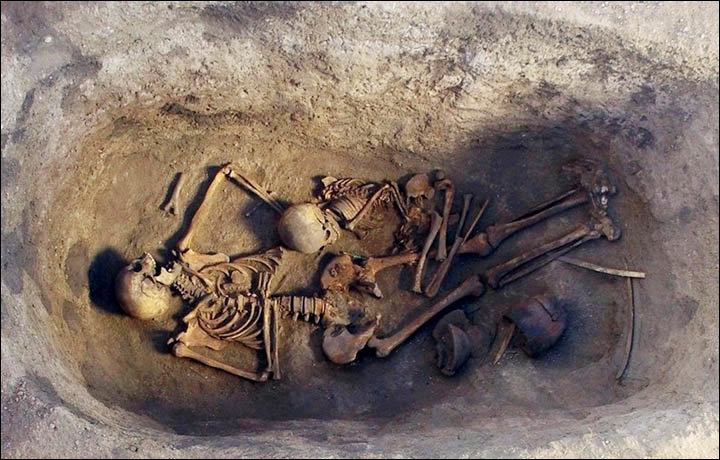
Found grave of Siberian noblewoman up to 4,500 years old

Siberia grave
© IIMK RASUndisturbed by pillaging grave robbers, the burial site of the woman, also containing the remains of a child, offers a wealth of clues about the life of these ancient people.
Her treasures include an incense burner decorated by solar symbols, 1,500 beads that once adorned her costume, and 100 pendants made from animal teeth.

The intriguing find of the remains of a 'noblewoman' from the ancient Okunev Culture was made in the Republic of Khakassia.

The Okunev people are seen as the Siberian ethnic grouping most closely related to Native Americans. In other words, it was ancestors of the Okunevs who populated America, evidently using primitive boats to venture to the ice-covered Beringia land bridge some 12,600 years ago.

The mysterious ancient culture was 'unparalleled' in Siberia in terms of its artistic richness and diversity, according to experts.

Undisturbed by pillaging grave robbers, the burial site of the woman, also containing the remains of a child, offers a wealth of clues about the life of these ancient people.


Bullseye

25 years since the failed coup that ended the Soviet Union

Gorbachev/ Yanaev
© www.rt.comSoviet President Mikhail Gorbachev, right, and Vice President Gennady Yanayev, left.
The junta that tried to seize power in the Soviet Union on August 18-21, 1991, is one of the most inept in the history of palace coups. Not only did it fail to take power, but it also brought about the opposite of its aims - the collapse of the USSR.

The coup was triggered by the New Union Treaty, Soviet leader Mikhail Gorbachev's stillborn, last-ditch attempt to save the USSR. The union was in the midst of an uncontrollable collapse of its command economy and being torn apart by its increasingly-nationalist minorities. With six Soviet republics, led by the Baltic States, already virtually seceding over the previous year, and upstart Boris Yeltsin threatening to marginalize Gorbachev in Moscow, the perestroika ideologist attempted to consolidate the remaining nine members into a new, looser confederacy of autonomous states.

"I thought that the worst instability was behind us at the time," Gorbachev said on the eve of the anniversary of the attempted coup, insisting that he still has no regrets over the plan. "There would have been difficult times ahead, but nothing like the momentous suffering caused by the economic reforms undertaken after the breakup of the country."

Yet while Gorbachev drew up new borders, destined to remain only as historical curios, his hard-line opponents saw a different picture - that he was simply paving the way for the dissolution of the country, not striking the workable compromise that he intended. "The treaty was an act of treason," Vasily Starodubtsev, one of the plotters, said simply when interviewed years later.

The 1991 Soviet coupt d'etat attempt, also known as the August Putsch.


Radar

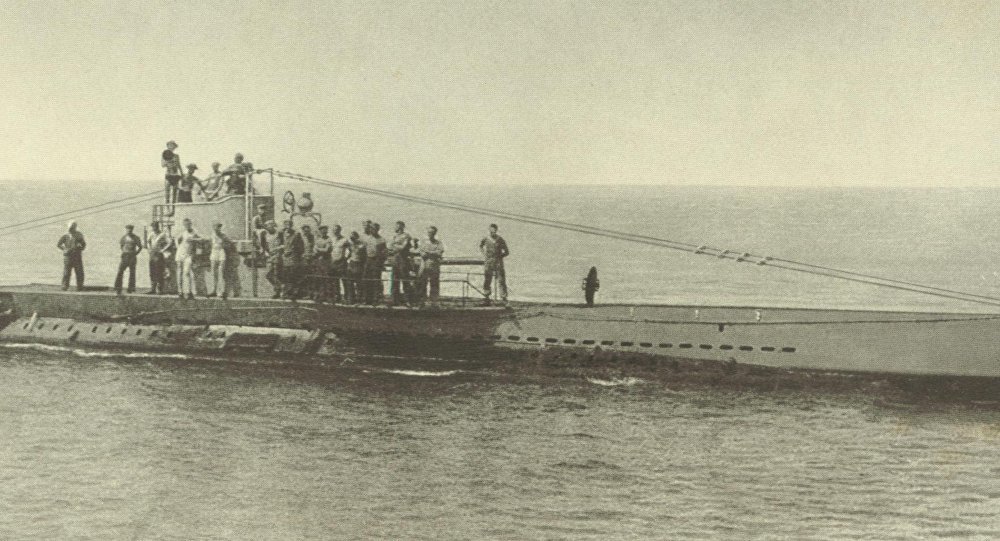
Danes stumble upon mysterious WW1 German submarine

WWI German submarine SM U-38
© Wikipedia
A surprising find of an ancient submarine loaded with weaponry on the seabed of the North Sea prompted Danish Maritime Authority to issue a prohibition on fishing and diving in the area.

The ban on fishing, diving or dropping anchor anywhere within a radius of 1,000 meters from the old wreckage came after Danish Maritime Authority and Defense Ministry received a warning from a team of divers, who found a WW1 submarine with unexploded mines and torpedoes on board.

On board the wreck there are 18 fully-intact mines and six torpedoes, Gert Normann Andersen, director of Sea War Museum Jutland and diving company JD-Contractor, which carried out the expedition, told the Danish tabloid newspaper BT. According to him, this is a rare find.

Boat

Amazingly intact 18th century shipwreck discovered on bed of Lake Ontario

Washington single-mast sailing boat sloop
© shipwreckworld / YouTube
A trio of senior 'shipwreck hunters' have found a superbly-preserved trading boat which sank some 213 years ago at the bottom of Lake Ontario.

The 16-meter (53ft) Washington is believed to be the oldest commercial vessel ever discovered in one of the Great Lakes. It has remained in good condition because the deep, cold waters which surround it contain low oxygen levels, so its wood hasn't rotted to any great extent.

Built in 1797 in Pennsylvania, it was the first known boat to sail on both Lake Erie and Lake Ontario and would typically transport furs.

The ship's final voyage was a November 1803 attempt to travel from from Kingston in Ontario to Niagara. A violent storm sank the vessel and killed all five men on board.

Info

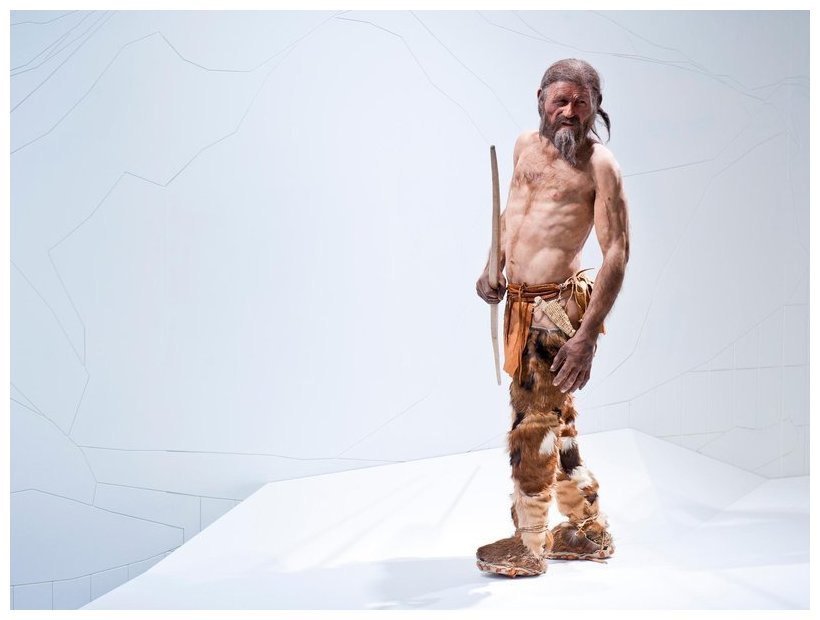
DNA reveals Ötzi the Iceman's clothes were made from many different animals

Ötzi the Iceman
© OetziTheIceman /Flickr CCA reconstruction of Ötzi the Iceman at the South Tyrol Museum of Archaeology.
Since 1991, when the 5,300-year-old mummy commonly known as Ötzi was discovered atop a mountain in the Italian Alps, researchers have studied every inch of his remarkably preserved remains. Scientists have uncovered hints as to what he ate, how he lived, diseases he suffered from and even how he died.

While Ötzi's frozen body has provided a wealth of knowledge about the lives of ancient Europeans, there are still many limits to what researchers can learn about him. Of particular interest is the species of animals that lent their hides for Ötzi to wear. After being frozen in ice for millennia, the hair and leather samples are too damaged for archaeologists to analyze with standard DNA techniques.

But using new analysis methods, scientists have unlocked a trove of information from the Copper Age man. They describe their results in a study published today in the journal Scientific Reports.

"Just based on the hair or just based on the type of leather, it's not easy sometimes to come down to the species level," microbiologist Frank Maixner, one of the study's authors, tells Smithsonian.com. "It was clear to have a little bit more insight, we had to go for the DNA."

In order to learn more about Ötzi's fashion choices, Maixner and his colleagues at the European Academy of Bozen/Bolzano (EURAC) used a form of DNA analysis that relies on markers found in mitochondrial DNA. While most DNA is stored in chromosomes within cells, mitochondria contain a tiny piece of their own DNA. It's a small fraction of the total human genome, but for the scientists, it was enough to pinpoint several animals that Ötzi turned into specific pieces of clothes.

Bomb

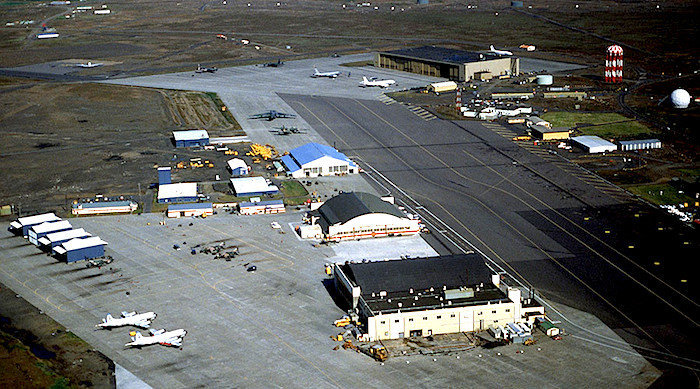
Cold War: US mulled storing secret nukes in unwitting Iceland, considered a deployment location option for WWIII

Iceland airbase
© WikipediaKeflavik Naval Air Station
Newly declassified documents dating back to the Cold War era show US authorities contemplated storing nuclear weapons in Iceland in the 1950s-60s without alerting the country's authorities. Recently declassified State Department documents obtained by the National Security Archive show that US government officials debated using Iceland, where they had a then-operational naval air station in Keflavik, as an "atomic base," including through "secret deployments."

A letter from the US ambassador to Iceland at that time, Tyler Thompson, dated August 1960, shows the Icelandic authorities inquired whether US "nuclear weapons were kept at Keflavik or carried through it in transit." Despite all references to Iceland being deleted from Thompson's letter, as this archival release shows, his signature and a daily staff summary from the US State Department, dated June 1960, which refers to the letter, indicate that Iceland was the site on the agenda.

In his letter, Thompson opposes the plan to use Iceland as a nuclear storage site, especially without alerting the authorities. He calls the plan a mistake, but the letter itself indicates that internal discussions were held on the matter.

Thompson warns of a "dramatic row" which could "be expected to have an unfortunate effect on our friends and allies, to affect adversely our interests as far as neutrals are concerned, and to provide a propaganda field day for our enemies" if Reykjavik learned about a secret deployment of nuclear weapons. The ambassador also appears concerned that Iceland could withdraw itself from NATO "in protest" against such deployment. In the end, these concerns won out and the plan was scrapped.

Comment: The National Security Archive reported 27 nuclear deployment sites. Nine were listed in the appendix; 18 were redacted and subsequently Belgium, Greece, Italy, Netherlands and Turkey were disclosed. Iwo Jima was later identified as an actual deployment site. Iceland was considered a 'conditional' deployment location in the event of war. Go here for the list of documents and synopses.


Info

Newly discovered Hindu epic Ramayana portrays Indian gods more as humans

Rama and Sita
© Wikimedia CommonsLord Rama and Sita.
A different version of the integral Hindu epic Ramayana, written by Valmiki has been extracted from a Sanskrit library in Kolkata. As much as it has moved the scholars who found it, it might as well widen the readers' horizon.

Last year in December, the manuscript was found by accident at the Asiatic Society Library by scholars who were researching on Vanhi Purana of the 6th century. The scholars were searching through a global informational storage known as Catalogus Catalogorum, where they found that a manuscript of the other version of Ramayana was tucked at the 100-year-old Samskrita Sahitya Parishad, Kolkata.

This version of Ramayana is different from the one widely read by people out of its difference that this manuscript talks more about the separation of Sita and Lord Rama as a husband and wife than the separation of father and son. Ram and Sita have also been portrayed more as humans than God and goddess, mentioned indiadivine.org report.

The scholars found the second manuscript of Vanhi Purana in the library's archives, and analysed the slokas that they were different yet familiar to Ramayana, for the story revolves around Ram, Sita, and Ravana. This manuscript, the Dasa Griba Rakshash Charitram Vadha, was perhaps a result of various interpolations.

Info

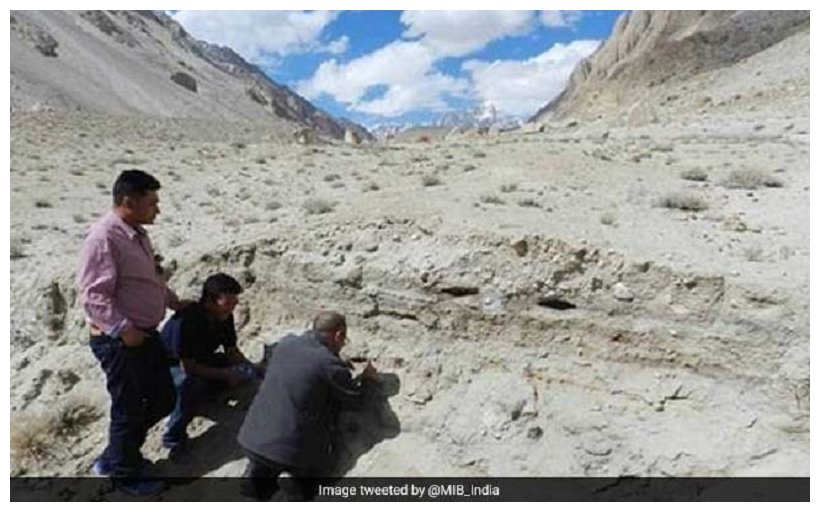
Ancient camp site discovered at 14000ft above sea level in Ladakh

Ladakh Campsite
© Tweeted by @MIB_IndiaThe site was unearthed at 14,000 feet above the sea level on the way from Saser La to Ladakh.
New Delhi - The Archaeological Survey of India (ASI) has discovered an ancient camping site dating 8500 BC in Ladakh in Jammu and Kashmir, indicating humans were camping in the area 10,500 years ago.

The site was unearthed at 14,000 feet above the sea level on the way from Saser La to Ladakh, an official release said.

While exploring in Nubra valley during 2015-16, ASI Joint Director General SB Ota noticed a section, exposed due to road construction, showing successive layers comprising burning residue.

A charcoal sample collected from the site, which was sent to Beta Lab, Florida for radiocarbon, dated it back to 8500 BC.Realising the significance of the evidence, a team of ASI officials were sent for further inspection last month.

Further, charcoal samples from lower and upper deposits sent for dating have provided radiocarbon dates of 8500 BC and 7300 BC respectively, indicating repeated human activity at this camping site for about eight hundred years, the release said.

Preliminary studies of charred bones collected from the site, carried out by PP Joglekar of Deccan Collage, Pune, have shown the presence of Gorel and Yak, it added.

"The research so far carried out has proved the antiquity and nature of human activities to an extent, but their camping patterns, extent of camping area, tools and other cultural aspects are yet to be traced," the release said.

To address these issues, proper archaeological excavations and explorations are being planned by the ASI, it said adding, however, it will not be an easy task to undertake these works in such a rugged terrain at an altitude around 14000 feet, with low oxygen and no habitation.

Info

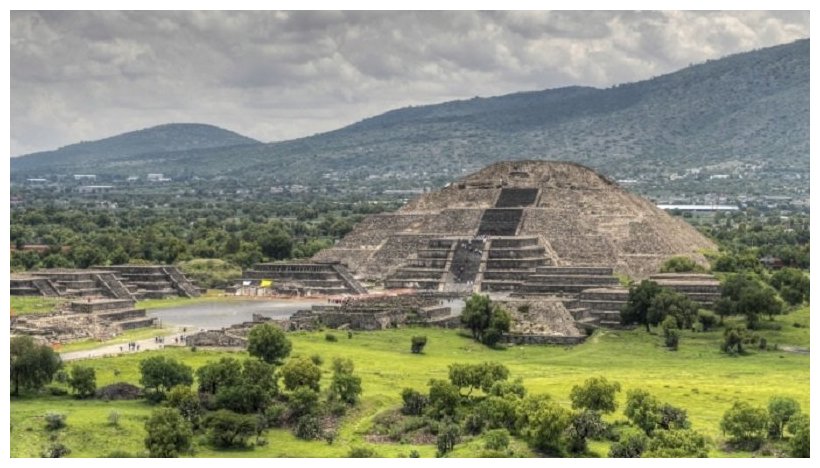
Mexican archaeologist says Teotihuacán was built to worship water

Pyramid of the Moon
© emerzel21/iStockphotoThe ancient Pyramid of the Moon, the second-largest pyramid in Teotihuacan, Mexico.
Perched on a plateau surrounded by mountains some 30 miles northeast of Mexico City, the city of Teotihuacán reached its peak between A.D. 200 and 450, when it was home to as many as 100,000 people. In A.D. 600, Teotihuacán was mysteriously abandoned, leaving future generations of scholars to puzzle for centuries over the secrets of the ancient city, its magnificent pyramids and its people. Now, in what may be a major breakthrough in the study of Teotihuacán, one archaeologist argues that the city was likely built around the worship of a single essential substance: water.

For centuries, archaeologists and other scholars have struggled to unlock the secrets of the ancient city of Teotihuacán. After reaching its peak just as the Roman Empire was in decline, the city was largely destroyed around A.D. 600 by fire and looting, perhaps as the result of a civil war or enemy invasion. By A.D. 750, the surviving members of Teotihuacán's population seem to have been absorbed into neighboring cultures, or to have abandoned the once-great city for their ancestral homelands.

Because they had no complex form of writing, relatively little is known about the founders and inhabitants of Teotihuacán. Archaeologists haven't discovered any carved slabs inscribed with characters, or any royal tombs. This lack of artifacts contrasts sharply with the wealth of evidence left behind by the Maya, who also built impressive pyramids in their cities in Central America.

It was the Aztecs who found the ruins of Teotihuacán in the 1300s and gave the city its name, which means "the place where men become gods" in Nahuatl. It was also the Aztecs who linked Teotihuacán's two largest pyramid—the Pyramid of the Sun and the Pyramid of the Moon—to their own story of creation. But according to Verónica Ortega, the Aztecs may have had the story wrong.

Magnify

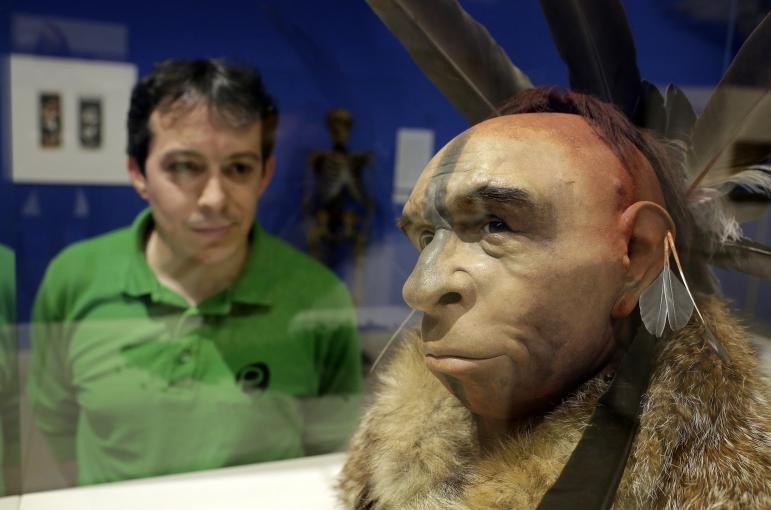
New study shows schizophrenia arose after divergence of modern humans from neanderthals

El Neandertal Emplumado
© Getty Images/Cesar Manso/AFPEl Neandertal Emplumado', a scientificly based impression of the face of a Neanderthal who lived some 50,000 years ago by Italian scientist Fabio Fogliazza.
Schizophrenia poses an evolutionary enigma. The disorder has existed throughout recorded human history and persists despite its severe effects on thought and behavior, and its reduced rates of producing offspring. A new study in Biological Psychiatry may help explain why-comparing genetic information of Neanderthals to modern humans, the researchers found evidence for an association between genetic risk for schizophrenia and markers of human evolution.

"This study suggests that schizophrenia is a modern development, one that emerged after humans diverged from Neanderthals," said John Krystal, Editor of Biological Psychiatry. "It suggests that early hominids did not have this disorder."

The cause of schizophrenia remains unknown, but researchers know that genetics play a significant role in the development. According to senior author Ole Andreassen from the University of Oslo in Norway and University of California, San Diego, some think that schizophrenia could be a "side effect" of advantageous gene variants related to the acquisition of human traits, like language and complex cognitive skills, that might have increased our propensity to developing psychoses.

Along with Andreassen, first authors Saurabh Srinivasan and Francesco Bettella, both from the University of Oslo, and colleagues looked to the genome of Neanderthals, the closest relative of early humans, to pinpoint specific regions of the genome that could provide insight on the origin of schizophrenia in evolutionary history.