Fire in the SkyS


Meteor

Meteorite strike? Russia can take it!

Image
© RIA Novosti. Vasiliy Litosh
If a large asteroid falls on the earth then the fallout will be huge and life as we know if comes to a choking, flaming end. But if it's a small one then Russia can take it.

That's more than can be said for Europe and North America, whose people can kiss the world goodbye if anything lands on them.

The reason is not that Russians are hardier than everyone else but that with its expanses of open space, covering one fifth of the world's land surface, Russia could take the strain.

A near miss

An asteroid the size of a truck skimmed past Earth four weeks ago, coming closer to us than the moon ever has. The 7-meter lump of celestial rock, named 2009 BD, came within 346,000 kilometers of Earth at around 9:51 pm Moscow time The moon's average distance from us is about 385,000 km.

So it, was relatively speaking, by a gnat's whisker that a calamity approaching the Hiroshima bomb bypassed humanity.

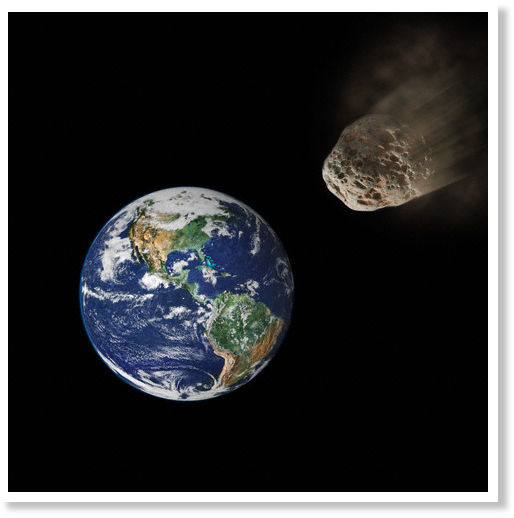
Comment: Actually, the possibility of a strike is much more imminent. Perhaps not by the "killer asteroid", but one doesn't need to be knocked over by the a sledgehammer, when series of "undetected" darts can do the job very well. The stony "drops" have been falling on our heads for quite some time now, and we wonder if one of them is about to provide us with the last wake-up call.


Bizarro Earth

Large Asteroid To Pass Between Earth And Moon

Image
© Unknown
The third near-earth asteroid of 2011 will pass between the moon and earth later this year, NASA has confirmed. The 400-metre wide asteroid, named 2005 YU55, will pass within 0.85 lunar distances of the Earth on November 8, 2011.

Discovered December 28, 2005 by Robert McMillan of the Spacewatch Program near Tucson Arizona, the object is believed to be a very dark, nearly spherical object 400 meters in diameter.

According to NASA's Neart Earth Object Program: "Although classified as a potentially hazardous object, 2005 YU55 poses no threat of an Earth collision over at least the next 100 years. However, this will be the closest approach to date by an object this large that we know about in advance and an event of this type will not happen again until 2028 when asteroid (153814) 2001 WN5 will pass to within 0.6 lunar distances."

Earlier this week, earth experienced one of its closest encounters with an asteroid in recent years. But as NASA indicated in the days ahead of Monday afternoon's 'cosmic close call', the encounter was so close that Earth's gravity sharply altered the asteroid's trajectory and prevented the space rock from impacting the planet.

2011MD, a newly discovered asteroid passed within 12,000 kilometres (7,500 miles) of Earth. The asteroid was only sighted for the first time on 22 June by a robotic telescope in New Mexico, USA. The International Astronomical Union's Minor Planet Center in Massachusetts, USA, put out an alert Thursday.

Meteor

The Mysterious Crestone Crater in Colorado, US: A real meteor crater or not?

Image
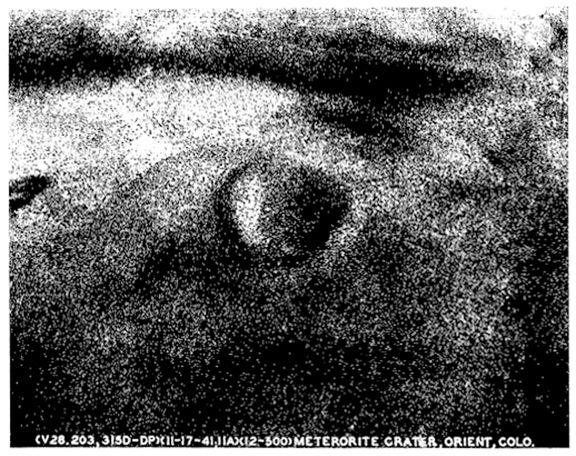
© H. H. Nininger (1941)Aerial view of the Crestone Crater looking eastward from an altitude of about 500 feet.
Is the hole in the ground south of Crestone a meteor crater or not, and if not, what is it? Well it sure looks like one, and many geologists believe it is, but a few others say they aren't sure. It's a Crestone mystery that's not completely solved.

Known as the "Crestone Crater" to most, this striking feature lies inside of the Great Sand Dunes National Park, one mile from the Liberty Gate entrance in the Baca, and 6 miles from downtown Crestone. This crater measures 355 feet by 246 feet with a mean depth of 23 feet.

The crater was first discovered by Crestone resident V.M. King in 1934. He and many others around the San Luis Valley had witnessed a fireball crash in the same area back in 1892. It was first studied in 1941 by Denver geologist Dr. H.H. Nininger, an expert in this line of research. His initial study suggested that it could be a true meteor crater, or perhaps an impact from a comet.

Meteor

Australia: Colourful Spectacle Lights Up Sky Over Melbourne's West

Mysterious bright lights have been spotted in the sky over Melbourne's western suburbs this morning.

Streaks of luminous blue, green and white lit up the area shortly before 6am.

The phenomenon was most likely caused by space junk or a meteor entering our atmosphere, according to Australasian Science Magazine astronomy expert David Reneke.

"My favourite (possibility) is always the fireball - that is, a meteor that's on fire," he said.

"It's pretty rare. I've seen two in my lifetime. You're seeing a piece of rock physically melting in front of your eyes. These things are pretty startling."

The lights probably moved too quickly for anyone to catch the event on camera, he said.

The spectacle comes after orbiting junk came perilously close to the International Space Station on Wednesday.

Meteor

One Hundred Years Ago Today, A Mars Meteorite Fell in a Blaze

meteroite
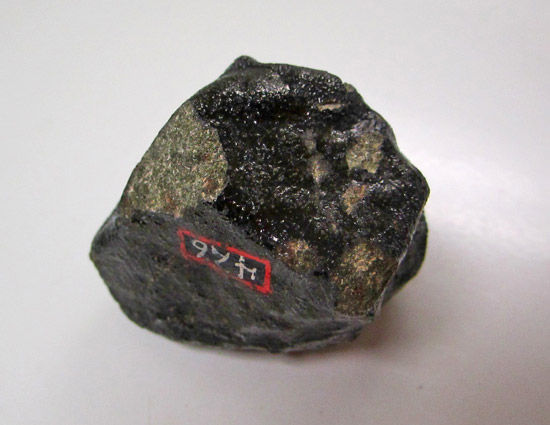
One of the two original pieces of Nakhla sent to the Smithsonian, virtually untouched since 1911. Photo courtesy of the Natural History Museum.

On the morning of June 28, 1911, somewhere between 8:30 and 9:00 in the morning, a fireball was observed northwest of Alexandria, Egypt. Few would realize what it was. But soon after, W.F. Hume, minister of the Geological Survey of Egypt, began taking eyewitness statements, and two months later published his report, "The First Meteorite Record in Egypt."

One of those statements, from a farmer who claimed to have seen a fragment fall on a dog, gave rise to the popular myth that Nakhla, as the meteorite would be named, was "the dog killing meteorite," an unsubstantiated claim, but the dramatic account is irresistible: "The fearful column which appeared in the sky at Denshal was substantial. The terrific noise it emitted was an explosion which made it erupt several fragments of volcanic materials. These curious fragments, falling to earth, buried themselves into the sand to the depth of about one metre. One of them fell on a dog. . .leaving it like ashes in a moment."

Approximately 40 stones were recovered southeast of Alexandria, near the town of Abu Hummus. Of the stones recovered, Hume immediately sent two of them to the Smithsonian Institution, weighing 117g and 52g (or 4.3 4.13 ounces and .117 1.83 ounces). They arrived in August of 1911 and have been a part of the Natural History Museum's collections ever since. Today, we celebrate the 100th anniversary of Nakhla's landing.

Bizarro Earth

Peekskill Meteorite

You may not have known it, but yesterday (Monday, June 27, 17:00 UTC) a 10 meter diameter asteroid called 2011 MD passed within 12,400 km (7430 miles) of the Earth's surface. For reference, that's about one Earth diameter away from us and about 31 times closer than the Moon. There was no danger of it hitting but sometimes the Earth's gravitational field happens to catch one of these space rocks. Here's the story of a much smaller meteorite which came crashing into the Hudson Valley 20 years ago.

On October 9, 1992, a meteorite entered Earth's atmosphere somewhere over Kentucky, exploded into fragments, which continued over West Virginia, where it was first filmed at 11:48 pm. The trajectory was toward the northeast, moving as a fireball through the skies over Maryland, eastern Pennsylvania, and finally crashing down to Earth striking a 1989 Chevy Malibu belonging to a Michelle Knapp at 207 Wells Street in Peekskill - a town in the in the lower Hudson Valley of New York (across the river from Bear Mountain).

At least 16 people in several states were able to film the meteorite fragments flying through the sky that evening. The Peekskill fragment was the only one found, but there were others that didn't make such a conspicuous touchdown.

Sun

What's Going On With the Sun?

Solar Flare
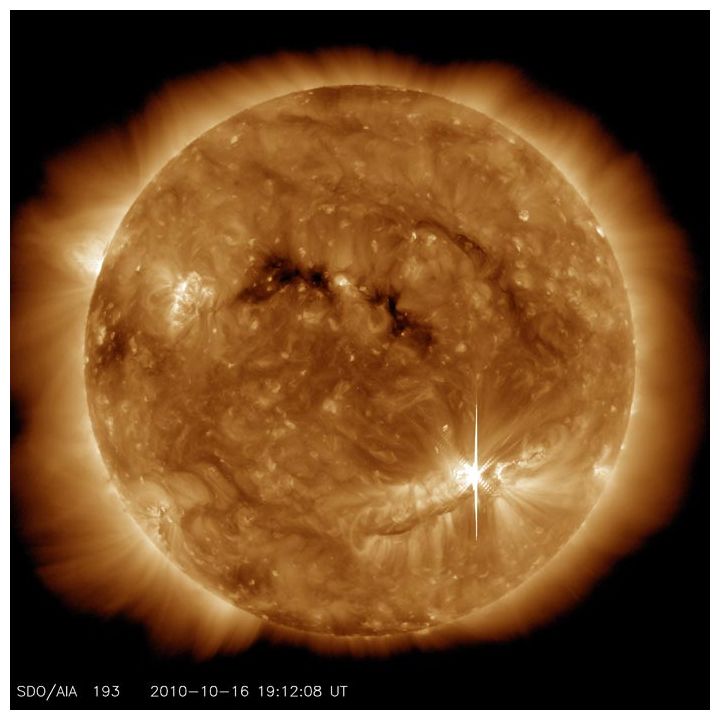
© NASAA solar flare crackles from the site of a sunspot on the solar surface.
Earlier this month a lot of column inches were devoted to the news that the Sun continues to behave in a peculiar manner - and that solar activity could be about to enter a period of extended calm. The story emerged after three groups of researchers presented independent studies at the annual meeting of the Solar Physics Division of the American Astronomical Society, which appear to support this theory. But are the new findings really that clear-cut and what implications do they have for the climate here on Earth? Physicsworld.com addresses some of the issues.

Why the recent interest in the Sun's activities?

Solar physicists agree that the Sun has been acting strangely of late. It relates to apparent abnormalities in the solar cycle, an approximately 11-year period during which the Sun's magnetic activity oscillates from low strength to high strength, then back again. When the Sun's magnetic activity is low, during a solar minimum, its surface remains relatively quiet, which leads to fewer sunspots. Then, as magnetic activity begins to increase, the surface becomes more dynamic and the sunspot numbers begin to increase in the lead up to a solar maximum.

Meteor

Britain in list of countries 'most at risk' if an asteroid strikes

Image
© Associated Press/NASA
Britain has been identified among a host of countries scientists believe would be worst affected in the event of an asteroid strike.

Experts at Southampton University have drawn up a league table of countries most likely to suffer severe loss of life or catastrophic damage should a large asteroid hit Earth.

The list is largely made up of developed nations including China, Japan, the United States and Italy, on the basis that the size of their populations would mean millions of deaths.

The US, China, Indonesia, India and Japan are most in danger on this basis. Canada, the US, China, Japan and Sweden are rated most at risk in terms of potential damage to their infrastructure.

Meteor

Looking for threats from outer space

Image
© Leonid Kulik Expedition, WikipediaTunguska: The Largest Recent Impact Event
If you think that the worst that could happen to us is a run on the banks and economic meltdown then think again.

This Monday 27th June 2011 a small asteroid will pass within 8,000 miles of the Earth, a mere hair's breadth by astronomical standards.

NASA's Near Earth Object Observation Programme though is on the watch for those objects that threaten to actually collide with our planet. Their aim is to detect these threats as far ahead as possible, leaving us many years, if not decades or more, to work out how to prevent any collision.

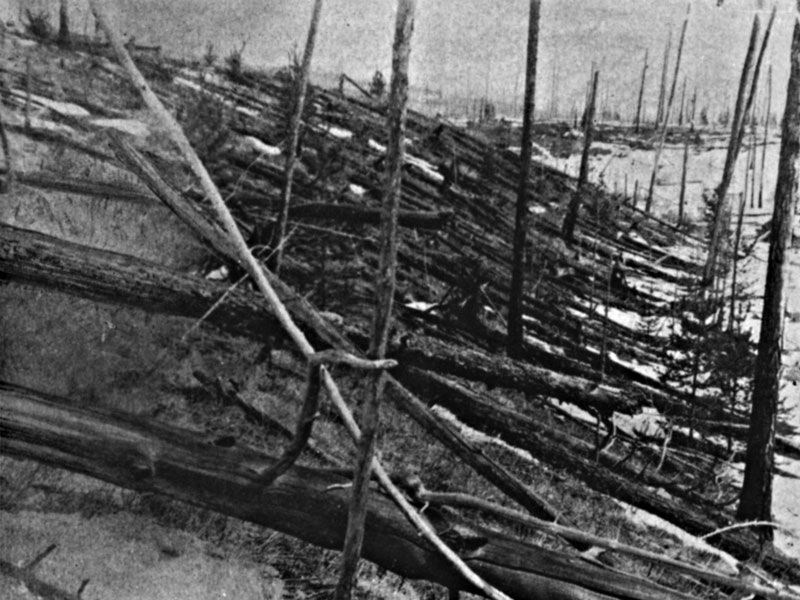
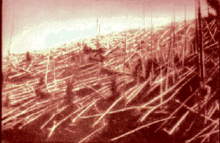
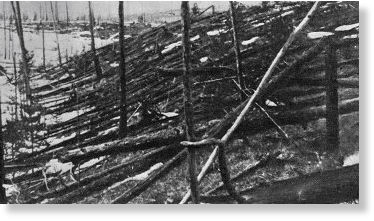
This month 103 years ago a large comet entered the atmosphere and caused an air burst over Podkamennaya Tunguska River, Siberia. As a result some 80 million trees were flattened. The trees nearest the epicentre were still standing but stripped as bare as telephone poles. Although no-one was reported to have died in this event in such a remote area, hundreds of the reindeer the locals relied on for their livelihood were killed.

Meteor

South Carolina, US: Charleston's about to party for the 103rd anniversary of The Tunguska Event

Image
© Soviet Academy of Science Trees knocked over by the Tunguska blast.
Charleston's about to party for the 103rd anniversary of The Tunguska Event

On June 30th, 1908, the largest explosion in Earth's recent history occurred near the Tunguska River in remote Siberia.

A massive space rock traveling at a speed of 33,500 miles per hour plunged into the atmosphere before detonating in the sky, releasing energy equivalent to that of 185 Hiroshima bombs. Seismic shockwaves were registered as far away as England. There is no direct evidence that any humans perished. There are many theories abound as to what exactly happened, but we may never know the entire truth.

To celebrate the 103rd anniversary of this cataclysmic anomaly, Tivoli Studios & Garden will be hosting The Tunguska Event, a celebration of art, music, and mobile cuisine in an explosive setting on Thursday, June 30th, from 6 to 10 p.m. The South Carolina Broadcasters will play several sets throughout the evening, as live art demonstrations take place around the warehouse. Roti Rolls, Diggity Donuts, and Taco Boy will be on hand to feed you from their trucks. All of the artist studios at Tivoli will be open to the public.