
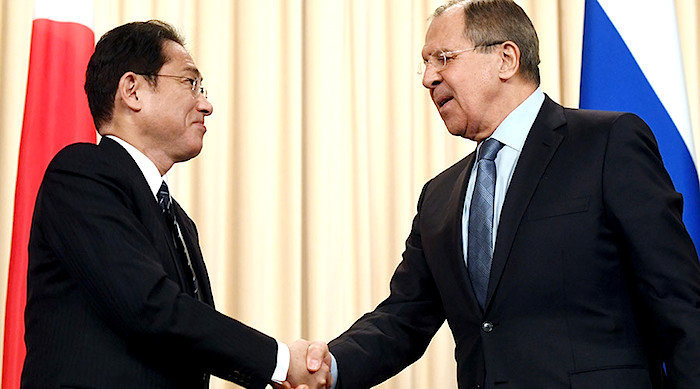
© Evgeny Biyatov / ReutersJapanese Foreign Minister Fumio Kishida and Russian Foreign Minister Sergey Lavrov
"We turned the attention of our Japanese colleagues to the threats posed to the region by the deployment of the US global missile defense system. Russia believes that regional security cannot be provided by military blocs, but through equal and universal dialogue based on the principles of integrity and security," Lavrov said at a meeting with his Japanese counterpart, Fumio Kishida, as quoted by RIA Novosti news agency.
Earlier this year, the US and South Korea unveiled plans to deploy THAAD [Terminal High Altitude Area Defense] antimissiles by the end of 2017. China strongly objects to the move, saying it would compromise its own capabilities. Despite growing Russian and Chinese concerns over security in the region, Washington argues that THAAD only aims to counter threats from North Korea by keeping Pyongyang's nuclear ambitions at bay.
Comment: As weapons, the THAAD system is relatively useless against North Korea. North Korean Nodong missiles travel at lower altitudes. DPRK missiles travel at an altitude of 20-30 km. The U.S. anti-missile system is designed to shoot down missiles at a much higher altitude of 40-150 km." THAAD technology has tested more successfully since 2005 against terminally-high altitude threats weapons that only Russia and China possess.










Comment: Japan has some decisions to make regarding its old loyalties and its future well-being. Russia is using economics and friendly but firm persuasion. The US has military bases in Japan which are a non-dialog form of persuasion. However, wild card Trump could change stale dynamics for fresh ideas and regional cooperation.