Science & TechnologyS


Footprints

Utah geologists discover 'dinosaur dance floor'

dance floor
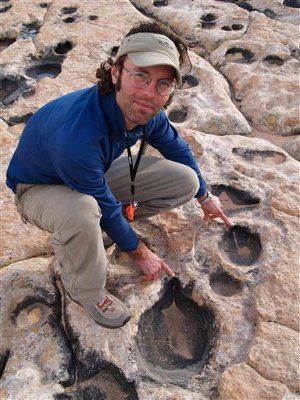
© AP Photo/University of Utah, Nicole MillerIn this undated photo released by the University of Utah, geologist Winston Seiler poses next a trackway, or set of prints made by the same dinosaur, as it walked through a wet, sandy oasis some 190 million years ago in what is now the Coyote Buttes North area straddling the Utah-Arizona border. Seiler and Marjorie Chan, chair of geology and geophysics at the University of Utah, published a new study in the October issue of the science journal Palaios showing that numerous impressions at the site are dinosaur tracks, not erosion-caused potholes as was believed previously.

SALT LAKE CITY - Utah geologists say they have discovered prehistoric animal tracks so densely packed on a 3/4-acre rock site, they're calling it a "dinosaur dance floor." The site along the Arizona-Utah border is offering a rich new set of clues about the lives of dinosaurs 190 million years ago.

Sun

Sun's protective 'bubble' is shrinking

The protective bubble around the sun that helps to shield the Earth from harmful interstellar radiation is shrinking and getting weaker, Nasa scientists have warned.
sunny
© APData has shown that the sun's heliosphere is shrinking

New data has revealed that the heliosphere, the protective shield of energy that surrounds our solar system, has weakened by 25 per cent over the past decade and is now at it lowest level since the space race began 50 years ago.

Scientists are baffled at what could be causing the barrier to shrink in this way and are to launch mission to study the heliosphere.

Satellite

Update 1: Spacecraft IBEX Will Study Boundaries Of Solar System

The U.S. space agency launches today a space probe that will keep an eye on the violence and turbulence at the very edge of the solar system.

NASA's Interstellar Boundary Explorer (IBEX) is due to begin its mission at Kwajalein Atoll, the largest coral atoll on the planet, where it will be launched aboard a Pegasus rocket that will be dropped from a jet.

According to the National Aeronautics and Space Administration, IBEX will orbit high above the Earth to photograph the interstellar boundaries that separate our heliosphere from the local interstellar medium of our Galaxy. The region is an enormous stretch of turbulent gas and twisting magnetic fields. This mission of taking pictures and recording those baffling boundaries will last two years.

Robot

Study: 6.5 million robots are in use worldwide

Although you still don't have to declare domestic robots on your council tax return, the IFR Statistical Department supported by the robotics and automation division of the VDMA, the German mechanical engineering and plant manufacturing association, carries out an annual check on how many of them are running around on the earth's surface and what they are doing there.

Info

Real Pilots And 'Virtual Flyers' Go Head-to-Head

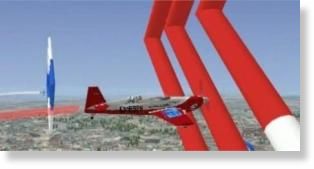
Stunt pilots have raced against computer-generated opponents for the first time - in a contest that combines the real and the 'virtual' at 250 miles per hour.
electronically-generated world with the real world
© Air Sports Ltd.New technology -- made possible by the Geospatial Research Centre (GRC), a joint venture between The University of Nottingham, the University of Canterbury in New Zealand and Canterbury Development Corporation -- can merge an electronically-generated world with the real world using a combination of satellite navigation technology (GPS, or global positioning system) and inertial navigation system technology (INS).

Using technology developed, in part, by a University of Nottingham spin-out company, an air-race in the skies above Spain saw two stunt pilots battle it out with a 'virtual' plane which they watched on screens in their cockpits.

The 'virtual' aircraft was piloted by a computer-gamer who never left the ground, but could likewise see the relative location of the real planes on his own computer screens as the trio swooped around each other during the 'Sky Challenge' race. The event could pave the way for massive online competitions, and also demonstrates the power and scope of the very latest in GPS and related systems.

The 'Sky Challenge' was organised by Air Sports Ltd, a New Zealand company which specialises in advanced sports TV technology.

Info

Genetic-based Human Diseases Are An Ancient Evolutionary Legacy, Research Suggests

Tomislav Domazet-Lošo and Diethard Tautz from the Max Planck Institute for Evolutionary Biology in Plön, Germany, have systematically analysed the time of emergence for a large number of genes - genes which can also initiate diseases. Their studies show for the first time that the majority of these genes were already in existence at the origin of the first cells.
Artistic illustration of a phylostratigraphy
© Irena Andreic, Ruđer Bošković Institute, ZagrebArtistic illustration of a phylostratigraphy.

The search for further genes, particularly those which are involved in diseases caused by several genetic causes, is thus facilitated. Furthermore, the research results confirm that the basic interconnections are to be found in the function of genes - causing the onset of diseases - can also be found in model organisms (Molecular Biology and Evolution).

The Human Genome Project that deciphered the human genetic code, uncovered thousands of genes that, if mutated, are involved in human genetic diseases. The genomes of many other organisms were deciphered in parallel. This now allows the evolution of these disease associated genes to be systematically studied.

Telescope

Ghostly Glow Reveals Galaxy Clusters In Collision

A team of scientists, including astronomers from the Naval Research Laboratory (NRL), have detected long wavelength radio emission from a colliding, massive galaxy cluster which, surprisingly, is not detected at the shorter wavelengths typically seen in these objects.
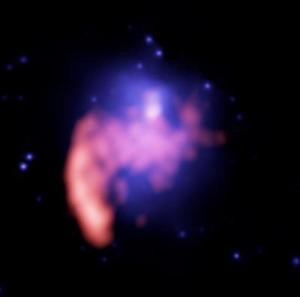
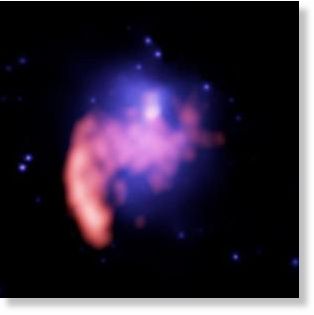
Superimposed false-color images of the galaxy cluster A521
© Radio (NCRA/GMRT/INAF/G.Brunetti et al.); X-ray (NASA/CXC/INAF/S.Giacintucci et al.)Superimposed false-color images of the galaxy cluster A521. The blue color represents hot gas typical of many galaxy clusters detected by the Chandra X-ray Observatory. The shape of the X-ray emission indicates that the cluster has undergone a recent collision or "merger event" that could generate turbulent waves. The red represents radio emission at 125 cm wavelength. The bright radio source on the lower left periphery of the X-ray gas is a separate source. The region of radio emission generated by turbulent waves is located at the center of the cluster, where the colors overlap.

The discovery implies that existing radio telescopes have missed a large population of these colliding objects. It also provides an important confirmation of the theoretical prediction that colliding galaxy clusters accelerate electrons and other particles to very high energies through the process of turbulent waves. The team revealed their findings in the October 16, 2008 edition of Nature.

This new population of objects is most easily detected at long wavelengths. Professor Greg Taylor of the University of New Mexico and scientific director of the Long Wavelength Array (LWA) points out, "This result is just the tip of the iceberg. When an emerging suite of much more powerful low frequency telescopes, including the LWA in New Mexico, turn their views to the cosmos, the sky will 'light up' with hundreds or even thousands of colliding galaxy clusters." NRL has played a key role in promoting the development of this generation of new instruments and is currently involved with the development of the LWA. NRL radio astronomer and LWA Project Scientist Namir Kassim says "Our discovery of a previously hidden class of low frequency cluster-radio sources is particularly important since the study of galaxy clusters was a primary motivation for development of the LWA."

Satellite

NASA's Ibex Launches for Examination of Sun's Weakening Shield

NASA launched its Interstellar Boundary Explorer, or Ibex, into orbit today for an examination of the solar winds that shield the Earth from harmful cosmic rays.

Ibex will give scientists a better understanding of how the solar wind -- made of magnetically charged particles -- interacts with the larger galaxy. The winds have fallen to the weakest level in half a century.

Much as the Earth's magnetic field repels cosmic rays, the solar wind protects the entire solar system. Ions, expelled by the sun in every direction at 1 million miles (1.6 million kilometers) per hour, create a ''bubble.'' This shield screens 90 percent of the intense, stellar radiation pulsing throughout the galaxy, said the National Aeronautics and Space Administration.

Telescope

NASA Hits Snag in Reviving Hubble Space Telescope

NASA's attempt to revive the ailing Hubble Space Telescope has hit a snag, leaving the iconic observatory's return to science observations in limbo until two new glitches can be solved, agency officials said Friday.

The new issues cropped up on Thursday while engineers were attempting to switch Hubble to a backup data relay channel and restore the telescope's ability to beam images and data back to Earth following a hardware failure last month.

"We think the soonest that we would be back doing full science would be sometime late next week," said Art Whipple, chief of NASA's Hubble systems management office at Goddard Space Flight Center in Greenbelt, Md., in a Friday teleconference.

Telescope

Canadian researchers uncover tool for hunting dark matter

Researchers at the Sudbury Neutrino Observatory say they have developed a new technique in the search for dark matter, the invisible substance or group of substances that make up a large percentage of the universe.

The Picasso group, made up of researchers from Canada, the United States and Czech Republic, said the new method will clear out background noise from other particles to give detectors a better shot at finding dark matter signals.

Dark matter is an important part of our picture of the universe - its gravitational influence helps explain why stars at the edges of galaxies appear to move at the same speed as those near the centre, for example.