Science & TechnologyS


Control Panel

KOBIAN: Emotional Humanoid Robot

Researchers from Waseda University have teamed up with Kyushu-based robot manufacturer tmsuk to develop a humanoid robot that uses its entire body to express a variety of emotions.

Binoculars

Why We Stare, Even When We Don't Want To

The stares of strangers endured by Connie Culp, recent face transplant recipient, might have little to do with cruelty or lack of empathy. These responses are likely a result of neurologic, biologic and evolutionary factors.
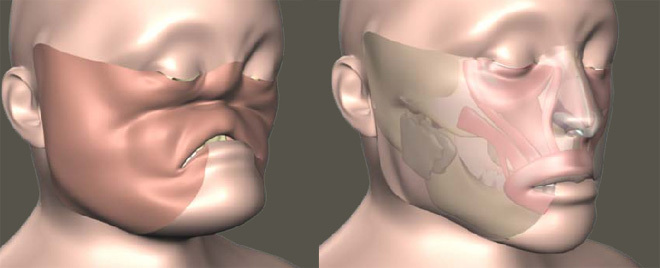
Schematic of Culp's transplant procedure
© UnknownSchematic of Culp's transplant procedure
Prior to her operation, the center of Culp's face was blank skin traversed by a single raw scar where she once had a nose, upper lip and cheeks. The disfigurement made her the target of something perhaps even less fixable: millions of years of evolutionary uncouth. When she went out in public, people gaped at her. After her operation, her face still looks unusual and the stares continue.

"We stare. Even if you don't want to, even if your better judgment tells you 'I need to be nice to this person. They've obviously suffered a tragedy,' there's something so alien and uncomfortable - it just doesn't look like us," said facial expression expert Erika Rosenberg, who focuses on evolution at UC Davis' Center for the Mind and Brain. "It goes back to a very primal thing."

Saturn

How Did the Brown Dwarf Get Its Spots?

Image
© NASA / JPL / HST / David JamesThe location of the brown-dwarf binary 2MASS J05352184-0546085 in the Orion Nebula, the closest big, hot star nursery. The two closely-orbiting objects appear as a single point in these infrared images
A pair of nearly identical brown dwarfs - dim, low-mass substars - seems more and more to defy basic models of star formation. But researchers have found a way out.

Just as sociologists and biologists study twins to understand how people with the same origin can differ, astronomers study binary and multiple stars knowing that they formed at the same time and place. The most valuable binary stars are eclipsing binaries. As the stars cross each other, the depths, shapes, period, and colors of their eclipses, combined with spectroscopy showing the stars' radial velocities, can give very accurate readings of the stars' masses, temperatures, surface brightnesses, and physical sizes.

Sherlock

Acheulian human remains found in Morocco

Rabat -- A Moroccan-French archaeology team has discovered the rear part of a human mandible that dates back to the prehistoric Acheulian phase, local MAP news agency reported on Monday.

The mandible, which belongs to a young human, holds a premolar and a molar, the report said.

The fossil was uncovered on May 14 in the Thomas I quarry site in Casablanca, along with stone tools "that characterize the Acheulian civilization" and remnants of gazelles, antelopes, warthogs, bears, monkeys, said the report.

Magnify

Ship Over 2,000 Years Old Found in Novalja

Novalja, Croatia - In the Caska Bay on the Island of Pag, near Novalja, an ancient sewn ship over 2,000 years old was found. This is the result of research done by the city of Novalja and the Zadar University, in cooperation with the French institute for scientific research (CNRS-CCJ University in Marseille) and numerous other foreign associates.

Archaeologists have found a ancient sewn ship more than 2000 years old in Pag's Caska Bay, reports ezadar.hr.

Better Earth

Microfossils Challenge Prevailing Views Of 'Snowball Earth' Glaciations On Life

Image
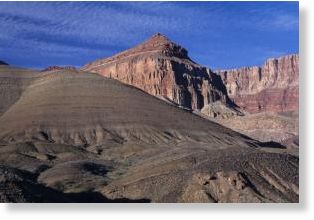
© Carol DehlerThis is an exposure of the Chuar Group in Carbon Canyon, Grand Canyon.
New fossil findings discovered by scientists at UC Santa Barbara challenge prevailing views about the effects of "Snowball Earth" glaciations on life, according to an article in the June issue of the journal Nature Geoscience.

By analyzing microfossils in rocks from the bottom of the Grand Canyon, the authors have challenged the view that has been generally assumed to be correct for the widespread die-off of early life on Earth.

"Snowball Earth" is the popular term for glaciations that occurred between approximately 726 and 635 million years ago and are hypothesized to have entombed the planet in ice, explained co-author Susannah Porter, assistant professor of earth science at UCSB. It has long been noted that these glaciations are associated with a big drop in the fossil diversity, suggesting a mass die-off at this time, perhaps due to the severity of the glaciations. However, the authors of the study found evidence suggesting that this drop in diversity occurred some 16 million or more years before the glaciations. And, they offer an alternative reason for the drop.

Telescope

Sunset Moon

Image
© Marek Nikodem
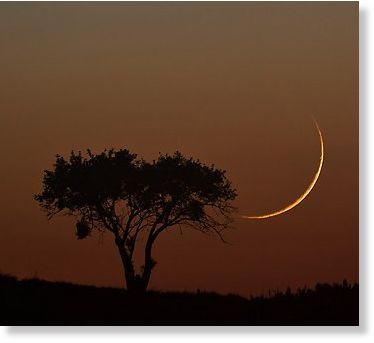
When the sun goes down tonight, step outside and look west. Marek Nikodem of Szubin, Poland, took the picture last night using a Nikon D700. "The Moon was only 31 hours past new," he says. "It was a lovely crescent!"

Only one day older and a few percent wider, the crescent Moon will be back again this evening.

Telescope

Space Station Flares

Image
© Quintus Oostendorp
Lately, a growing number of observers are reporting intense "flares" coming from the International Space Station (ISS). A typical sighting begins with a normal, sedate flyby: The station soars overhead, cutting silently through the stars with no hint that something extraordinary is about to happen. Then, a startling explosion of light boosts the station's luminosity 10-fold or more. Some observers have witnessed flares of magnitude -8 or twenty-five times brighter than Venus.

On May 22nd, Dutch amateur astronomer Quintus Oostendorp watched a flare through his backyard telescope. A movie he recorded using his Canon 1000D shows what happened.

Sun

Space storm caught slamming into Earth's atmosphere

A space storm has been observed exploding from a central point in Earth's upper atmosphere for the first time. The result could one day lead to better predictions of the storms, which can harm satellites and power grids on the ground.

The energy that powers space storms comes from clouds of plasma hurled at Earth by the sun. These clouds stretch our planet's magnetic field like a rubber band, storing energy in a long magnetic tail behind our planet.

The energy released when the field snaps back into place creates the ethereal glow of auroras (see a gallery of the light shows). It also floods the space around our planet with radiation that can incapacitate satellites and sicken astronauts, and can trigger electric currents on Earth capable of knocking out power grids.

Now, scientists have obtained the clearest view yet of the energy that was released in the magnetic tail arriving and initiating a disturbance in Earth's upper atmosphere, or ionosphere.

Robot

Crater was Shaped by Wind and Water, Mars Rover Data Shows

Most of the data relates to the central question of the role water might have played in the planet's past, and a new paper in Science, describing Opportunity's exploration of Victoria Crater in Meridiani Planum, a plain near the equator, is no exception.

The paper, by Steven W. Squyres, a Cornell astronomer, and more than 30 colleagues, summarizes information that has been released over the past several years, and can itself be summarized in two words - wet and windy. As in, water and wind have altered the terrain around the crater as they have done elsewhere, suggesting that the processes are regional in scope.