Science & TechnologyS


Bizarro Earth

A Clash of Polar Frauds and Those Who Believe

Image
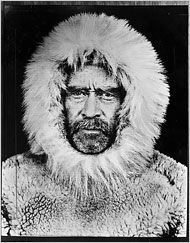
© New York Times CompanyARCTIC JOURNEY Robert E. Peary during his mission to the North Pole in 1909. Some still back his version of events despite evidence to the contrary.

In September 1909, Dr. Frederick A. Cook and Robert E. Peary each returned from the Arctic with a tale of having reached the North Pole. Neither provided any solid proof or corroborating testimony; both told vague stories with large gaps. They couldn't even convincingly explain how they had plotted their routes across the polar ice.

Yet each explorer's claim immediately attracted its supporters, and no amount of contradictory evidence in the ensuing years would be enough to dissuade the faithful.

A century later, the "discovery" of the North Pole may qualify as the most successful fraud in modern science, as well as the longest-running case study of a psychological phenomenon called "motivated reasoning."

Sherlock

UK: 10,000 Roman Coins Unearthed by Amateur Metal Detector Enthusiast

Coins
© SWNSStrike it lucky: Nick Davies found this amazing haul of 10,000 Roman coins on his first ever treasure hunt.
A massive haul of more than 10,000 Roman coins has been unearthed by an amateur metal detecting enthusiast - on his first ever treasure hunt.

The silver and bronze 'nummi' coins, dating from between 240AD and 320AD, were discovered in a farmer's field near Shrewsbury, in Shropshire, last month.

Finder Nick Davies, 30, was on his first treasure hunt when he discovered the coins, mostly crammed inside a buried 70lb clay pot.

Experts say the coins have spent an estimated 1,700 years underground.

The stunning collection of coins, most of which were found inside the broken brown pot, was uncovered by Nick during a search of land in the Shrewsbury area - just a month after he took up the hobby of metal detecting.

His amazing find is one of the largest collections of Roman coins ever discovered in Shropshire.

And the haul could be put on display at Shrewsbury's new £10million heritage centre, it was revealed today.

It is also the biggest collection of Roman coins to be found in Britain this year.

Nick, from Ford, Shropshire, said he never expected to find anything on his first treasure hunt - especially anything of any value.

Chalkboard

Mice Levitated in Lab

Scientists have now levitated mice using magnetic fields.

Other researchers have made live frogs and grasshoppers float in mid-air before, but such research with mice, being closer biologically to humans, could help in studies to counteract bone loss due to reduced gravity over long spans of time, as might be expected in deep space missions or on the surfaces of other planets.

Mice
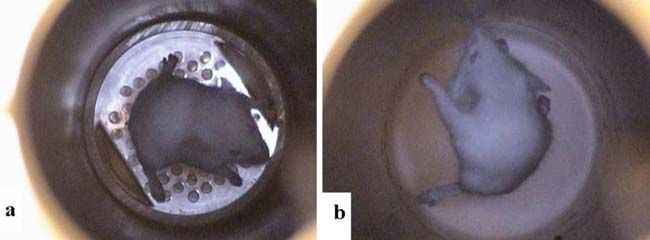
© Da-Ming Zhu et alA three-week-old mouse weighing about 10 grams levitated by magnetic fields, either with a magnet (a) or without (b).
Scientists working on behalf of NASA built a device to simulate variable levels of gravity. It consists of a superconducting magnet that generates a field powerful enough to levitate the water inside living animals, with a space inside warm enough at room temperature and large enough at 2.6 inches wide (6.6 cm) for tiny creatures to float comfortably in during experiments.

Chalkboard

They Say in Hard Times People Return to Superstition

Lucky
© Brian Snyder/ReutersLucky red shirt: Tiger Woods
Today I want to write about two mysterious human attributes - why we swing our arms when we walk and why we are superstitious. One of the mysteries, the arm-swinging, has recently been explained, but the other remains a somewhat open question, writes William Reville

Why humans naturally swing their arms in opposition to their legs when they walk has long been a mystery. The arms do not touch the ground (if you are having any luck at all with your relative anatomical proportions) and, so, the swinging didn't seem to serve any mechanical function. One explanation was that arm- swinging remains hard-wired into the human nervous system since the time our ancestors walked on four legs.

Info

Depressions evolutionary roots

Image
© Istock/Guillermo Perales Gonzalez
Depressed, thinking
Two scientists suggest that depression is not a malfunction, but a mental adaptation that brings certain cognitive advantages

Depression seems to pose an evolutionary paradox. Research in the US and other countries estimates that between 30 to 50 percent of people have met current psychiatric diagnostic criteria for major depressive disorder sometime in their lives. But the brain plays crucial roles in promoting survival and reproduction, so the pressures of evolution should have left our brains resistant to such high rates of malfunction. Mental disorders should generally be rare - why isn't depression?

This paradox could be resolved if depression were a problem of growing old. The functioning of all body systems and organs, including the brain, tends to deteriorate with age. This is not a satisfactory explanation for depression, however, as people are most likely to experience their first bout in adolescence and young adulthood.

Or, perhaps, depression might be like obesity - a problem that arises because modern conditions are so different from those in which we evolved. Homo sapiens did not evolve with cookies and soda at the fingertips. Yet this is not a satisfactory explanation either. The symptoms of depression have been found in every culture which has been carefully examined, including small-scale societies, such as the Ache of Paraguay and the !Kung of southern Africa - societies where people are thought to live in environments similar to those that prevailed in our evolutionary past.

There is another possibility: that, in most instances, depression should not be thought of as a disorder at all. In an article recently published in Psychological Review, we argue that depression is in fact an adaptation, a state of mind which brings real costs, but also brings real benefits.

Camera

Crystal Cave Of Giants: Inner Space Terranauts

Crystal Cave 1
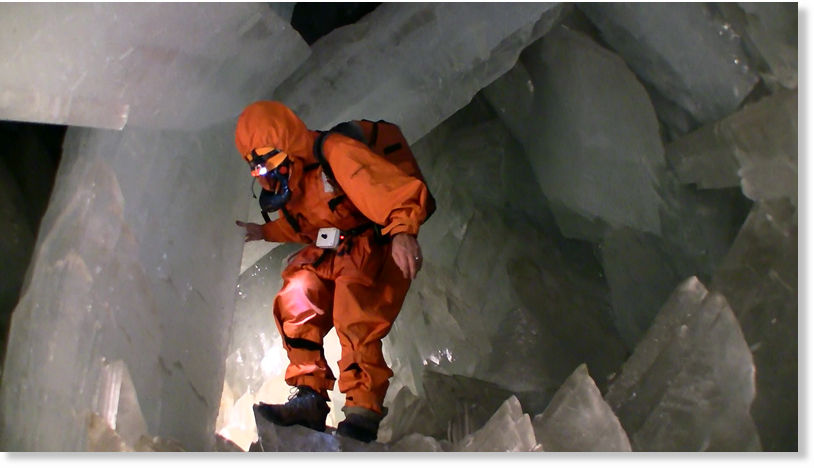
© George Kourounis
This week, while astronauts orbited high above Earth installing new science equipment in the laboratories of the International Space Station, a team of terranauts descended into the Earth on their own mission of discovery.

"We were not in outer space, but inner space," says explorer George Kourounis, who sent his pictures from the Cave of Crystals in Naica, Mexico

Blackbox

Mystery of the missing mini-galaxies

Like moths about a flame, thousands of tiny satellite galaxies flutter about our Milky Way. For astronomers this is a dream scenario, fitting perfectly with the established models of how our galaxy's cosmic neighbourhood should be. Unfortunately, it's a dream in more ways than one and the reality could hardly be more different.


Telescope

Hubble portraits of celestial dragons and giant butterflies

Image
© NASA/ESA/Hubble SM4 ERO Team/ST-ECF
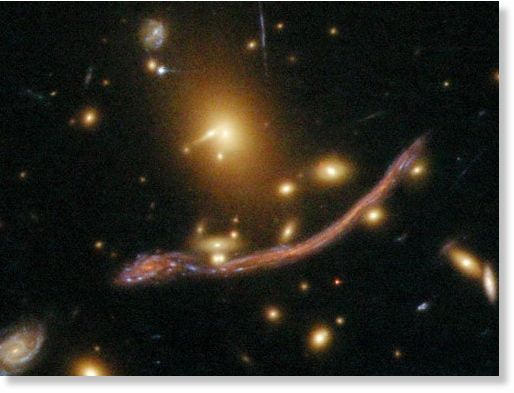
The most dramatic example of gravitational lensing seen in the previous slide is this dragon-like shape, which is made up of multiple images of a spiral galaxy that lies some 10 billion light years from Earth (seen most clearly as the head of the dragon). Hubble's Advanced Camera for Surveys reveals unprecedented detail in this lensed galaxy.

See a gallery of the new Hubble images.

Telescope

Black holes are the ultimate particle smashers

Image
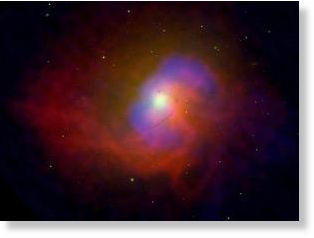
© NASA / CXC / S.Allen (Kavli Inst., Stanford) et al; Radio in blue - NRAO / G.Taylor (VLA ); Infrared in green - NASA / ESA / W.Harris (McMaster Univ.)When material falls toward the black hole in the centre of the galaxy NGC 4696, energy is produced as some of the matter is blasted back out in jets.
What will happen to fundamental physics when our descendants reach the limit of particle accelerator technology? We'll surely run out of space and money long before the smallest building blocks of the universe can be probed with machines, because of the massive energies required.

One saviour may be the universe's own particle smashers - black holes. If two particles are accelerating towards a rotating black hole with a certain velocity then they should collide with energies higher than anything we could hope to achieve on Earth.

The singularity at the centre of a black hole is so dense that any matter and light that reaches the black hole's point of no return, or event horizon, gets sucked in due to the extreme gravitational attraction. The closer that particles get to the black hole, the greater the energy they have.

Control Panel

Hubble Opens New Eyes On The Universe

Image
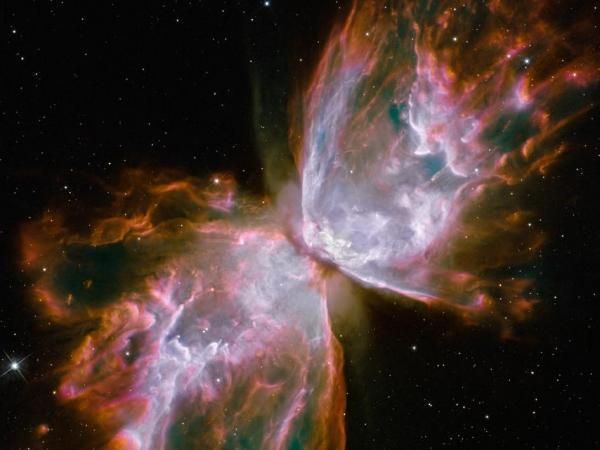
© NASA, ESA, and the Hubble SM4 ERO TeamButterfly emerges from stellar demise in Planetary Nebula NGC 6302.
NASA's Hubble Space Telescope is back in business, ready to uncover new worlds, peer ever deeper into space, and even map the invisible backbone of the universe.

The first snapshots from the refurbished Hubble showcase the 19-year-old telescope's new vision. Topping the list of exciting new views are colorful multi-wavelength pictures of far- flung galaxies, a densely packed star cluster, an eerie "pillar of creation," and a "butterfly" nebula.

With the release of these images, astronomers have declared Hubble a fully rejuvenated observatory. Sen. Barbara A. Mikulski, D-Md., unveiled the images at NASA Headquarters in Washington, D.C., on Sept. 9, 2009.

With its new imaging camera, Hubble can view galaxies, star clusters, and other objects across a wide swath of the electromagnetic spectrum, from ultraviolet to near-infrared light. A new spectrograph slices across billions of light-years to map the filamentary structure of the universe and trace the distribution of elements that are fundamental to life.