Science & TechnologyS


Info

People Read Real Books Faster than E-Books on iPad and Kindle

People can read traditional printed books a good bit faster than eBooks on tablet computers, a new study has found.

The study tested peoples' pace of reading on two popular e-reader tablets - Apple's iPad and Amazon's Kindle 2 - as well as a standard PC monitor and a plain ol' regular book.

The 24 study participants read short stories by the author Ernest Hemingway, chosen "because his work is pleasant and engaging to read, and yet not so complicated that it would be above the heads of users," said Jakob Nielsen, who led the study for the Nielsen Norman Group.

Magnify

Sassanid fire temple discovered in central Iran

Image
© Unknown
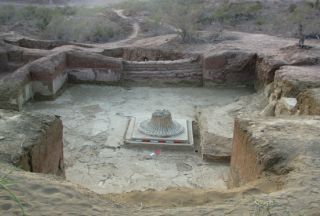
Ruins of a fire temple dating back to the Sassanid era have recently been discovered during a series of archaeological excavations in the Vigol region near Kashan in central Iran.

The discovery was made during the latest season of excavations, which are being carried out by a team of archaeologists led by Mohsen Javeri and began in mid-June, the Cultural Heritage, Tourism and Handicrafts Organization announced in a press release on Monday.

Magnify

Neanderthal Males Had Popeye-Like Arms

Image
© Getty ImagesNeanderthal males had unusually strong upper arms, particularly on the right side, research shows.
Arm bone remains show that Neanderthals were unusually pumped up on male hormones, possibly due to an all-meat diet.
Remains of an early Neanderthal with a super strong arm suggest that Neanderthal fellows were heavily pumped up on male hormones, possessing a hormonal status unlike anything that exists in humans today, according to a recent paper.

Neanderthal males probably evolved their ultra macho ways due to lifestyle, genes, climate and diet factors, suggests the study, published in the journal Archaeology, Ethnology & Anthropology of Eurasia.

Nuke

Fusion reactor eats Euro science budgets

More than a billion euros will be channeled to the astronomically over-budget ITER fusion reactor rather than to a broad range of needy European research projects.

"This will not make us friends," one senior fusion boffin, who declined to be identified, confessed to Nature, which reported the research-funding switcheroo.

The ITER project, which has the goal of (someday) fusing hydrogen isotopes to create (possibly affordable) energy, has been beset by budget horrors since its inception in 2006.

Control Panel

Living, Breathing Human Lung-On-A-Chip: The New Way to Test Drugs

Lung on a Chip
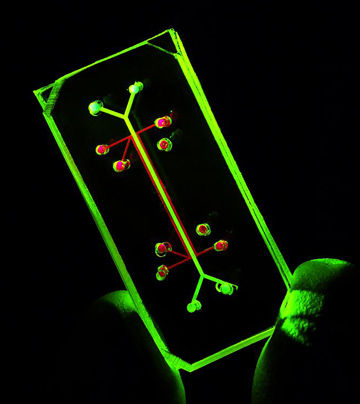
© Wyss Institute for Biologically Inspired EngineeringThe lung on a chip, shown here, was crafted by combining microfabrication techniques from the computer industry with modern tissue engineering techniques, human cells and a plain old vacuum pump.
Findings:

Researchers at Harvard's Wyss Institute have combined microfabrication techniques from the computer industry with modern tissue engineering techniques, human cells and a plain old vacuum pump to create a living, breathing human lung-on-a-chip. The device mimics the most active part of the lung, the boundary between the air sac and the bloodstream.

Relevance:

Because this "organ-on-a-chip" device responds to stimuli such as bacteria or airborne pollutants the same way a lung in a living body responds, it can potentially be used to test efficacy and safety of drugs and environmental toxins in the future. Such a tool could reduce the dependence on animal testing in the pharmaceutical industry, thereby reducing the cost and time it takes to bring new drugs to market. The device also opens the door to creating lung-on-a-chip systems using a patient's own cells for testing individualized therapies.

Recycle

Used Coffee Cups to be Converted into Ethanol

discarded coffee cups
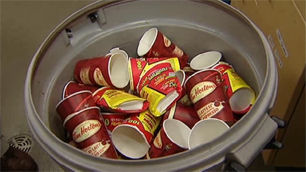
© CBCThe researchers got the idea after walking past coffee outlets on campus and noticing how many cups were being thrown away.
Discarded Tim Hortons coffee cups are being turned into ethanol by researchers at the University of Manitoba.

Microbiologists Richard Sparling and David Levin said they came up with the idea of using the paper cups after walking past some of the four Tim Hortons outlets on campus.

"We see a lot of cups being thrown away," Sparling said. "Knowing that these are not sent away for any type of recycling at this time, we thought ... they would make excellent food for the bacteria that we use to make biofuels such as ethanol or even hydrogen."

Since starting the project "on a whim" in 2009, they've had some promising results: they have found they are able to generate about 1.3 litres of ethanol from about 100 Tim Hortons cups.

Info

Driving while blind? Maybe, with new high-tech car

Image
© AP Photo/National Federation of the Blind
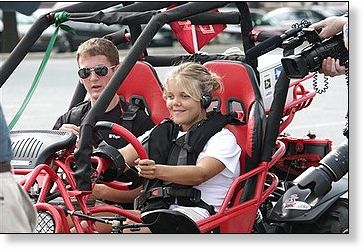
Could a blind person drive a car? Researchers are trying to make that far-fetched notion a reality. The National Federation of the Blind and Virginia Tech plan to demonstrate a prototype vehicle next year equipped with technology that helps a blind person drive a car independently.

The technology, called "nonvisual interfaces," uses sensors to let a blind driver maneuver a car based on information transmitted to him about his surroundings: whether another car or object is nearby, in front of him or in a neighboring lane.

Advocates for the blind consider it a "moon shot," a goal similar to President John F. Kennedy's pledge to land a man on the moon. For many blind people, driving a car long has been considered impossible. But researchers hope the project could revolutionize mobility and challenge long-held assumptions about limitations.

Rocket

ISS crew capture robotic spacecraft

Progress 38 docks at second attempt

The International Space Station crew successfully captured the Progress 38 spacecraft yesterday, after the unmanned Russian supply vessel sailed past the orbiting outpost on Friday.

A telemetry failure 25 minutes before the scheduled docking prompted last week's unscheduled flyby. The cause was a glitch in the TORU teleoperated rendezvous and docking system, provoked by "the activation of the TORU 'Klest' TV transmitter*, which created interference with TORU itself", NASA explains.

Rocket

'Huge airships to carry freight starting 10 years from now'

Flying zeppelin
© The Register'Fresh fruit, vegetables, flowers and other foreign luxuries' will arrive like this.

Ex UK.gov top boffin's amazing claim

The long-touted idea of using airships to replace cargo aircraft is in the news again, courtesy of former head government boffin Professor Sir David King, who says "this is something I believe is going to happen".

King's remarks were reported by the Guardian this week. The former UK chief scientific adviser, nowadays turned big cheese at Oxford uni, was addressing a green biz forum there.

Rocket

Last shuttle mission shifted to Feb 2011

NASA firms up dates for final two flights

NASA has announced that the last space shuttle mission - Endeavour's STS-134 to the International Space Station - will now lift off on 26 February next year.

Discovery's STS-133 mission, meanwhile, is scheduled for 1 November. NASA explains: "The target dates were adjusted because critical payload hardware for the STS-133 mission will not be ready in time for the previously targeted date. With Discovery's move, Endeavour had to plan for its next available window, which was February."