RTFri, 22 Apr 2022 15:12 UTC
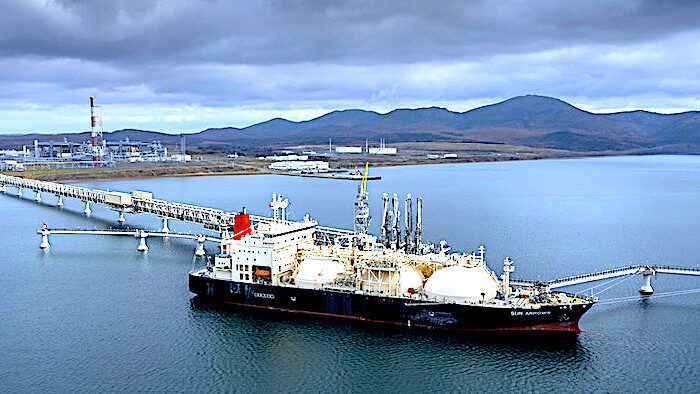
© APThe tanker Sun Arrows loads its cargo of liquefied natural gas from the Sakhalin-2 project in the port of Prigorodnoye, Russia, October 29, 2021
The settlement switch may be possible without breaching sanctions, the European Commission says
European Union companies may be able to comply with Russia's proposed system to pay for gas in rubles
without falling foul of the bloc's sanctions against Moscow, the European Commission said on Friday.
At the same time, EU executives say that
it is not yet clear how such a scheme would work. "The procedure for derogations from the requirements of the decree is not clear yet," the document issued by the commission said.
In March, the Russian government issued a decree
requiring European energy companies to open accounts at Gazprombank, where payments in euros or dollars would be converted to rubles.
The step came shortly after Russian President Vladimir Putin demanded that hostile countries, which have imposed economic sanctions on Moscow in connection with the ongoing conflict in Ukraine, pay for Russian gas with rubles.
Last week, the EC said that paying for Russian gas in rubles by European Union buyers as demanded by Moscow
would break the EU's sanctions regime."This mechanism would lead to a breach of the existing EU restrictive measures adopted in respect of Russia, its government, the Central Bank of Russia, and their proxies," an internal note, seen by Reuters, read.
Comment: And the workarounds?
EU companies may be able to work around Russia's demand to receive gas payments in rubles without breaching sanctions, if they pay in euros or dollars which are then converted into the Russian currency, the European Commission (EC) said on Friday.
In an advisory document sent to member states on Thursday, the Commission reportedly said that Moscow's gas-for-rubles proposal does not necessarily prevent a payment process that would comply with EU sanctions against Russia.
The document said there were options that could allow companies to continue lawfully paying for gas.
"EU companies can ask their Russian counterparts to fulfill their contractual obligations in the same manner as before the adoption of the decree, i.e. by depositing the due amount in euros or dollars."
The procedure for securing exemptions from the requirements of the decree is not yet clear, it added.
The plan is identical to what the Russian government had suggested earlier this month.
Brussels also said that, before making payments, EU operators could make a clear statement that they consider their contractual obligations to be completed when they deposit euros or dollars with Gazprombank - as opposed to later, after the payment is converted into rubles.
According to the document, the sanctions regime does not prohibit companies from opening accounts with Gazprombank, or from engaging with the bank to attempt to seek a solution.
Hedging bets:
The United Kingdom has granted a license for continued payments to Russia's Gazprombank for more than a month.
London's Office of Financial Sanctions Implementation (OFSI) issued the sanctions waiver on Thursday for "the purpose of making gas available for use in the European Union," noting that the license expires on May 31.
It applies to contracts agreed prior to Thursday with Gazprombank and its subsidiaries, and it allows for "the opening and closing of bank accounts" so long as it helps to secure the flow of gas into the EU.
Following a flurry of other financial penalties in the wake of Moscow's attack on Ukraine, the UK government imposed sanctions on Gazprombank late last month, also targeting other major financial firms such as Alfa Bank. In announcing the latest waiver, however, the Treasury cited a 2019 law which allows exemptions for penalties on Russia under certain circumstances.
Despite the push to penalize Russia, a number of European countries are reluctant to support calls for outright embargoes on gas, oil and coal.
Gazprombank is among the largest banks in Russia by assets held, largely working in the corporate and investment sectors. The United States and a series of allies slapped penalties on the bank in February, imposing debt and equity restrictions after Russia attacked Ukraine, part of a coordinated effort to "isolate" and "cripple" Russia's economy.
Pay up or literally chill out! Russia can choose to cancel or not renew contracts.








The Russian’s have consistently made the west look stupid (not that that’s hard.)
Here’s Vlad [Link]