
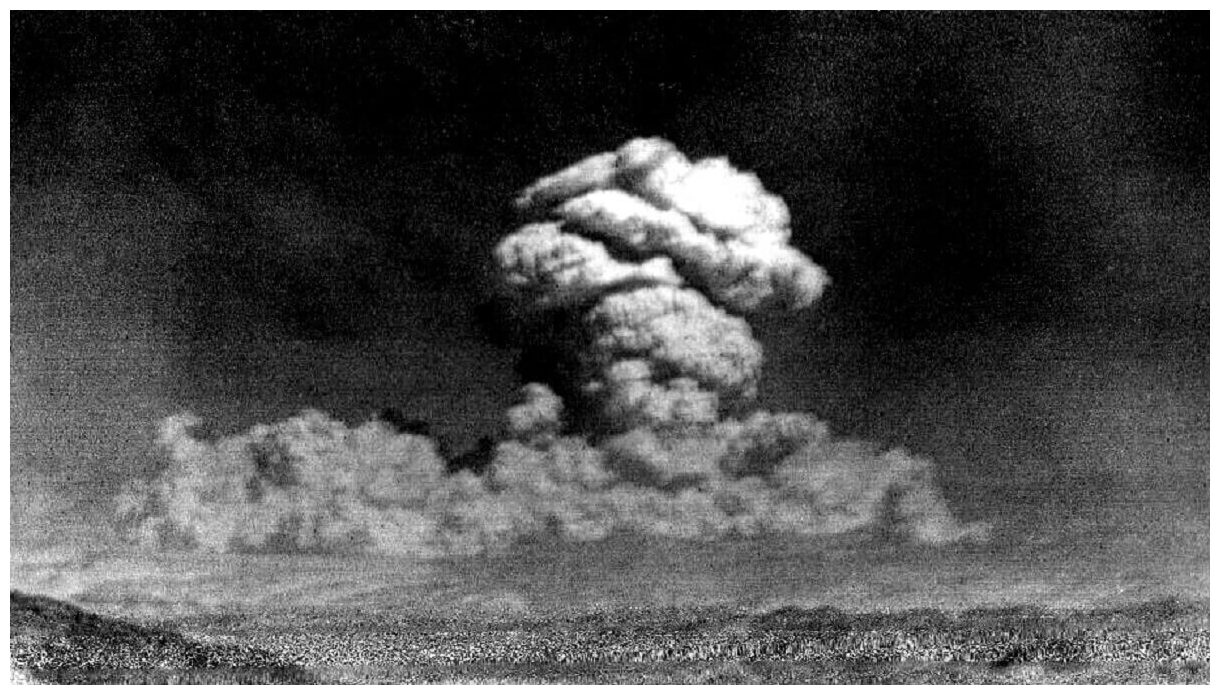
© Cosmos MagazineA nuclear test in Nevada, US. Australia hosted a number of nuclear tests, particularly from the British at Maralinga.
A study from Monash University in Melbourne has now examined plutonium particles from the blasts to find they're more complicated than initially thought. This has implications for how they behave in the environment, although these implications are still unclear.
"The British detonated nine nuclear bombs and conducted hundreds of nuclear tests in outback South Australia between 1953 and 1963," says Megan Cook, a PhD student at Monash and lead author on a paper describing the research, published in Scientific Reports.
"The resulting radioactive contamination and cover-up continues to haunt us."
But the effects of radioactive particles in the environment are still poorly understood. Study of these particles is "one of those things we don't have an international best practice for," Cook says.
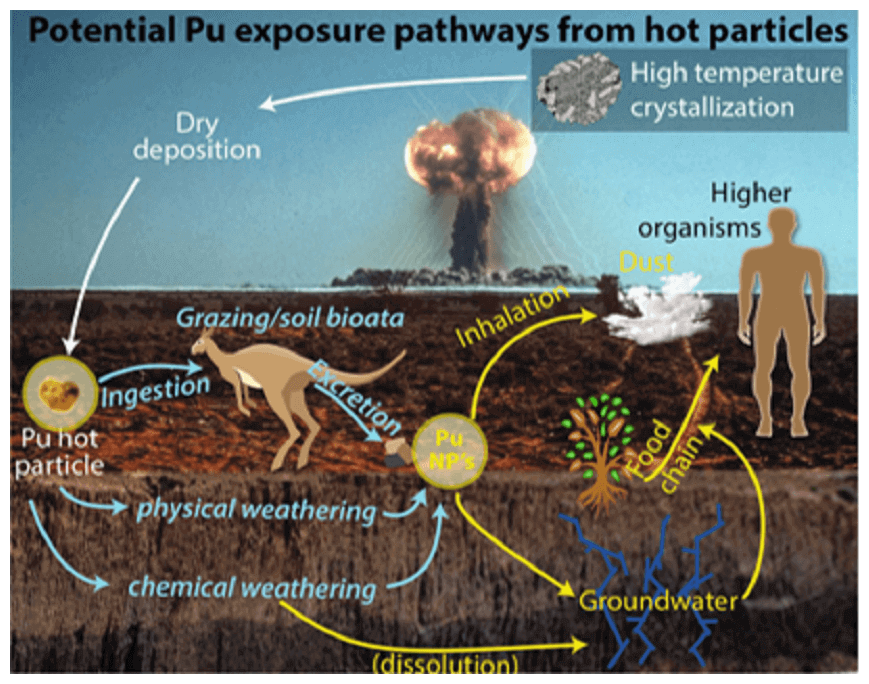
© The background image is from the UK Atomic Energy Authority/Atomic Weapons Research Establishment, available under the Open Government License / diagram from Cook et al 2021, Scientific ReportsRadioactive plutonium particles can get into the environment in a variety of different ways, including through soil groundwater and direct inhalation by organisms. Once in the environment, they can travel through the food chain into other organisms.
The researchers collected six radioactive particles, each a few hundred micrometres across (about the size of a grain of dust), from the Maralinga site. They used a synchrotron in the UK to examine their chemical and physical make-up, and an ion beam at Monash to look at them in further detail.
Cook says that identifying radioactive particles from a contaminated site takes "a lot of patience".
"There were some bulk soil samples taken from Maralinga when the clean-up was done by the Australian Radiation Authority [now ARPANSA]," she says.
Identifying the six particles took "sifting through those samples with a very small alpha detector, which detects the alpha radiation which is emitted by the particles. It's almost like a metal detector but it's for radiation."
Then, once there was a centimetre-sized section of soil identified that might have a radioactive particle in it, the researchers would find it by "getting under a microscope, with a bit of needle and some tweezers".
"We found that the particles contained low-valence plutonium-uranium-carbon compounds that are typically highly reactive, yet had been stabilised in the hot-particle matrix for nearly 60 years," says Barbara Etschmann, a researcher at Monash and co-author on the paper.
The complexity of the particles came from the way they cooled after the atomic explosions.
"This has changed the way that we think about hot-particle contaminated sites," says Cook.
The authors say that it's hard to tell how these complex particles will behave at Maralinga. "It is notoriously difficult to predict the long‑term environmental behaviour of hot particles," write the authors in their paper. They urge more research to understand how the radiation at the site has behaved.
"We don't know everything that we need to know yet," says Cook.
"Understanding the fate of hot particles in the unique setting of the Australian outback is critical for securing Australia in case of nuclear incidents in the region, and returning all the native land affected by the British tests to the traditional Anangu owners of the Maralinga Tjarutja lands," says co-author Joël Brugger.






Too small to generate a gamma field to register on most detection equipment. Alpha emitters too need specialized detectors with mica shielded tubes vs. the cheaper glass types.