
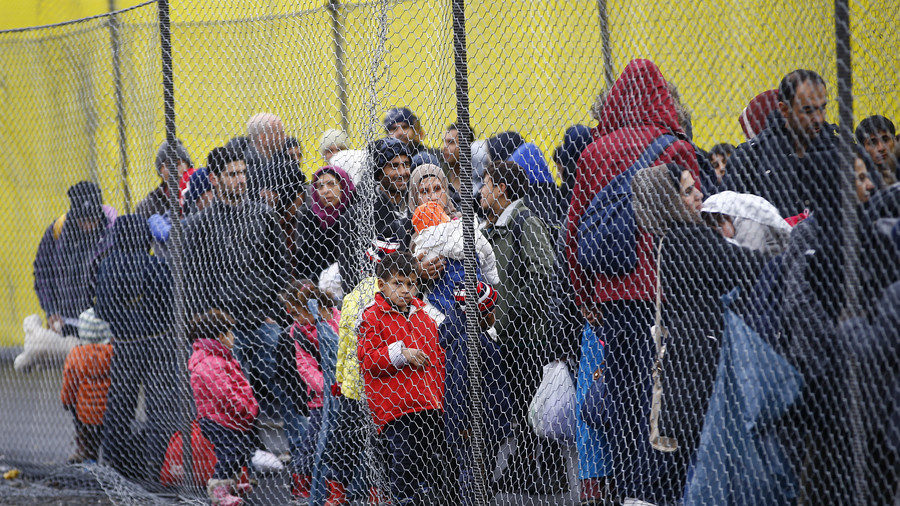
© ReutersFILE PHOTO Migrants wait to cross the border from Slovenia into Spielfeld in Austria, February 16, 2016
"The migration problem has developed in a way that now all member states of the European Union are affected," Major General Robert Brieger told Ö1 radio station on Wednesday. He stressed that mass migration has become the "greatest threat" to Austria's security.
The top military official said that "as long as external border protection is not fully guaranteed, there is a need to act at the national level." Border controls can safeguard Austria from "terrorist threats," Brieger, who took on his post on Tuesday, insisted.
Austria has seen a large influx of asylum seekers, like many other EU states, ever since the refugee crisis kicked off in 2015. In June Austria's Defense Minister Mario Kunasek said that the EU Border Guard (Frontex) should be bolstered with soldiers and policemen. According to Kunasek, the beefed-up force would work in EU border countries, namely Italy and Greece, but might actually venture into "African countries with the consent of the respective state."
The idea to create a special "border protection unit" was floated by Austrian Interior Minister Herbert Kickl in January this year. Stressing that scenarios like the 2015 refugee crisis "cannot be allowed to happen" again, Kickl insisted that a standby police unit would be able to react and secure border crossings within a few hours, as well as carry out identity checks.
In the latest attempt to relieve southern Mediterranean countries, namely Italy and Greece, of some of the burden of the migrant crisis, the EU proposed to give members states €6,000 for each migrant. The plan was immediately slammed by Italy's Interior Minister Matteo as "charity," He stressed that the bloc simply fails to appreciate what is actually needed.
The proposal came after a summit between EU leaders in June. The gathering saw the hammering-out of a solution which would involve EU members propping up so-called controlled centers on a volunteer basis. Austria was among those EU states to turn down the proposal, with Prime Minister Sebastian Kurz saying: "Of course not... we are not a first-arrival country, unless people jump with parachutes."



Comment: While the EU was quick to sanction countries that refused to kowtow to their migrant quotas, they're now facing a backlash, including from those countries that initially 'welcomed' them. It's becoming worryingly clear to many that the impacts of the migrant crisis are nuanced but that, if it continues as the bureaucrats in Brussels would like it to, the effects to Europe and its culture would be disastrous:
- Immigration, Crime and Propaganda
- Macron calls for sanctions on EU states that refuse migrants - Italy's Salvini denounces his "arrogance"
- Soros looks to gain from investments with European 'forced migration'
Also check out SOTT radio's: