
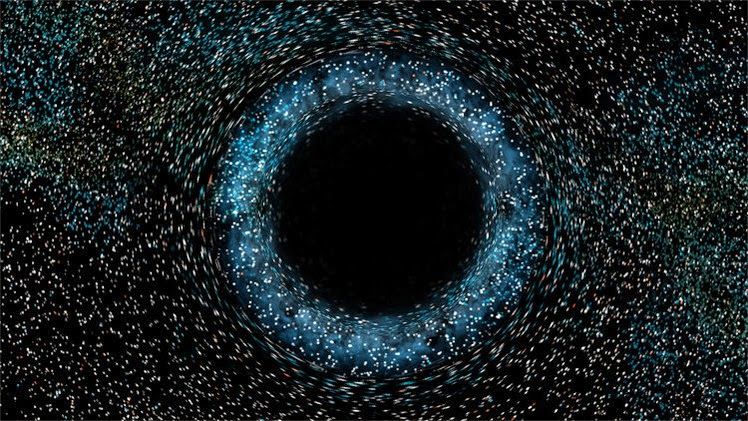
© shabalgnob.blogspot.comGigantic black hole spotted by Hubble
The diameter of M60-UCD1 is about 300 light years - just 1/500th of our galaxy's width. However, it is packed with 140 million stars, which also makes it one of the densest galaxies.
For comparison, NASA explains, the nighttime sky we see from Earth's surface shows 4,000 stars. If we lived inside the newly-discovered M60-UCD1, our nighttime sky would be covered with at least one million stars "visible to the naked eye."
But what really surprised astronomers is the supermassive black hole they found inside M60-UCD1.
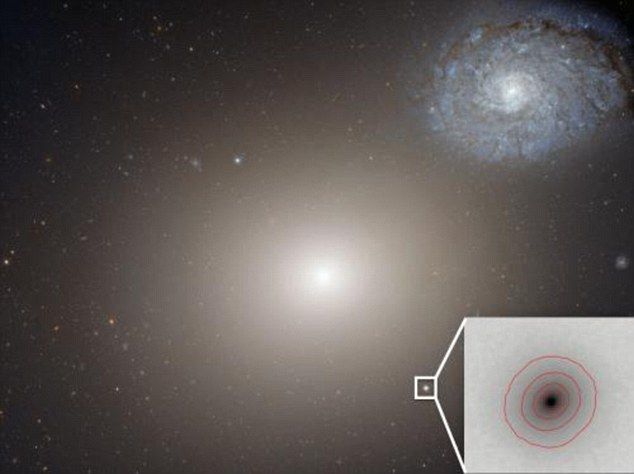
© www.dailymail.co.ukDwarf Galaxy's 'giant black heart' has a mass equivalent to 21 million suns.
"That is pretty amazing, given that the Milky Way is 500 times larger and more than 1,000 times heavier than the dwarf galaxy M60-UCD1," University of Utah astronomer Anil Seth, lead author of an international study on the dwarf galaxy, said in Nature's Thursday publication.
The finding has prompted astronomers to consider rethinking dwarf galaxy theories.
They have now grown to suggest that dwarf galaxies may, in fact, be the stripped remnants of larger galaxies that were torn apart during collisions with other galaxies. Until the discovery, they thought that tiny galaxies were small islands of stars born in isolation.
"We don't know of any other way you could make a black hole so big in an object this small," Seth said. The observation also suggests that there are many other compact galaxies in the universe that contain supermassive black holes.
It could be that M60-UCD1 was once a large galaxy containing 10 billion stars, but then it passed very close to the center of an even larger galaxy, M60. As a result, the stars and dark matter in the outer part of the galaxy were torn away and became part of M60.
It is possible that M60-UCD1 may eventually be pulled to fully merge with M60, which has its own black hole that is more than 1,000 times bigger than the black hole in our galaxy.
Should this happen, the black holes in both galaxies - which are 50 million light-years away - would also likely merge.



Comment: The astronomers used adaptive optics technology to study the galaxy and its massive black hole. Using data from NASA's Hubble Space Telescope along with the Gemini North 8-meter optical and infrared telescope on Hawaii's Mauna Kea, they captured the dwarf galaxy and the black hole's mass. Normally, images from telescopes on the ground are blurred out by the 'twinkling' of the stars caused by the refraction of light in the atmosphere. With adaptive optics, a flexible mirror is used to undo the affects of the atmosphere and get a sharper image. Since there were no bright stars next to M60-UCD1, the team used a laser to create their own "fake" stars in the upper atmosphere to use for the adaptive optics process. This allowed them to study the motions of the stars at many points within the very small object. By observing the motions of the stars at the center of the ultra-compact dwarf compared to in its outskirts, they were able to separately weigh the stars in the galaxy and the black hole.